
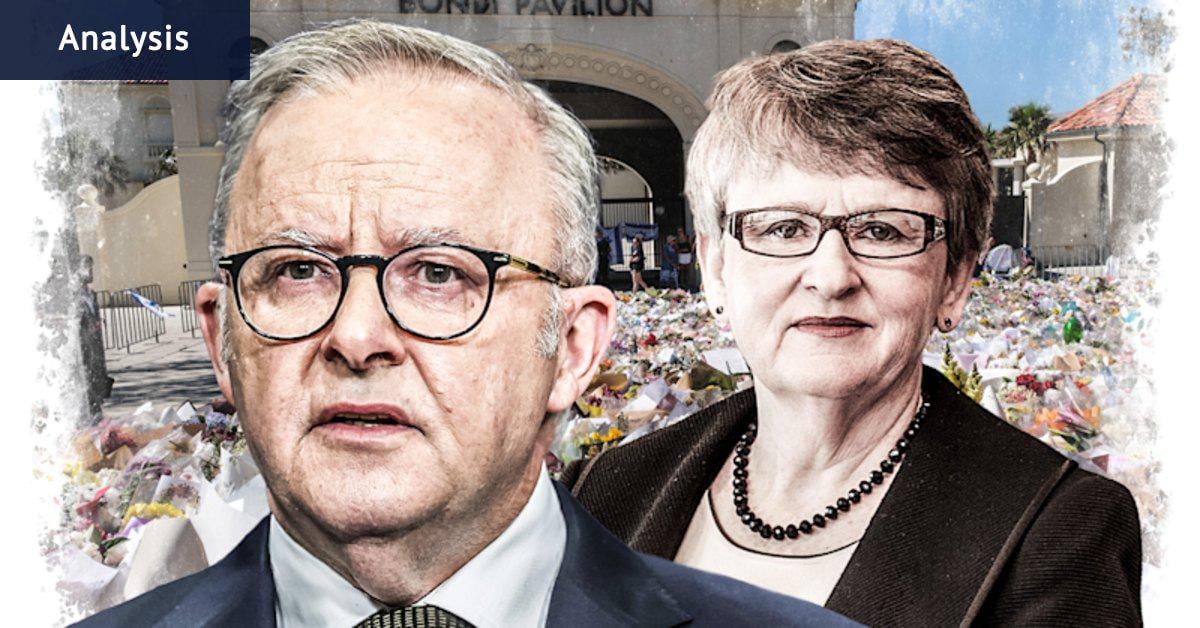
Prime Minister Anthony Albanese was emphatic about one thing as he stood in his courtyard on Thursday afternoon to announce a major reversal in his position on a Commonwealth royal commission: he had been listening.
“As prime minister, I respect people’s views and I listen to them.”
Albanese described sitting down with leaders in the Jewish community – in their homes, without cameras – and shedding tears with them. He thanked those people for “honest and open-hearted conversations” and stressed his priority was for the country to heal, learn and come together in a spirit of national unity.
“It’s clear to me that a royal commission is essential to achieving this,” the prime minister said.
And he was clear on that point. Late on Thursday afternoon, he made a compelling case for why the Royal Commission on Antisemitism and Social Cohesion, with former High Court justice Virginia Bell at its helm, would help Australia probe its pernicious problem with antisemitism.
More than that, he gave the impression the government had been working up to this point the whole time. “This hasn’t been done up this morning. We have been working on this for weeks. I have been engaged with the community,” he said.
It was an impressive and persuasive performance, if you were watching his press conferences for the first time since Christmas. If you’d been watching Albanese closely in these last three weeks, it was confounding.
The government was not ambivalent on a Commonwealth royal commission – it argued explicitly against one.
Albanese and his ministers argued a royal commission was not the best-placed forum to deal with security and intelligence issues, and warned it would cause further division in the community by platforming the worst examples of antisemitic hate speech. This was on top of arguments that it would duplicate and delay other work.
The cynical political reading of this situation dictates that Albanese was backed into a corner and eventually saw giving in to the growing demands for a royal commission – which came from far-reaching corners of public life as well as families of the Bondi victims – as his only way out.
The generous interpretation, and the prime minister’s explanation, is that he took time to listen the Jewish community away from the media circus, and is taking responsible action after carefully considering their wishes.
Both invite further interrogation. What to make of Albanese’s reasons for denying a royal commission? Either they no longer apply or Albanese is pressing ahead against his own judgment. Both present a credibility issue.
If the view is that he listened, took in feedback and changed his mind, then why did it take him more than three weeks to get to that point? And why come out so strongly against it if he was amenable all along?
The prime minister responded to all those streams of criticism on Thursday. To deal with concerns about reviewing intelligence matters, the government will stick with the review from ex-ASIO boss Dennis Richardson. This will be folded into the royal commission and still report by April.
It maintains the urgency that Albanese says is paramount, and Richardson retains his role as the nominated expert. The commission’s final report will be expected by December – a short turnaround by any comparison with other federal inquiries.
When he was asked to justify why he’d ditched the most controversial argument, that a royal commission would deepen divisions, Albanese went back to his point about listening. “What we’ve done is listen, and we’ll work through those issues, and we’ve concluded that where we have landed today is an appropriate way forward for national unity,” he said.
As for why listening took so long? “There is not a single point in time, it’s a series of discussions that I’ve had in homes,” he said. “I’ve sat there and I’ve listened to people and engaged with them… and I’m absolutely determined that anything we did had to build social cohesion, not bring it apart.”
This could satisfy fair-minded people who have been watching the debate from afar. Albanese is not the first to resist a royal commission – recall the Coalition’s opposition to a banking royal commission, until it was pushed to the brink by Labor. It recovered.
These two cases are not the same – the Bondi royal commission is marred by the violence, hatred and grief at the heart of the issue. This time there is more trust to be recovered and deeper social fractures to heal.
Albanese did not express any regret on Thursday, nor concede his rebuttals sound stubborn in hindsight. But his conciliatory tone and terms of reference met the mood – if only he had found that weeks ago.
\*\*Natassia Chrysanthos\*\*
Source: Stompy2008