
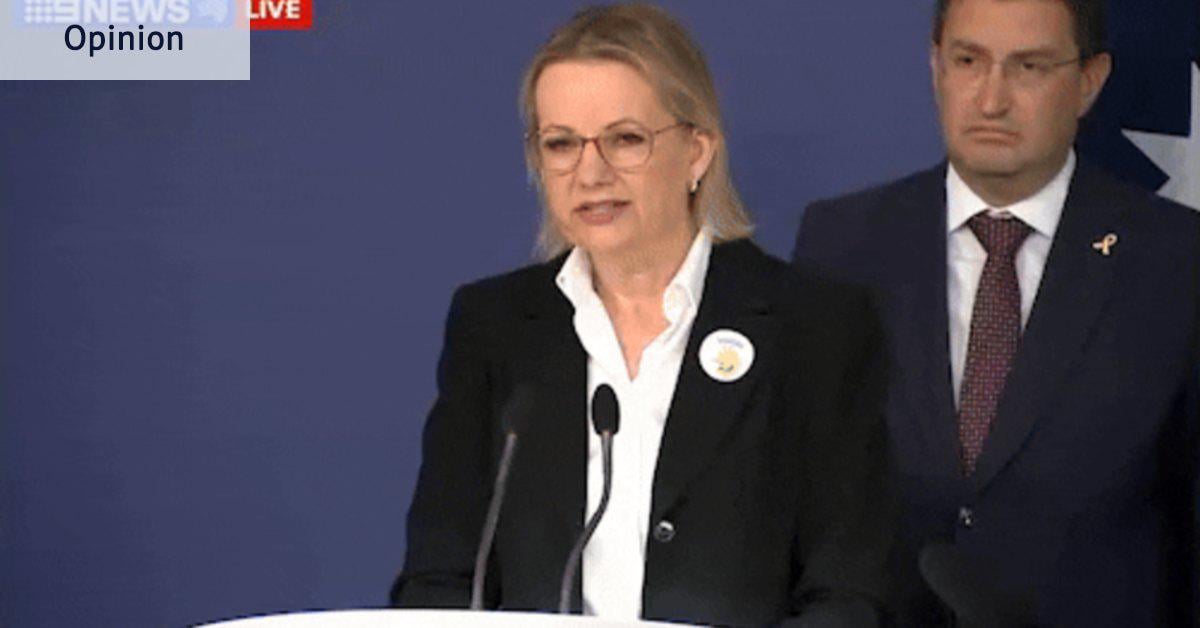
Right at the heart of the Coalition’s current problems lies the very regrettable partisan approach the Liberal Party’s leaders took following the Bondi terror attacks on December 14. They were joined by several retired politicians and much of the media.
Accusing Prime Minister Anthony Albanese of being responsible for the attacks was not just wrong, it was reckless, because it served to divide Australia right at the time we needed to pull together.
The killers went to Bondi to kill Jews and most of their victims were Jewish. But this was an attack on all Australians. Millions of Australians recognised that, and came together in solidarity with the victims and the wider Jewish community. In contrast, our political leaders were at war with each other.
Liberal Party leader Sussan Ley and her colleagues could have risen above partisan politics and joined hands with Albanese in the way State Opposition Leader [and Liberal MP for Vaucluse] Kellie Sloane did with NSW Premier Chris Minns or the way former federal Labor leader Kim Beazley had done with then-prime minister John Howard after Port Arthur. She could have offered to work with Albanese to review weaknesses in existing laws and carefully consider amendments where required.
In fact, the tone of her first statement on the evening of the attack was co-operative – but that did not last to the next news cycle. It is as though her first instinct was right, and then it unravelled. How that happened has not been explained.
As former head of ASIO Dennis Richardson observed in the immediate aftermath of the tragedy, it is not as though we had no hate speech legislation. An obvious problem was that the existing laws were not being enforced.
The demand that parliament immediately return to pass sweeping legislation on hate speech was a recipe for rushed and inadequately considered legislation. Ley, again buoyed by a wave of media indignation, succeeded in bustling Albanese into the early return of parliament she had demanded.
It was surely obvious that any legislation restricting gun ownership would be a hard sell to regional MPs in general and the National Party in particular.
It is not so long ago that the right wing of the Liberal Party (loudly supported by Sky News and The Australian) wanted to amend section 18C of the Racial Discrimination Act so as to effectively license hate speech, including antisemitic hate speech.
Ley was there in the cabinet in 2014 when these extreme proposals on repealing hate speech legislation were thwarted. She was there when former attorney-general George Brandis said in the Senate, “people do have a right to be bigots, you know”. She knew that limiting speech, even in the cause of fighting antisemitism, would be a difficult and controversial issue for the Coalition party room.
She might have reflected on Liberal Party founder Robert Menzies’ warning when, in 1939, he introduced a national security bill giving extensive powers to the government to control a wartime economy. “The greatest tragedy that could overcome a country would be for it to fight a successful war in defence of liberty and to lose its own liberty in the process.”
So I am not surprised the Coalition melted down over this legislation. It was entirely foreseeable.
Once the Nationals had resolved to take a different approach it was open to Ley to agree that their ministers could vote differently from the Liberals. It would not be a good look, but certainly better than the current spectacle.
So what can be done now?
The Liberals and Nationals need to be back in coalition to win government. But more importantly they need to be focused on the matters of concern to most Australians – the cost of living, housing affordability, the state of the environment, health and education. They could even talk about how Australia should adapt to the dramatically altered strategic environment where the US president is threatening to annex the territory of NATO allies.
But instead, their constant focus is on culture war issues that “throw red meat to the base” by which is meant the devoted viewers of Sky News and similar right-wing media outlets. This angry, dwindling minority may loom large at party branch meetings but is miles away from the concerns of most Australians.
The Liberals, and Nationals, should realise they cannot “out-Hanson” Pauline Hanson. Australian politics is decided in the centre. That is the great benefit of compulsory preferential voting.
Our democracy needs a strong viable opposition – without that governments get complacent, lazy and worse.
Right now, the chaos in the political rabble formerly known as the Coalition is leaving the Labor Party, alone, unchallenged at the centre of Australian politics.
Malcolm Turnbull is the former prime minister of Australia.
Source: Expensive-Horse5538
1 Comment
It looked like, for a while, that we had come through the era of dramatic terror attacks relatively unscathed, minus of course the Lindt seige.
Then Bondi happened.
After this Turnbull seems to think we should all do a unity dance. He is insane.