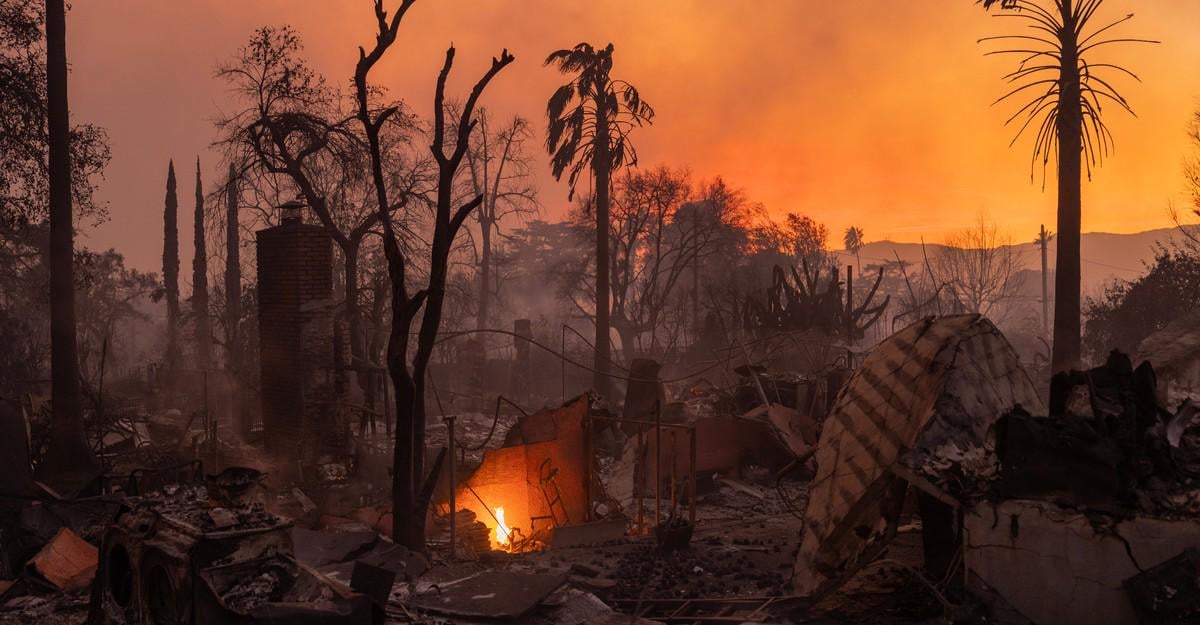
Katharine Gammon: “After just a year, the fires that spread around Los Angeles are already the most studied urban wildfires in history. While the Palisades Fire lapped at the edge of UCLA, the Eaton Fire, on the east side of town, came dangerously close to Caltech. Even as the fires were spreading, these research powerhouses, as well as the University of Southern California, deployed sensors, scientists, and new hypotheses. Researchers around the city began collecting water, soil, and air samples; physicians started to recruit participants into long-term health studies.
“Even as the researchers absorbed the reality of the damage across an area that included 20 million residents, they understood that this was a chance, one that might never exist again, to better understand the nature of these types of disasters. These particular fires offered researchers opportunities to collect samples in ways they hadn’t before been able to—‘so close to the fire and so timely,’ Yifang Zhu, an environmental scientist at UCLA, told me.
“Some of these efforts will take years to become fully fleshed out. The Los Angeles Fire Human Exposure and Long-Term Health Study, for instance, is a multi-institution, 10-year effort to better understand the short- and long-term health impacts of the fires. A year after the fires, though, researchers have some early answers to what happens to mental and physical health after wildfires move from trees and shrubs to homes and buildings.”

1 Comment
Katharine Gammon: “After just a year, the fires that spread around Los Angeles are already the most studied urban wildfires in history. While the Palisades Fire lapped at the edge of UCLA, the Eaton Fire, on the east side of town, came dangerously close to Caltech. Even as the fires were spreading, these research powerhouses, as well as the University of Southern California, deployed sensors, scientists, and new hypotheses. Researchers around the city began collecting water, soil, and air samples; physicians started to recruit participants into long-term health studies.
“Even as the researchers absorbed the reality of the damage across an area that included 20 million residents, they understood that this was a chance, one that might never exist again, to better understand the nature of these types of disasters. These particular fires offered researchers opportunities to collect samples in ways they hadn’t before been able to—‘so close to the fire and so timely,’ Yifang Zhu, an environmental scientist at UCLA, told me.
“Some of these efforts will take years to become fully fleshed out. The Los Angeles Fire Human Exposure and Long-Term Health Study, for instance, is a multi-institution, 10-year effort to better understand the short- and long-term health impacts of the fires. A year after the fires, though, researchers have some early answers to what happens to mental and physical health after wildfires move from trees and shrubs to homes and buildings.”
Read more: [https://theatln.tc/D79AOn7N](https://theatln.tc/D79AOn7N)