**Rise of One Nation reflects deeper divisions in society**
Last week, a clip circulated of Indigenous children standing in what looked like a prison yard, singing. It was a mock-up of a Qantas ad, and the tune was I still call Australia home. Instead of the usual words, the children were singing about being incarcerated. “I’m only 10 and so far from grown, I shouldn’t call this place home.”
It was a rare piece of satire: cutting, yes, but also moving. It pointed to the gap between the pride in Australia so often used to sell us things – be it plane seats or political parties – and the things in this country nobody should take pride in. But the clip, taken from Tony Armstrong’s show Always Was Tonight, had a blunter point, too, about the criminal age of responsibility – which in parts of this country is just 10 years old. How are we putting these kids behind bars?
Today is January 26 – usually the time for a debate about celebrating Australia Day. Is it racist? Is Australia racist? How can we move on from or respond to or adequately memorialise the different facets of our history?
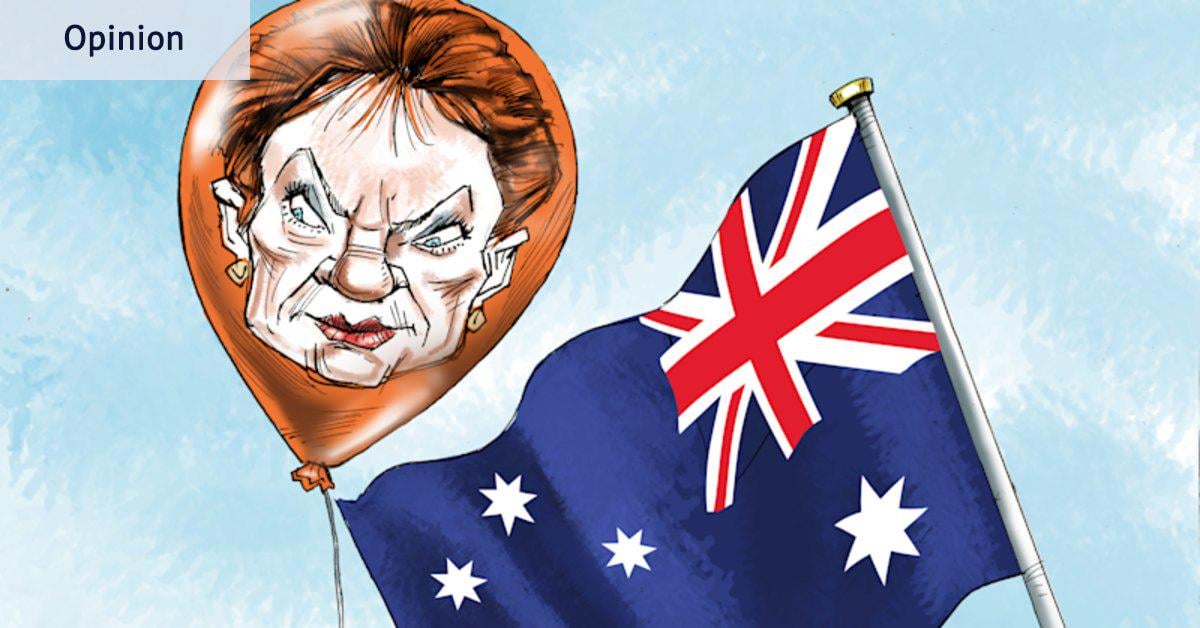
This year, that debate has different contours. Rather than reckoning with our past, the facts force us to reckon with the changing role of racial politics in our present. This masthead’s Resolve poll found 68 per cent of Australians support leaving Australia Day where it is – a remarkable rise from 47 per cent just three years ago. Meanwhile, Pauline Hanson’s party is polling either within spitting distance of or above the Coalition. Federally, the Nationals have just broken from the Coalition – driven at least in part by fears about One Nation’s gains.
There are other worrying signs around attitudes to immigration – again discernible from polling. Ten years ago, a third of voters said immigration was “too high”. Now, over half of us think that.
Those numbers are from the Scanlon Foundation’s Mapping Social Cohesion report. There is, it should be said, also very strong support for multiculturalism and immigration as a general phenomenon. In other words, it’s possible to believe these are good things, while also believing immigration is too high.
But this is not as reassuring as it might seem, when you take account of the authors’ warning that all these sentiments are potentially affected by concerns about housing and the economy. This warning isn’t a vague suspicion: it is based on numbers showing overlaps in beliefs. For example: “People who believed that immigrants increase house prices or take jobs away in 2024 were 2.2 times more likely to change their minds between 2024 and 2025 from agreeing that immigrant diversity makes Australia stronger in 2024 to disagreeing in 2025.”
So we know sentiments are changing and we have some sense of potential reasons. And so we should take note when we see prominent politicians leaning into such narratives – because this has the potential to change attitudes further. Andrew Hastie, reportedly now campaigning for the Liberal leadership, wrote of Australians becoming “strangers in our own home” in an Instagram post last year, evoking the notorious 1968 Rivers of Blood speech from British politician Enoch Powell. Hastie’s focus was on the housing crisis, which he traced to “unsustainable immigration”.
Increasingly, parts of the Coalition seem to be moving in on One Nation’s territory. But we shouldn’t think of this as new. Instead, we should recognise it as a trend in our politics stretching back at least a quarter-century.
In a 2017 Quarterly Essay on One Nation, David Marr wrote that Hanson had, in 2000, called for a blockade against refugees. The next year, John Howard delivered Hanson’s policy, when those aboard the Tampa were sent to Nauru. “We will decide who comes to this country and the circumstances in which they come,” Howard said. Marr said that this, too, echoed Hanson, who in her maiden speech said: “If I can invite whom I want into my home, then I should have the right to have a say in who comes into my country.”
Howard had found a way to fight off Hanson: adopt her policies. Hanson did poorly at the next election – but the Liberals did well. This did not mean Hanson’s ideology had been defeated. Rather, Marr writes, it had “entered the political mix of the nation”.
It is impossible to say what happens to the Coalition next because there are so many permutations. But what we do know is that we are about to watch various individuals and groups jockey for position – the Nationals, conservative Liberals and One Nation itself. It seems likely that the politics of race are about to become more dominant – and more horrible – than ever.
In the short term, what is stopping One Nation from rising further? Marr identified two main drivers of the party’s support: concern about immigration and distrust of government (with nostalgia and law and order also factors). Both have risen over time, and they may keep rising. And so One Nation’s competitors will feel pressed to follow, just as Howard did. And consider, too, the new likelihood of another rate rise: if housing unaffordability is a more recent driver of anti-immigration sentiment, that may be a dangerous catalyst.
Some suggest that Anthony Albanese has, again, got marvellously lucky with the Coalition divisions, just when he was under pressure. But as we watch the mess in Canberra, we should remember that it is not just “Coalition chaos” or fascinating polling – some bemusing political circus. All this is a pointer to deeper divisions in our society. Attitudes are changing, in worrying ways. This is what we are seeing reflected in the rhetoric of and battles between some of our most prominent politicians. We may be entering an ugly time – and given how horrible some of the past years have been, an uglier time is an awful thought. This is the nation Albanese must now try to lead and keep together. “Lucky” is not the word that comes to mind.
*Sean Kelly is author of The Game: A Portrait of Scott Morrison, a regular columnist and a former adviser to Julia Gillard and Kevin Rudd.*
No_Rub77 on
it probably reflects a lot of cash flow from the same nefarious actors in the business of sowing the division, too
jimadory on
More far right propaganda from Mossad and Russia
screenscope on
The rise of ON is the natural consequence of the most disgraceful, divisive government and the weakest, ineffective opposition Australia has ever seen.
The (party) choice remaining is between the Greens, a ragtag bunch of loony racists, or ON, a limited, one-trick-pony party pushing populist policies the Libs have abandoned. Oh, and there’s the Teals, the party you have when you don’t have a party.
The only positive is that this very sorry and regrettable state of affairs is now blowing up in our faces and coming to a head, but it remains to be seen if politicians can come to their senses and realise they desperately need to find a way of reuniting the country.
Happy Australia Day!
karma3000 on
I think the solution to all this is to make property more affordable.
When people have the security of owning their own home, most concerns over immigration will reduce markedly.
Chuster8888 on
It all started when some smart people told us 5 years can pick which gender they want to be
Responsible_Berry829 on
Good on Pauline, she’s slogged it out, been aparent in public during times of crisis and offering solutions to the masses.

7 Comments
**Rise of One Nation reflects deeper divisions in society**
Last week, a clip circulated of Indigenous children standing in what looked like a prison yard, singing. It was a mock-up of a Qantas ad, and the tune was I still call Australia home. Instead of the usual words, the children were singing about being incarcerated. “I’m only 10 and so far from grown, I shouldn’t call this place home.”
It was a rare piece of satire: cutting, yes, but also moving. It pointed to the gap between the pride in Australia so often used to sell us things – be it plane seats or political parties – and the things in this country nobody should take pride in. But the clip, taken from Tony Armstrong’s show Always Was Tonight, had a blunter point, too, about the criminal age of responsibility – which in parts of this country is just 10 years old. How are we putting these kids behind bars?
Today is January 26 – usually the time for a debate about celebrating Australia Day. Is it racist? Is Australia racist? How can we move on from or respond to or adequately memorialise the different facets of our history?
This year, that debate has different contours. Rather than reckoning with our past, the facts force us to reckon with the changing role of racial politics in our present. This masthead’s Resolve poll found 68 per cent of Australians support leaving Australia Day where it is – a remarkable rise from 47 per cent just three years ago. Meanwhile, Pauline Hanson’s party is polling either within spitting distance of or above the Coalition. Federally, the Nationals have just broken from the Coalition – driven at least in part by fears about One Nation’s gains.
There are other worrying signs around attitudes to immigration – again discernible from polling. Ten years ago, a third of voters said immigration was “too high”. Now, over half of us think that.
Those numbers are from the Scanlon Foundation’s Mapping Social Cohesion report. There is, it should be said, also very strong support for multiculturalism and immigration as a general phenomenon. In other words, it’s possible to believe these are good things, while also believing immigration is too high.
But this is not as reassuring as it might seem, when you take account of the authors’ warning that all these sentiments are potentially affected by concerns about housing and the economy. This warning isn’t a vague suspicion: it is based on numbers showing overlaps in beliefs. For example: “People who believed that immigrants increase house prices or take jobs away in 2024 were 2.2 times more likely to change their minds between 2024 and 2025 from agreeing that immigrant diversity makes Australia stronger in 2024 to disagreeing in 2025.”
So we know sentiments are changing and we have some sense of potential reasons. And so we should take note when we see prominent politicians leaning into such narratives – because this has the potential to change attitudes further. Andrew Hastie, reportedly now campaigning for the Liberal leadership, wrote of Australians becoming “strangers in our own home” in an Instagram post last year, evoking the notorious 1968 Rivers of Blood speech from British politician Enoch Powell. Hastie’s focus was on the housing crisis, which he traced to “unsustainable immigration”.
Increasingly, parts of the Coalition seem to be moving in on One Nation’s territory. But we shouldn’t think of this as new. Instead, we should recognise it as a trend in our politics stretching back at least a quarter-century.
In a 2017 Quarterly Essay on One Nation, David Marr wrote that Hanson had, in 2000, called for a blockade against refugees. The next year, John Howard delivered Hanson’s policy, when those aboard the Tampa were sent to Nauru. “We will decide who comes to this country and the circumstances in which they come,” Howard said. Marr said that this, too, echoed Hanson, who in her maiden speech said: “If I can invite whom I want into my home, then I should have the right to have a say in who comes into my country.”
Howard had found a way to fight off Hanson: adopt her policies. Hanson did poorly at the next election – but the Liberals did well. This did not mean Hanson’s ideology had been defeated. Rather, Marr writes, it had “entered the political mix of the nation”.
It is impossible to say what happens to the Coalition next because there are so many permutations. But what we do know is that we are about to watch various individuals and groups jockey for position – the Nationals, conservative Liberals and One Nation itself. It seems likely that the politics of race are about to become more dominant – and more horrible – than ever.
In the short term, what is stopping One Nation from rising further? Marr identified two main drivers of the party’s support: concern about immigration and distrust of government (with nostalgia and law and order also factors). Both have risen over time, and they may keep rising. And so One Nation’s competitors will feel pressed to follow, just as Howard did. And consider, too, the new likelihood of another rate rise: if housing unaffordability is a more recent driver of anti-immigration sentiment, that may be a dangerous catalyst.
Some suggest that Anthony Albanese has, again, got marvellously lucky with the Coalition divisions, just when he was under pressure. But as we watch the mess in Canberra, we should remember that it is not just “Coalition chaos” or fascinating polling – some bemusing political circus. All this is a pointer to deeper divisions in our society. Attitudes are changing, in worrying ways. This is what we are seeing reflected in the rhetoric of and battles between some of our most prominent politicians. We may be entering an ugly time – and given how horrible some of the past years have been, an uglier time is an awful thought. This is the nation Albanese must now try to lead and keep together. “Lucky” is not the word that comes to mind.
*Sean Kelly is author of The Game: A Portrait of Scott Morrison, a regular columnist and a former adviser to Julia Gillard and Kevin Rudd.*
it probably reflects a lot of cash flow from the same nefarious actors in the business of sowing the division, too
More far right propaganda from Mossad and Russia
The rise of ON is the natural consequence of the most disgraceful, divisive government and the weakest, ineffective opposition Australia has ever seen.
The (party) choice remaining is between the Greens, a ragtag bunch of loony racists, or ON, a limited, one-trick-pony party pushing populist policies the Libs have abandoned. Oh, and there’s the Teals, the party you have when you don’t have a party.
The only positive is that this very sorry and regrettable state of affairs is now blowing up in our faces and coming to a head, but it remains to be seen if politicians can come to their senses and realise they desperately need to find a way of reuniting the country.
Happy Australia Day!
I think the solution to all this is to make property more affordable.
When people have the security of owning their own home, most concerns over immigration will reduce markedly.
It all started when some smart people told us 5 years can pick which gender they want to be
Good on Pauline, she’s slogged it out, been aparent in public during times of crisis and offering solutions to the masses.
No wonder shes gaining popularity.
Good on her! #1 🦰