
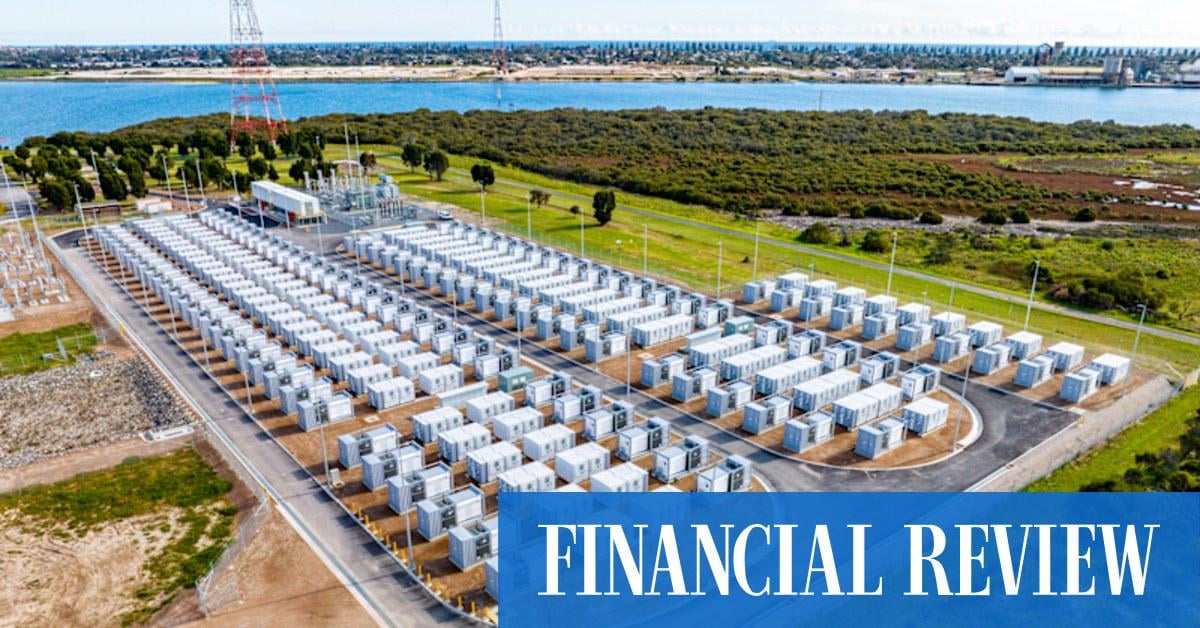
Large-scale batteries are set to make up a greater share of Australia’s electricity grid than gas by 2027, according to forecasts that analysts say will radically transform the operation of the energy market and potentially put downward pressure on power bills.
Australia has become the third-largest market for utility-scale batteries globally, after China and the United States, as plummeting costs and favourable economics encourage both local and international investors to pile into the sector.
Australia has a huge pipeline of grid-scale batteries.
This has led to a massive spike in shovel-ready big battery projects in Australia’s development pipeline, which, on estimated construction timelines, will surpass the total gas capacity of the grid within two years, according to energy consultancy Rystad Energy.
The projects, which are backed by big energy incumbents such as Origin and AGL, as well as new players including Akaysha, Quinbrook and Neoen, can be operated profitably by storing power during the day at low prices and selling it during evening peaks when supply is constrained and prices are higher.
By contrast, investment in new gas-fired power generation remains almost flat, despite most energy experts agreeing on the critical importance of the power source as a long-term back-up for renewables during wind and solar droughts.
Gas is not included in the federal government’s underwriting program for new energy supply, the Capacity Investment Scheme.
David Dixon, an analyst at Rystad, who compiled the forecasts as part of a 2026 outlook report, said the batteries coming online would provide critical new supply during evening peaks historically dominated by coal and gas power.
“You’re going from a situation where there is limited competition [during the evenings] to this scenario where you’ve got 15 gigawatts entering the market – more than the entire gas fleet,” he said.
“During the evening, this is going to have a downward effect on prices.”
He said almost half of the batteries under construction would come online this year, with the other half entering in 2027.
The change will be “transformational”, Dixon said, because the batteries will also soak up a lot of the solar and wind power produced during the day but not used – known as curtailment – which has proven to be a headache for energy investors in big solar and wind projects.
The exponential growth of both large and small-scale batteries is a rare success story for the federal government’s clean energy transition, which has been beset by delays and cost blowouts, particularly involving wind farms and poles and wire projects.
Energy retailing and generation giant Origin Energy last week said the slow pace of the renewables rollout was key to its decision to push back the planned closure date of its Eraring coal power station near Newcastle, which is the biggest in the country.
The company is one of many that have invested heavily in grid-scale batteries, which now make up around half of the projects in the market operator’s connections pipeline.
The total amount of power provided to the grid by big batteries in 2025 was up 143 per cent year-on-year – albeit from a low base – while gas generation was down around 14 per cent, according to figures compiled by UNSW energy systems analyst Dylan McConnell.
McConnell said the excess evening supply from the flood of new battery projects coming online could theoretically put downward pressure on wholesale power prices, which have historically been heavily influenced by gas generators.
But he said that was contingent on the level of competition between battery operators, which could be weakened if ownership of the assets was concentrated among key energy players.
“The big thing we haven’t seen in the rollout so far is a decoupling of [overall] prices from gas prices. Theoretically, when we get more capacity and more competition between batteries, we could get lower prices,” he said.
McConnell said that even though batteries are increasingly squeezing gas out of the system during evening peaks, they would not fundamentally change the fuel’s role in the system, which is to be available as a backstop during “high impact, low probability” events.
“Batteries are eating gas’ lunch for around four hours a day. But if you need gas to run for 12 hours or so during a cold snap, that’s where the gas generators actually make their money. That’s not really affected by batteries because batteries simply can’t do that.
“You end up using gas a lot less, but it’s still there. It’s still good value for those long-duration events.“
Source: SweetChilliJesus
3 Comments
Quicker the better as it means we can ban fossil fuel developments quicker.
That’ll piss off David Janetzki, who’s just ordered a new gas peaking plant be built.
Good that using less gas will piss off the LNP.
*But when the sun don’t shine and the wind don’t blow.*
[Throws something]