
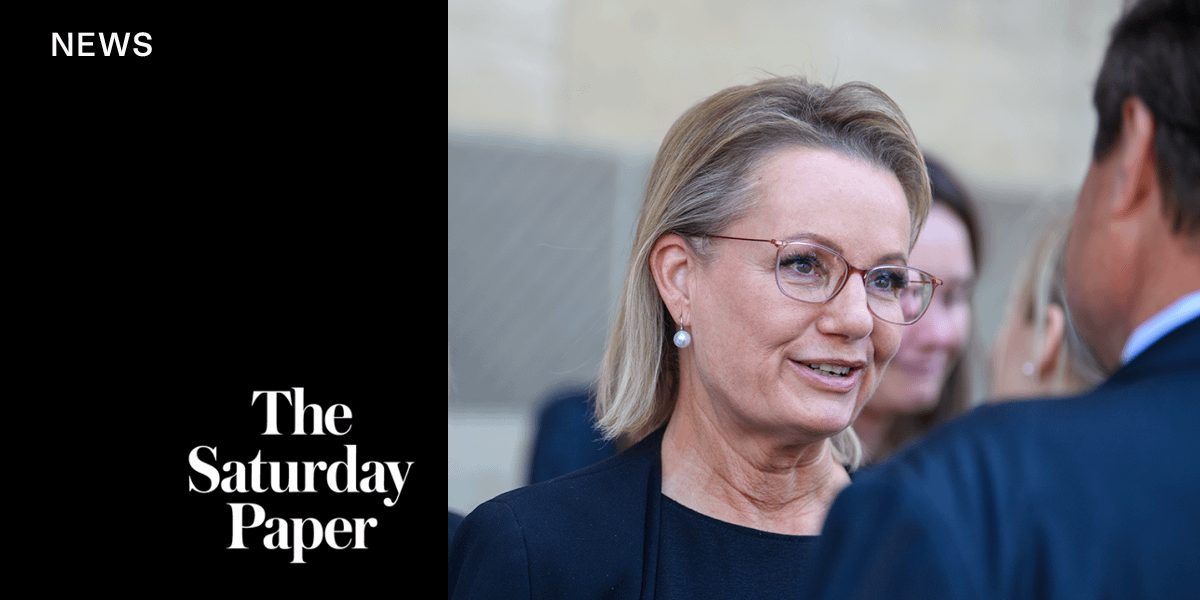
The view inside the Liberal Party is that the numbers are there for a spill, that it will happen on Tuesday and that the winner will be Angus Taylor.
“I think it’s definitely on,” one Liberal powerbroker tells The Saturday Paper. “And I think Taylor will emerge as the leader of the Liberal Party … They’ll move a spill on Tuesday morning, and everyone will feel very bad for Sussan, and she’ll be as remembered as Brendan Nelson is, which is not at all. She is dead.”
When Liberal MPs gathered in Melbourne on Thursday, ahead of a memorial service for Liberal MP Katie Allen, senior figures convened a private face-to-face between Taylor and Andrew Hastie in an effort to force a resolution between what were then the two lead candidates, both of whom come from the party’s right.
Taylor and Hastie were joined by a group of senior right-wing MPs, including opposition home affairs spokesman Jonno Duniam, who is Hastie’s Canberra flatmate; Western Australian Senator Matt O’Sullivan; and finance spokesman James Paterson.
The meeting was brokered by former frontbencher and right faction organiser Michael Sukkar, who was drafted back into negotiations despite losing his seat of Deakin at the last election.
While the presence of so many senior figures underscored the seriousness of the moment, no agreement was reached, discussions were deferred and the uncertainty prolonged.
For moderates, the timing of the meeting was not just ill-judged but offensive. That Taylor and Hastie would convene to plot the removal of the Liberal Party’s first female leader on the morning of Katie Allen’s memorial service – a former MP held in high regard and a committed supporter of Ley’s – was seen as a stark demonstration of how far personal ambition had eclipsed judgement.
For many Liberal women, the symbolism was unavoidable: two senior men meeting with a handful of other men moving against a female leader before the funeral of a female colleague who had stood by her.
Throughout this, Ley has been drawing on the support of the party’s most successful modern leader: John Howard.
The former prime minister has supported Ley since she won the leadership and that support has intensified in recent weeks, after Nationals leader David Littleproud decided to end the Coalition arrangement and began pushing for Ley’s resignation.
“They talk or message each other most days,” one Ley confidant says of the relationship with Howard. “And over the past week or so, ever since Littleproud blew up the Coalition, I would say they have been in touch more than once a day.”
Howard has also gone out of his way to put that support on display. At last week’s National Day of Mourning at the Sydney Opera House, commemorating the 15 victims of the December 14 Bondi Beach massacre, he arrived alongside Ley.
“Before the memorial at the Opera House, Sussan and John Howard had a meeting, and then they walked in together, and then they sat next to each other at the memorial,” says another Ley supporter. “Obviously, he’s been giving her a lot of advice through this period and has publicly endorsed her decisions around accepting the resignations of the three Nationals MPs who broke shadow cabinet solidarity and voted against the hate speech legislation.”
The failure to strike a deal at Thursday’s meeting in Melbourne has become an unexpected source of stability for Ley and her allies. For the right, it has exposed a deeper weakness: a faction confident of its entitlement to rule yet unable to execute even the most basic act of political coordination.
According to one senior Liberal figure, the failure to resolve the leadership question is not accidental. It is the inevitable consequence of a destabilisation strategy that was never matched by a credible plan for succession.
“These are not rational people weighing up what is the best option,” the source says. “They’re just a group of people who have been pursuing a strategy for some time to destabilise and to stymie Sussan’s chances of succeeding. They’re amateurs.”
Their campaign, the source argues, has relied less on substance than on opportunism – sudden demands for policy rigour from figures who were conspicuously silent during the party’s last term in opposition under Peter Dutton.
“Suddenly, we have this obsession with policy from people who sat very quietly for three years under Dutton and let us go over a cliff,” the same source says.
What the destabilisation strategy did not account for, the source says, was rivalry.
“One thing that that strategy did not account for is the ego and hubris of two conservative men who can’t work out who wants to be the leader,” they say. “And so that is the major sticking point here and as long as they cannot work it out, Sussan stays on as leader.”
The result, the source argues, is a party suspended in midair – damaged, distracted and exposed.
“They’ve managed to hurt the Liberal Party, they’ve managed to hurt Sussan, but they haven’t worked out how they’re going to take over,” the source says. “And as a result, we’re just floundering and the party is being damaged, and everyone’s being put at risk because they could not come up with a viable plan to take control.”
Late on Friday, Hastie finally accepted that he didn’t have the numbers and he would not be leader.
“Over the past few weeks there has been speculation about the future leadership of the Liberal Party of Australia,” he said in a statement.
“I’ve previously stated that I would welcome the opportunity to serve my party and our country as leader of the Liberal Party.
“But having consulted with colleagues over the past week and respecting their honest feedback to me, it is clear that I do not have the support needed to become leader of the Liberal Party.
“On this basis, I wish to make it clear I will not be contesting the leadership of the Liberal Party.”
For a wounded party, that leaves Taylor as the only credible candidate.
He has the kind of blue-chip background Liberals traditionally revere: a university medal in economics from Sydney University, and a law degree to go with it; a Rhodes Scholarship at Oxford, where he rowed for New College and completed a master’s in economics; and successful stints at global management consulting firm McKinsey & Co and Port Jackson Partners.
Having entered federal parliament in 2013 as the member for the rural New South Wales seat of Hume, he served as a senior minister under Malcolm Turnbull and Scott Morrison.
Yet his three years as shadow treasurer under Peter Dutton produced a perverse outcome: Labor emerged as the more trusted economic manager in the midst of the worst cost-of-living crisis in a generation.
Taylor also endorsed, alongside Dutton, a policy that would have increased the tax burden on every Australian, a remarkable position for a party that has defined itself by tax cuts.
These are not Taylor’s only problems, however. His abrasive style has irritated a sizeable number of the 51 MPs and senators who make up the federal Liberal party room. He has an implacable enemy in NSW centre-right powerbroker and current manager of opposition business in the House of Representatives Alex Hawke, who is fighting tooth and nail to make sure neither Taylor nor Hastie gets the leadership.
“Everything is at stake for Alex here, because there is no pathway for him under either Hastie or Taylor,” says one NSW Liberal.
Both Taylor and Hastie were members of the so-called Monkey Pod plot – the failed 2018-19 grouping that sought, unsuccessfully, to install Peter Dutton as leader.
“The key word there is unsuccessful,” says one Liberal moderate. “When it comes to numbers – as in, who will vote for who in a leadership ballot – Taylor can’t count and he lacks judgement.”
The fact that Taylor is not viewed as especially good at politics has not disqualified him from consideration. On the contrary, it has become almost incidental.
In the post-election Liberal Party, leadership challenges are no longer about who can win, govern or rebuild but about enforcing the national right’s agenda. Taylor is useful not because he is strong but because he is the only one available.
Over the past fortnight, a spate of opinion polls has sharpened the pressure on Ley, placing the Liberal Party behind an insurgent One Nation on its right flank.
Since the May 3 election, the Liberals have lost about a third of the voters who supported them – a collapse that has unsettled MPs already grappling with defeat and internal division.
For many in the party room, that haemorrhage has rendered Ley’s leadership untenable, not because of any single decision she has made but because the numbers now suggest a party bleeding support in both directions and a leader unable to arrest the slide.
“I think there is undoubtedly concern from colleagues that even though we had a summer in which the government was held to account for the bad decisions it was making … it doesn’t appear that the public has warmed to the Coalition or warmed to the Liberal Party in response to that work,” Victorian Liberal Senator Jane Hume, a moderate who backed Taylor in last year’s leadership ballot, told Sky News on Thursday.
“What I want to see, most importantly, is an opportunity to unify our party, unify the Liberal Party. Because we have a lot of work to do to remind ourselves, and those who do support us, what it is that we stand for and the values that we hold dear.”
For electoral analyst Ben Raue, writer of The Tally Room blog, the dysfunction now gripping the Liberal Party cannot be separated from a wider problem on its right flank – one that predates Ley’s leadership and has been building steadily since the election.
“I’m always careful about one poll,” Raue tells The Saturday Paper. “But you have to say at this point that the One Nation trend has been happening everywhere for months.”
Raue cautions against treating recent polling as predictive – particularly seat projections that assume an organisational capacity One Nation has rarely demonstrated. Still, Raue believes the trend itself is real.
“Obviously it’s a long time out from the election, but it is interesting.”
For Raue, the deeper dilemma for the Liberals is strategic and internal.
“I do wonder if part of the story here is that the Coalition under someone like Peter Dutton was able to tell itself a narrative and hold together its right-wing flank,” Raue says. “And then the election went so badly they lost Peter Dutton.”
What has followed, Raue suggests, is a party pulled in opposite directions. On one side is a desire to recover voters lost to teal independents in the inner cities, and on the other is an increasingly restless right-wing grouping that is drifting elsewhere.
“There clearly is this desire to appeal to that moderate base,” Raue says, “but any move to appeal to those moderates they lost in the inner cities is going to make things harder for them with this right-wing flank – it clearly is going somewhere else.”
That tension, he argues, has become acute not because of what might happen at the next election but because of what is already happening inside parliament.
“The problem right now is that it’s causing immediate internal conflict in parliament,” Raue says. “Like, they can’t even get to that point.”
In that sense, the struggle over Ley’s leadership is less a contest between individuals than a referendum on what the Liberal Party is.
Howard’s model of authority – patient, disciplined, institutional – still hovers over the debate, but it no longer commands obedience.
Whether Ley survives or falls, the deeper problem remains unresolved. The Liberal Party is now unable to decide whether it wants to govern again or simply to win its internal arguments.
Source: Niscellaneous
3 Comments
Hate squabbling like orcs over dinner. There’s a sort of Vogan poetry emerging, I hope it’s a classic!
there is only one mob that will try and get us out of the shit and it’s not the rw.
If a party spends more effort on internal struggles than actually advocating their platform to the wider electorate, they aren’t going to be picking up any new votes. I get the feeling that the moderates and reactionaries are going to split at some point, further fracturing the conservative vote.
The moderates might be able to form a new political party with the Teals, which would win back some city seats, but the politics they want are far removed from the Nats and right wing Liberals. The Nats and right wing Liberals could unite like the LNP, but I don’t know how they’ll fare with One Nation rising. Interesting times.
It’s a matter of principle. Either you have a political conviction as a conservative, or you pander to people who will give their preferences to the ALP or the Greens anyway.