
As it stands today, Australia has just one party of government. And that is the party that currently holds government. With the splintering of the Coalition, no one else conceivably could come close to the threshold of power – winning a majority of seats in the House of Representatives.
For a majority, you need 76 seats in the House. Until a few days ago, the Coalition held 42. They were in the wilderness, yet with potential to return to power at the next election or, more plausibly, the one following. Rather than figure out a plan to get from 42 to 76, they’ve blown themselves up.
Now that the Nationals have flounced off in a spiteful fit of pique, the Liberals have a mere 28. And the Nationals just 14. Together, they were in the wilderness. Apart, they are all in oblivion.
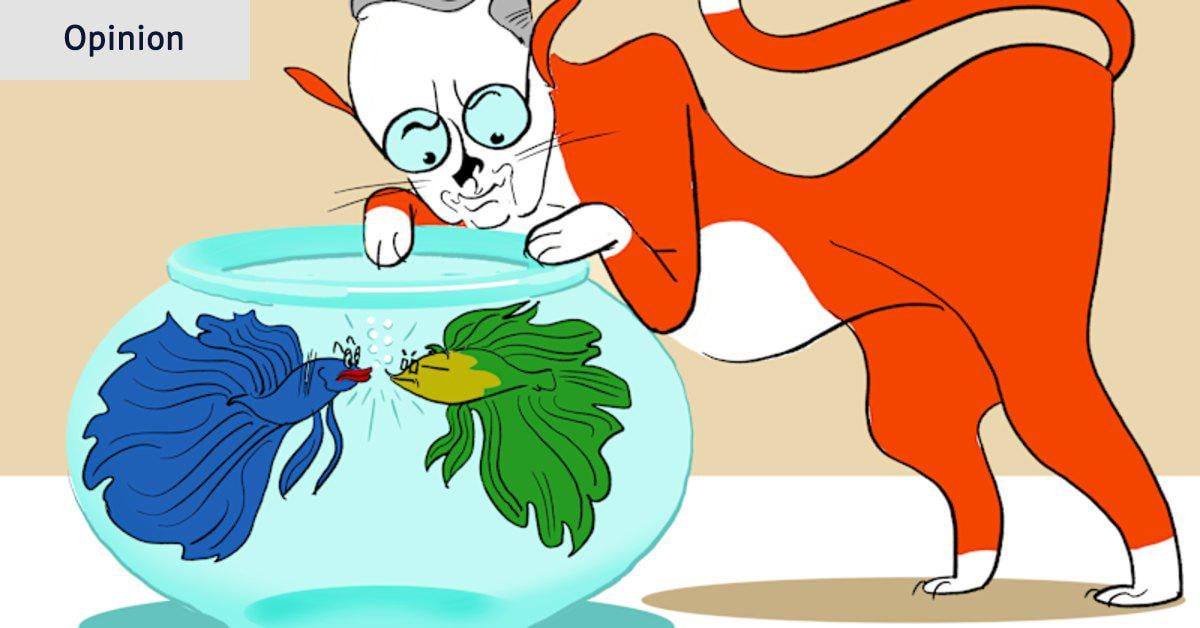
The Coalition is the Siamese fighting fish of the political aquarium. A notable feature of this colourful species is that while it’s always up for a fight, it’s just as ready to attack itself. On seeing its own reflection in glass, it will strike.
This is just the sort of self-harming aggression displayed by the Coalition, and the Nationals in particular. “I want to give you a counterargument,” says a Liberal frontbencher, of why the Coalition is not as brainless as a pointlessly pugnacious pisces, “but I can’t think of one.”
Australia long operated a two-party system, with Labor and the Coalition vying for power. It’s now a one-party-and-some-bits system. “We are no longer a coalition; we are a collection of minor parties on the right,” says a senior Liberal, encompassing the Liberals, Nationals and One Nation.
The Nationals are now a party of protest, like One Nation, like the Greens. Parties of grievance, not government. The Liberals in recent years have been heading in this direction, too.
Prime Minister Anthony Albanese has expressed an ambition to entrench Labor in power long enough to make it the “natural party of government”, a title long claimed by the Coalition. He’s excelled beyond his wildest dreams. Thanks to the Nationals’ walkout, Labor is now the only party of government.
Barnaby Joyce, now a member of One Nation, puts it this way: “Anthony Albanese is the only person in the history of Australian politics who’s safe with a primary vote of 32 per cent,” quoting the figure from this week’s Newspoll. “That screams of the seismic change in Australian politics.”
So what is the seismic change? And is Albanese truly so safe? Labor Party headquarters this week sent out to party members a fundraising email with the subject line: “Pauline Hanson as PM?”
“The latest polls show One Nation passing the Liberals on primary vote for the first time,” reads the email. Hanson has said she’s ready to form government, it says. “We don’t share their view, but we also can’t ignore the signs.”
The immediate seismic event was the decision of the Nationals to break from the Liberals, for the second time. The simple fact that they’ve walked out twice in eight months – after nearly four decades of coalition stability – tells you that there is an underlying dysfunction, not simply a couple of points of disagreement.
There are three common factors in the two break-ups. First, David Littleproud, Nationals’ leader, is widely seen to have mismanaged both situations. Some of the Nationals are deeply unimpressed. That’s why one of their backbenchers, Colin Boyce, has promised to challenge Littleproud for the party leadership on Monday.
Without the Liberals, the Nationals face “political oblivion”, he said in a statement of the obvious. Boyce isn’t going to win; he lacks support. Rather, he’s a “bomb-thrower” who is hoping to blow up Littleproud’s leadership by provoking other challengers to take up the contest, one of his colleagues says.
The Liberals are even less impressed.
Source: Expensive-Horse5538
2 Comments
Wouldn’t rule out a Reform-style surge in Australia where One Nation starts leading the primary vote and 2PP. The Labor fundraising email is correct.
In the event that the Liberal Party and the National Party win enough seats to form government, they have a strong incentive to at least do a deal for confidence and supply.
The coalition has been a bug not a feature.
The National Party has done a good job of persuading older, rural voters to elect it.
But the coalition has prevented the Liberal Party from addressing the real issues for the right wing, declining support among young, educated, urban voters.
Support for both major parties have been declining for decades. If that trend continues then minority government will be the rule, and Labor has historically been worse at this, see Tasmania and Gillard.