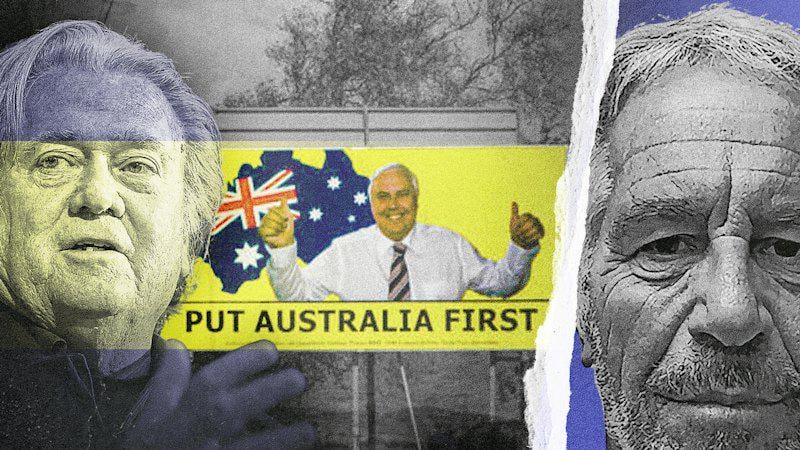
Former Trump strategist Steve Bannon boasted that he urged Australian billionaire Clive Palmer to bankroll an advertising campaign worth tens of millions during the 2019 federal election as part of a wider plan to disrupt global democracy.
In a message sent to an account that appeared to belong to Jeffrey Epstein on May 20, 2019 – two days after Labor’s shock election loss – Bannon told the convicted paedophile: “I had Clive Palmer do the $60m anti China and anti climate change ads.”
Photo: ARESNA VILLANUEVA
The exchange forms part of a tranche of material emerging from a US investigation into Epstein’s communications before the disgraced financier’s death in custody in August 2019. The released documents, while giving little new insight into the ties between Epstein and US President Donald Trump, further illuminate his extensive network of high-profile associates, ranging from former US president Bill Clinton to billionaires Elon Musk and Bill Gates.
The exchange suggests Bannon privately claimed influence to Epstein over what became Australia’s most expensive political advertising campaign to date.
Epstein replied by arguing that traditional political campaigning had been overtaken by online mobilisation, citing Australia’s election and Trump’s win three years earlier as evidence that opinion polling had failed.
“Telephone polls not accurate,” he wrote, urging Bannon to pursue a broader populist project unconstrained by national borders.
“New, non geographically limited groupings… You can champion a true world bank of the people not the countries,” Epstein added.
“Yes that’s the objective,” Bannon replied. “Next stop Kazikstan [sic].”
The exchange places the 2019 election within a wider conversation among populist global political operatives focused on disrupting the mainstream parties, climate policy and international institutions, and suggests Bannon viewed the Australian campaign as part of a broader sequence of political interventions.
Bannon, who rose to prominence as the head of the right-wing website Breitbart News and later as a senior strategist on Trump’s 2016 presidential campaign, was publicly expressing a keen interest in the Australian contest at the time.
In an interview with this masthead in May 2019, he described the election campaign as dull and consultant-driven, blaming political professionals for draining politics of meaning and intensity.
Records later revealed Palmer spent $83.6 million promoting the United Australia Party during the campaign, saturating television, radio, print and digital platforms with advertising attacking Labor leader Bill Shorten, opposing climate policies and repeatedly warning of China’s influence in Australian politics.
Several advertisements claimed “communist China” was attempting a clandestine takeover of Australia, including suggestions that a remote airport in Western Australia could be used for military invasion. Defence and strategic experts dismissed the claims as scaremongering and conspiratorial.
A United Australia Party newspaper advertisement from May 2019.
A United Australia Party newspaper advertisement from May 2019.
After the election, Palmer – having failed to win a single seat – claimed credit for the Morrison government’s victory, arguing the United Australia Party’s 3.5 per cent primary vote, coupled with its preference flows to the Liberals, had proved decisive, particularly in Queensland.
In its post-election review, Labor said the magnitude of Palmer’s expenditure crowded out Labor’s advertising in broadcast, print and digital media, and his entry as a high-wealth individual willing to outspend the entire ALP was a new and destabilising factor.
“In the final stages of the campaign,” the review said, “Palmer’s expenditure also directly backed in the Coalition’s anti-Labor messages, in an unprecedented act of collusion between supposed political rivals.”
The review also urged reforms to prevent high-wealth individuals effectively buying elections, warning that unchecked political spending represented a threat to democratic integrity.
Palmer, a life member of Queensland’s Liberal-National Party, won the seat of Fairfax in the House of Representatives in 2013 election, while his party also had three senators elected – Jacqui Lambie, Glen Lazarus and Dio Wang. He lost at the 2016 election but has remained a major presence since, through large and often outrageous advertising campaigns, borrowing from Trump’s tactics.
The newly released messages coincide with scrutiny of Bannon’s activities in Europe. The trove of messages shows the pair were frequent dining companions, with Epstein extending the use of his property portfolio –including residences in Paris and Palm Beach – and granting Bannon access to his private jet on multiple occasions.
The pair joked about French President Emmanuel Macron accusing Bannon and Russian-linked interests of working with nationalist parties to undermine the sovereignty of elections, warning voters not to be “naive” about foreign interference leading up to a European Parliament poll.
“U saw where Macron campaign manager coming after me personally,” Bannon texted Epstein.
He replied: “It is an attack on the sovereignty of the election… it makes you want to throw up,’ he fumed. Loved it.”
Bannon and Palmer have been contacted for comment
AKFRU on
Article Text: Former Trump strategist Steve Bannon boasted that he urged Australian billionaire Clive Palmer to bankroll an advertising campaign worth tens of millions during the 2019 federal election as part of a wider plan to disrupt global democracy.
In a message sent to an account that appeared to belong to Jeffrey Epstein on May 20, 2019 – two days after Labor’s shock election loss – Bannon told the convicted paedophile: “I had Clive Palmer do the $60m anti China and anti climate change ads.”
n Epstein and US President Donald Trump, further illuminate his extensive network of high-profile associates, ranging from former US president Bill Clinton to billionaires Elon Musk and Bill Gates.
The exchange suggests Bannon privately claimed influence to Epstein over what became Australia’s most expensive political advertising campaign to date.
Epstein replied by arguing that traditional political campaigning had been overtaken by online mobilisation, citing Australia’s election and Trump’s win three years earlier as evidence that opinion polling had failed.
“Telephone polls not accurate,” he wrote, urging Bannon to pursue a broader populist project unconstrained by national borders.
“New, non geographically limited groupings… You can champion a true world bank of the people not the countries,” Epstein added.
“Yes that’s the objective,” Bannon replied. “Next stop Kazikstan [sic].”
The exchange places the 2019 election within a wider conversation among populist global political operatives focused on disrupting the mainstream parties, climate policy and international institutions, and suggests Bannon viewed the Australian campaign as part of a broader sequence of political interventions.
Bannon, who rose to prominence as the head of the right-wing website Breitbart News and later as a senior strategist on Trump’s 2016 presidential campaign, was publicly expressing a keen interest in the Australian contest at the time.
Records later revealed Palmer spent $83.6 million promoting the United Australia Party during the campaign, saturating television, radio, print and digital platforms with advertising attacking Labor leader Bill Shorten, opposing climate policies and repeatedly warning of China’s influence in Australian politics.
Several advertisements claimed “communist China” was attempting a clandestine takeover of Australia, including suggestions that a remote airport in Western Australia could be used for military invasion. Defence and strategic experts dismissed the claims as scaremongering and conspiratorial.
After the election, Palmer – having failed to win a single seat – claimed credit for the Morrison government’s victory, arguing the United Australia Party’s 3.5 per cent primary vote, coupled with its preference flows to the Liberals, had proved decisive, particularly in Queensland.
lazy-bruce on
I don’t think anyone would be suprised by this.
I suppose people silly enough to have fallen for it may get upset, but it was weird at the time, so knowing it relates to Trumps circle of influence isnt surprising
Nippys4 on
Wonder who Bannon has started backing now is is whispering too.
I actually don’t wonder, it should be painfully obvious
Careful-Trade-9666 on
The saddest part of those ads ? Where he accused the Chinese of having their own airport in Australia, of having their own ports in Australia? 110% god honest truth. How so ? Because Clive Palmer leases them to the Chinese at his Iron Ore mine in WA.
AggravatedKangaroo on
People have been saying the US and other powers have been interfering with Australian elections for 25 years
Some Australians responses? “oh you’re cookers”
There’s more so called Western alliance countries trying to fuck us over then there is Eastern bloc.

7 Comments
Paywall.
Former Trump strategist Steve Bannon boasted that he urged Australian billionaire Clive Palmer to bankroll an advertising campaign worth tens of millions during the 2019 federal election as part of a wider plan to disrupt global democracy.
In a message sent to an account that appeared to belong to Jeffrey Epstein on May 20, 2019 – two days after Labor’s shock election loss – Bannon told the convicted paedophile: “I had Clive Palmer do the $60m anti China and anti climate change ads.”
Photo: ARESNA VILLANUEVA
The exchange forms part of a tranche of material emerging from a US investigation into Epstein’s communications before the disgraced financier’s death in custody in August 2019. The released documents, while giving little new insight into the ties between Epstein and US President Donald Trump, further illuminate his extensive network of high-profile associates, ranging from former US president Bill Clinton to billionaires Elon Musk and Bill Gates.
The exchange suggests Bannon privately claimed influence to Epstein over what became Australia’s most expensive political advertising campaign to date.
Epstein replied by arguing that traditional political campaigning had been overtaken by online mobilisation, citing Australia’s election and Trump’s win three years earlier as evidence that opinion polling had failed.
“Telephone polls not accurate,” he wrote, urging Bannon to pursue a broader populist project unconstrained by national borders.
“New, non geographically limited groupings… You can champion a true world bank of the people not the countries,” Epstein added.
“Yes that’s the objective,” Bannon replied. “Next stop Kazikstan [sic].”
The exchange places the 2019 election within a wider conversation among populist global political operatives focused on disrupting the mainstream parties, climate policy and international institutions, and suggests Bannon viewed the Australian campaign as part of a broader sequence of political interventions.
Bannon, who rose to prominence as the head of the right-wing website Breitbart News and later as a senior strategist on Trump’s 2016 presidential campaign, was publicly expressing a keen interest in the Australian contest at the time.
In an interview with this masthead in May 2019, he described the election campaign as dull and consultant-driven, blaming political professionals for draining politics of meaning and intensity.
Records later revealed Palmer spent $83.6 million promoting the United Australia Party during the campaign, saturating television, radio, print and digital platforms with advertising attacking Labor leader Bill Shorten, opposing climate policies and repeatedly warning of China’s influence in Australian politics.
Several advertisements claimed “communist China” was attempting a clandestine takeover of Australia, including suggestions that a remote airport in Western Australia could be used for military invasion. Defence and strategic experts dismissed the claims as scaremongering and conspiratorial.
A United Australia Party newspaper advertisement from May 2019.
A United Australia Party newspaper advertisement from May 2019.
After the election, Palmer – having failed to win a single seat – claimed credit for the Morrison government’s victory, arguing the United Australia Party’s 3.5 per cent primary vote, coupled with its preference flows to the Liberals, had proved decisive, particularly in Queensland.
In its post-election review, Labor said the magnitude of Palmer’s expenditure crowded out Labor’s advertising in broadcast, print and digital media, and his entry as a high-wealth individual willing to outspend the entire ALP was a new and destabilising factor.
“In the final stages of the campaign,” the review said, “Palmer’s expenditure also directly backed in the Coalition’s anti-Labor messages, in an unprecedented act of collusion between supposed political rivals.”
The review also urged reforms to prevent high-wealth individuals effectively buying elections, warning that unchecked political spending represented a threat to democratic integrity.
Palmer, a life member of Queensland’s Liberal-National Party, won the seat of Fairfax in the House of Representatives in 2013 election, while his party also had three senators elected – Jacqui Lambie, Glen Lazarus and Dio Wang. He lost at the 2016 election but has remained a major presence since, through large and often outrageous advertising campaigns, borrowing from Trump’s tactics.
The newly released messages coincide with scrutiny of Bannon’s activities in Europe. The trove of messages shows the pair were frequent dining companions, with Epstein extending the use of his property portfolio –including residences in Paris and Palm Beach – and granting Bannon access to his private jet on multiple occasions.
The pair joked about French President Emmanuel Macron accusing Bannon and Russian-linked interests of working with nationalist parties to undermine the sovereignty of elections, warning voters not to be “naive” about foreign interference leading up to a European Parliament poll.
“U saw where Macron campaign manager coming after me personally,” Bannon texted Epstein.
He replied: “It is an attack on the sovereignty of the election… it makes you want to throw up,’ he fumed. Loved it.”
Bannon and Palmer have been contacted for comment
Article Text: Former Trump strategist Steve Bannon boasted that he urged Australian billionaire Clive Palmer to bankroll an advertising campaign worth tens of millions during the 2019 federal election as part of a wider plan to disrupt global democracy.
In a message sent to an account that appeared to belong to Jeffrey Epstein on May 20, 2019 – two days after Labor’s shock election loss – Bannon told the convicted paedophile: “I had Clive Palmer do the $60m anti China and anti climate change ads.”
n Epstein and US President Donald Trump, further illuminate his extensive network of high-profile associates, ranging from former US president Bill Clinton to billionaires Elon Musk and Bill Gates.
The exchange suggests Bannon privately claimed influence to Epstein over what became Australia’s most expensive political advertising campaign to date.
Epstein replied by arguing that traditional political campaigning had been overtaken by online mobilisation, citing Australia’s election and Trump’s win three years earlier as evidence that opinion polling had failed.
“Telephone polls not accurate,” he wrote, urging Bannon to pursue a broader populist project unconstrained by national borders.
“New, non geographically limited groupings… You can champion a true world bank of the people not the countries,” Epstein added.
“Yes that’s the objective,” Bannon replied. “Next stop Kazikstan [sic].”
The exchange places the 2019 election within a wider conversation among populist global political operatives focused on disrupting the mainstream parties, climate policy and international institutions, and suggests Bannon viewed the Australian campaign as part of a broader sequence of political interventions.
Bannon, who rose to prominence as the head of the right-wing website Breitbart News and later as a senior strategist on Trump’s 2016 presidential campaign, was publicly expressing a keen interest in the Australian contest at the time.
In an interview with [this masthead in May 2019](https://www.smh.com.au/federal-election-2019/steve-bannon-thinks-the-aussie-election-is-dull-but-is-that-so-bad-20190503-p51juf.html), he described the election campaign as dull and consultant-driven, blaming political professionals for draining politics of meaning and intensity.
Records later revealed Palmer spent $83.6 million promoting the United Australia Party during the campaign, saturating television, radio, print and digital platforms with advertising attacking Labor leader Bill Shorten, opposing climate policies and repeatedly warning of China’s influence in Australian politics.
Several advertisements claimed “communist China” was attempting a clandestine takeover of Australia, including suggestions that a remote airport in Western Australia could be used for military invasion. Defence and strategic experts dismissed the claims as scaremongering and conspiratorial.
After the election, Palmer – having failed to win a single seat – claimed credit for the Morrison government’s victory, arguing the United Australia Party’s 3.5 per cent primary vote, coupled with its preference flows to the Liberals, had proved decisive, particularly in Queensland.
I don’t think anyone would be suprised by this.
I suppose people silly enough to have fallen for it may get upset, but it was weird at the time, so knowing it relates to Trumps circle of influence isnt surprising
Wonder who Bannon has started backing now is is whispering too.
I actually don’t wonder, it should be painfully obvious
The saddest part of those ads ? Where he accused the Chinese of having their own airport in Australia, of having their own ports in Australia? 110% god honest truth. How so ? Because Clive Palmer leases them to the Chinese at his Iron Ore mine in WA.
People have been saying the US and other powers have been interfering with Australian elections for 25 years
Some Australians responses? “oh you’re cookers”
There’s more so called Western alliance countries trying to fuck us over then there is Eastern bloc.
Time everyone faced reality.