*Past leaders have tried and failed to rehabilitate the Pasig River, but President Ferdinand Marcos Jr. is taking on the task with renewed enthusiasm.*
*Andreo Calonzo for Bloomberg News*
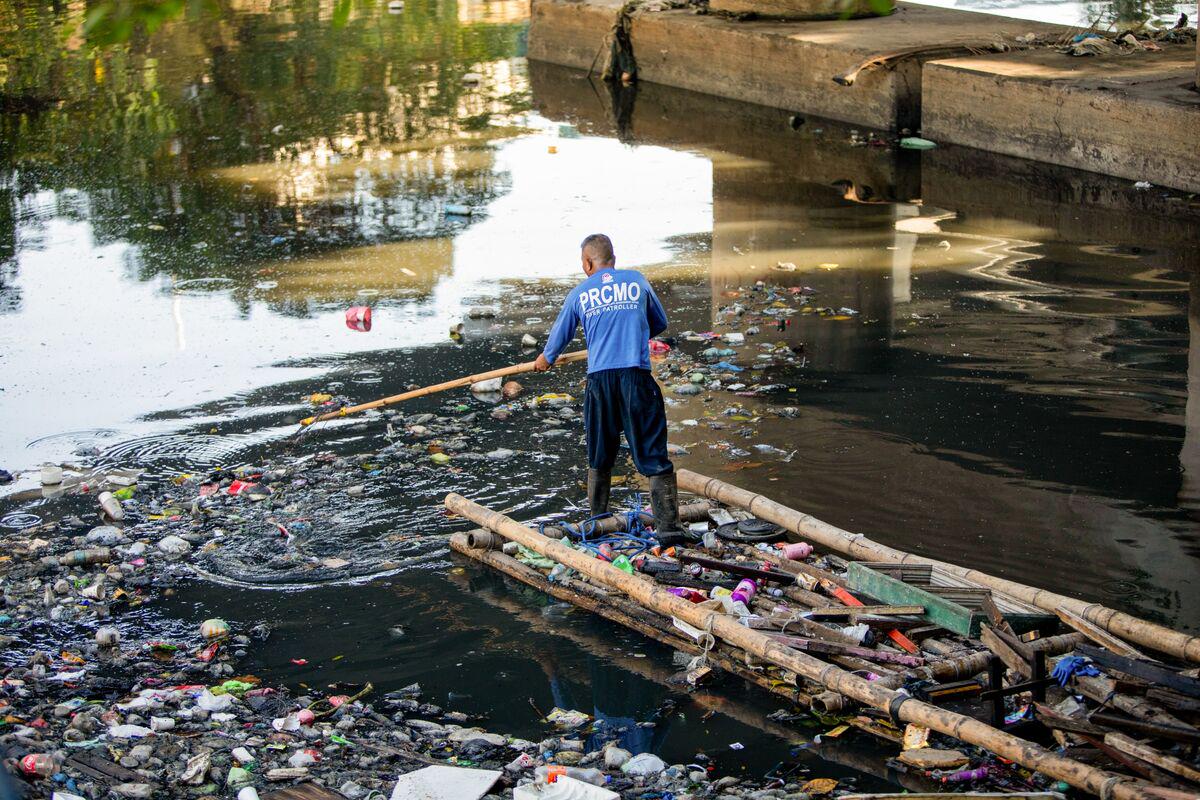
At a trash-choked, putrid creek in the heart of the Philippine capital, 63-year-old Xerxes Luna is helping fight the world’s battle against marine plastic pollution.
With eight co-workers, Luna spends entire days hauling hundreds of sacks of plastic bottles, detergent sachets and styrofoam containers from a tributary of the Pasig River, Manila’s main waterway. They use boats, bamboo rafts and trash traps to prevent garbage from being flushed into Manila Bay and into the sea.
“We are the policemen of river pollution,” Luna said. “We catch the trash here so they won’t end up in bigger bodies of water.”
While other nations have undertaken similar moves to rehabilitate major waterways like the Seine and the Han, the Philippines’ effort is of particular importance: the 26-kilometer (16-mile) Pasig River has been identified as a top emitter of plastic waste. A 2021 study showed that it is estimated to have contributed 6% of plastics from rivers leaking into oceans, more than rivers like India’s Ganges despite being shorter.
The Pasig River was once a pristine food source and transport route, but as Metro Manila grew into a megacity of 14 million, it deteriorated into a dumping ground, with thousands of families now living in makeshift houses along the river. Data from global consultancy company Arup — which partnered with the Asian Development Bank to build a digital model of the Pasig River to identify pollution hotspots — showed that plastic bottles, foam containers and film wrappers made up most of the plastic waste floating on one of its tributaries during last year’s rainy months.

1 Comment
*Past leaders have tried and failed to rehabilitate the Pasig River, but President Ferdinand Marcos Jr. is taking on the task with renewed enthusiasm.*
*Andreo Calonzo for Bloomberg News*
At a trash-choked, putrid creek in the heart of the Philippine capital, 63-year-old Xerxes Luna is helping fight the world’s battle against marine plastic pollution.
With eight co-workers, Luna spends entire days hauling hundreds of sacks of plastic bottles, detergent sachets and styrofoam containers from a tributary of the Pasig River, Manila’s main waterway. They use boats, bamboo rafts and trash traps to prevent garbage from being flushed into Manila Bay and into the sea.
“We are the policemen of river pollution,” Luna said. “We catch the trash here so they won’t end up in bigger bodies of water.”
While other nations have undertaken similar moves to rehabilitate major waterways like the Seine and the Han, the Philippines’ effort is of particular importance: the 26-kilometer (16-mile) Pasig River has been identified as a top emitter of plastic waste. A 2021 study showed that it is estimated to have contributed 6% of plastics from rivers leaking into oceans, more than rivers like India’s Ganges despite being shorter.
The Pasig River was once a pristine food source and transport route, but as Metro Manila grew into a megacity of 14 million, it deteriorated into a dumping ground, with thousands of families now living in makeshift houses along the river. Data from global consultancy company Arup — which partnered with the Asian Development Bank to build a digital model of the Pasig River to identify pollution hotspots — showed that plastic bottles, foam containers and film wrappers made up most of the plastic waste floating on one of its tributaries during last year’s rainy months.
[Read the full story here.](https://www.bloomberg.com/news/features/2026-03-12/manila-s-pasig-river-clean-up-is-crucial-front-in-fight-against-marine-plastics?accessToken=eyJhbGciOiJIUzI1NiIsInR5cCI6IkpXVCJ9.eyJzb3VyY2UiOiJTdWJzY3JpYmVyR2lmdGVkQXJ0aWNsZSIsImlhdCI6MTc3MzU3MDEwMSwiZXhwIjoxNzc0MTc0OTAxLCJhcnRpY2xlSWQiOiJUQlQzUzJLR0lGV1owMCIsImJjb25uZWN0SWQiOiJEMzU0MUJFQjhBQUY0QkUwQkFBOUQzNkI3QjlCRjI4OCJ9.qLYjda9_7arXfwNpPTNt2PucRhy0tRtRPTIEaNtrJsA)