
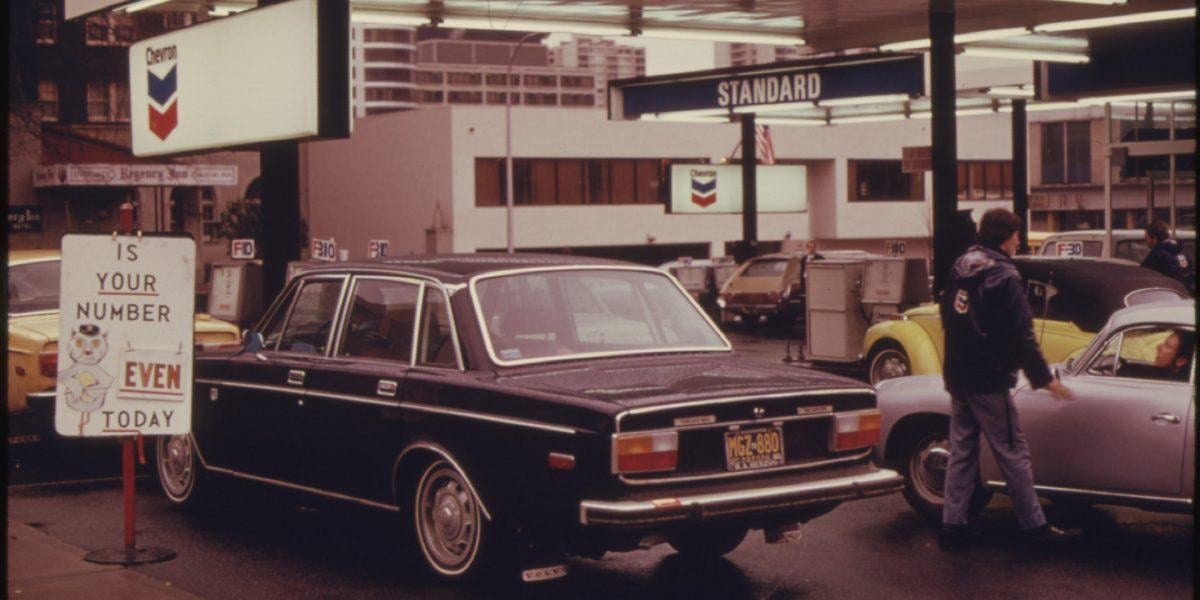
Picture this: you’re running out of the house to go see Blazing Saddles at the drive-in with friends. You hop in your car, turn on the ignition, flick on the radio and Elton John’s rhythmic vocals flow through the air as “Bennie and the Jets” starts playing. It’s the perfect kind of night, save for one issue: your car is a little low on gas, and it means you’re going to wake up at 4 am just to wait on a gas line for hours to fuel up, if you’re lucky.
For most of us, a gas crisis is an abstraction. We know prices go up. We complain. We maybe drive less. What we don’t know—perhaps because some of us never lived it—is the other kind of gas crisis, where the price doesn’t matter because there’s nothing to buy. The kind where your license plate number determined what days you were allowed to leave home. The kind where a green, yellow, or red flag hanging outside a gas station was the most important piece of information in your day. That America actually existed, and it may be closer than we think.
Gas prices in the U.S. have jumped nearly 11% since this time last year. The conflict with Iran has pinched the Strait of Hormuz—the narrow waterway through which about 20% of the world’s oil and liquefied natural gas travels every day—while Qatar, which produces 20% of global LNG, has halted production entirely. For most Americans, the immediate instinct is to watch the number on the pump climb and feel vaguely powerless. But for people over 65, the current moment carries a different kind of dread.
Read more: https://fortune.com/2026/03/15/so-what-happens-during-a-gas-crisis-anyway/
Source: fortune
5 Comments
Locking gas caps come back in style!
Switching to odd/even immediately ended lines at gas stations.
Except its not the 1970’s anymore and we have easily scalable renewables and electric vehicles, not as many as we should, but enough.
Uber a tesla
I hope they remember to exclude EVs from the number plate lottery.