
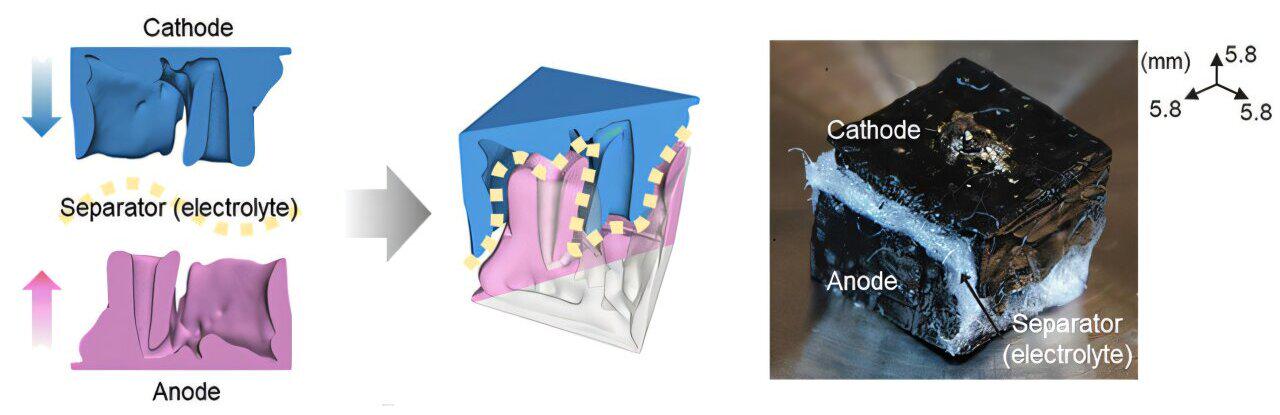
Good electrochemical energy storage (EES) devices such as rechargeable batteries and supercapacitors can store a lot of energy and release it quickly, but these design goals are often at odds with each other. Using design optimization and 3D printing, a team led by engineers and scientists at Lawrence Livermore National Laboratory (LLNL) has overcome this tradeoff and demonstrated a 3D-printed electrode design for EES that maximizes storage capacity under practical conditions.
The 5.8-millimeter, ultra-thick device, made with two interlocking electrodes that maximize active material and facilitate ion and electron transport, outperformed conventional designs and showed the potential of optimization for advancing next-generation energy storage. Their results were published in a recent paper in Materials Horizons.
Publication details
Zhen Wang et al, Ultra-thick three-dimensional interpenetrating graphene electrode architectures for high volumetric density energy storage, Materials Horizons (2026). DOI: 10.1039/d5mh01991e
Source: Choobeen