# New Research Shows Battery Electric Vehicles Have Lowest Carbon Footprints Across Climate Scenarios
## Key Findings
A comprehensive new study published in *Communications Earth & Environment* provides the most thorough analysis to date of passenger vehicle carbon footprints under realistic future energy scenarios. The research analyzed over 5,000 vehicle configurations across multiple powertrains and found that **battery electric vehicles (BEVs) consistently show the lowest carbon footprints** compared to hybrid, plug-in hybrid, and fuel cell vehicles.
## What Makes This Study Different
Unlike previous lifecycle assessments that use static, present-day energy data, this research employed **prospective lifecycle assessment (pLCA)** – accounting for how electricity grids, fuel production, and hydrogen systems will actually evolve over a vehicle’s 10-20 year lifespan. The study modeled four climate scenarios ranging from 1.5°C to 3.0°C warming pathways.
## Main Results
**Carbon Footprint Advantages:**
– BEVs showed 32-47% lower carbon footprints than hybrid vehicles across different climate scenarios
– BEVs outperformed hybrids in 99% of the 5,000 analyzed cases
– Even in regions with currently high-carbon electricity (like China and Eastern Europe), BEVs retained advantages due to expected grid decarbonization
**Breaking Point Analysis:**
– BEVs need to be driven only 51,000-87,000 km to offset their higher manufacturing emissions
– This “breakeven mileage” decreases significantly when future electricity decarbonization is considered
– Under the most ambitious climate scenario, the breakeven drops to just 51,000 km
## Why BEVs Come Out Ahead
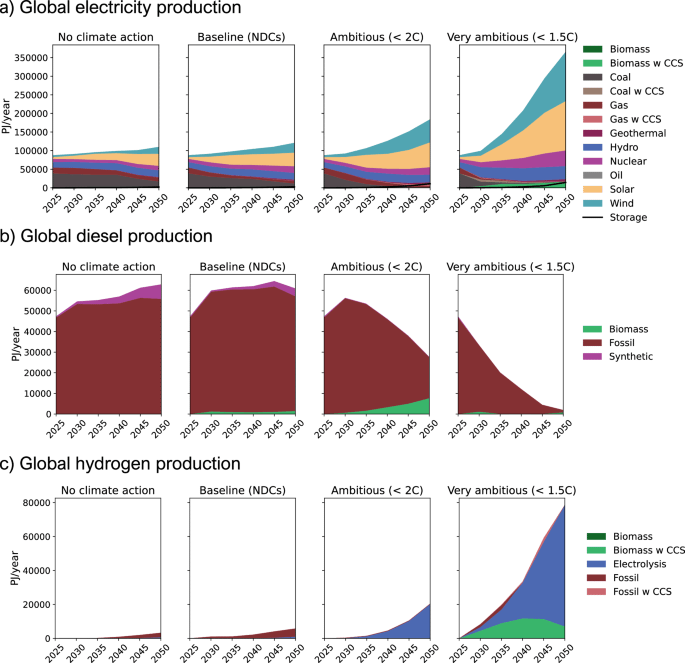
The study reveals that **electricity grids are decarbonizing much faster** than liquid fuel or hydrogen production systems. While all energy sources become cleaner over time, the pace and scale of electricity decarbonization gives BEVs the largest carbon footprint reductions during their operational lifetime.
**Energy System Decarbonization Rates:**
– Electricity: Rapid shift to solar, wind, and other renewables
– Diesel: Limited transition to biodiesel and synthetic alternatives
– Hydrogen: Slower transition from fossil-based to electrolysis and bio-based production
## Regional and Scenario Variations
The research found BEV advantages held across 16 global regions and all climate scenarios, with some notable exceptions:
– **Fuel Cell Vehicles:** Only outperformed BEVs in the most ambitious 1.5°C scenario, due to projected carbon-negative hydrogen from bioenergy with carbon capture (BECCS)
– **High-Carbon Regions:** Even in areas with coal-heavy electricity, BEVs maintained advantages due to anticipated rapid decarbonization
– **Plug-in Hybrids:** Performed as an intermediate option but were sensitive to driver behavior and electric mode utilization
## Implications for Climate Policy
The study supports BEVs as **”the most reliable climate mitigation option for passenger cars”** while highlighting important caveats:
**For Maximizing Climate Benefits:**
– Continued aggressive electricity grid decarbonization is essential
– Smaller vehicle sizes and improved manufacturing efficiency remain important
– Strategic BEV adoption should prioritize high-mileage use cases
**Manufacturing Considerations:**
– BEVs have higher production emissions due to battery manufacturing
– Benefits only realize during the use phase, emphasizing the importance of actual vehicle utilization
– Battery recycling and sustainable materials sourcing need continued improvement
## Methodology Strengths
This research addresses key limitations of previous studies by:
– Using multiple integrated assessment models (not just electricity scenarios)
– Covering broader energy system transitions beyond just electricity
– Applying rigorous time-adjusted analysis over vehicle lifespans
– Including Monte Carlo analysis of 5,000+ vehicle configurations
– Covering four different climate pathways
## Bottom Line
While acknowledging that different vehicle types may be optimal in specific circumstances, this comprehensive analysis provides strong scientific evidence that battery electric vehicles offer the most reliable path for decarbonizing personal transportation across a wide range of realistic future scenarios. The research suggests that continued support for BEV adoption and electricity grid decarbonization represents sound climate policy.

1 Comment
# New Research Shows Battery Electric Vehicles Have Lowest Carbon Footprints Across Climate Scenarios
## Key Findings
A comprehensive new study published in *Communications Earth & Environment* provides the most thorough analysis to date of passenger vehicle carbon footprints under realistic future energy scenarios. The research analyzed over 5,000 vehicle configurations across multiple powertrains and found that **battery electric vehicles (BEVs) consistently show the lowest carbon footprints** compared to hybrid, plug-in hybrid, and fuel cell vehicles.
## What Makes This Study Different
Unlike previous lifecycle assessments that use static, present-day energy data, this research employed **prospective lifecycle assessment (pLCA)** – accounting for how electricity grids, fuel production, and hydrogen systems will actually evolve over a vehicle’s 10-20 year lifespan. The study modeled four climate scenarios ranging from 1.5°C to 3.0°C warming pathways.
## Main Results
**Carbon Footprint Advantages:**
– BEVs showed 32-47% lower carbon footprints than hybrid vehicles across different climate scenarios
– BEVs outperformed hybrids in 99% of the 5,000 analyzed cases
– Even in regions with currently high-carbon electricity (like China and Eastern Europe), BEVs retained advantages due to expected grid decarbonization
**Breaking Point Analysis:**
– BEVs need to be driven only 51,000-87,000 km to offset their higher manufacturing emissions
– This “breakeven mileage” decreases significantly when future electricity decarbonization is considered
– Under the most ambitious climate scenario, the breakeven drops to just 51,000 km
## Why BEVs Come Out Ahead
The study reveals that **electricity grids are decarbonizing much faster** than liquid fuel or hydrogen production systems. While all energy sources become cleaner over time, the pace and scale of electricity decarbonization gives BEVs the largest carbon footprint reductions during their operational lifetime.
**Energy System Decarbonization Rates:**
– Electricity: Rapid shift to solar, wind, and other renewables
– Diesel: Limited transition to biodiesel and synthetic alternatives
– Hydrogen: Slower transition from fossil-based to electrolysis and bio-based production
## Regional and Scenario Variations
The research found BEV advantages held across 16 global regions and all climate scenarios, with some notable exceptions:
– **Fuel Cell Vehicles:** Only outperformed BEVs in the most ambitious 1.5°C scenario, due to projected carbon-negative hydrogen from bioenergy with carbon capture (BECCS)
– **High-Carbon Regions:** Even in areas with coal-heavy electricity, BEVs maintained advantages due to anticipated rapid decarbonization
– **Plug-in Hybrids:** Performed as an intermediate option but were sensitive to driver behavior and electric mode utilization
## Implications for Climate Policy
The study supports BEVs as **”the most reliable climate mitigation option for passenger cars”** while highlighting important caveats:
**For Maximizing Climate Benefits:**
– Continued aggressive electricity grid decarbonization is essential
– Smaller vehicle sizes and improved manufacturing efficiency remain important
– Strategic BEV adoption should prioritize high-mileage use cases
**Manufacturing Considerations:**
– BEVs have higher production emissions due to battery manufacturing
– Benefits only realize during the use phase, emphasizing the importance of actual vehicle utilization
– Battery recycling and sustainable materials sourcing need continued improvement
## Methodology Strengths
This research addresses key limitations of previous studies by:
– Using multiple integrated assessment models (not just electricity scenarios)
– Covering broader energy system transitions beyond just electricity
– Applying rigorous time-adjusted analysis over vehicle lifespans
– Including Monte Carlo analysis of 5,000+ vehicle configurations
– Covering four different climate pathways
## Bottom Line
While acknowledging that different vehicle types may be optimal in specific circumstances, this comprehensive analysis provides strong scientific evidence that battery electric vehicles offer the most reliable path for decarbonizing personal transportation across a wide range of realistic future scenarios. The research suggests that continued support for BEV adoption and electricity grid decarbonization represents sound climate policy.