
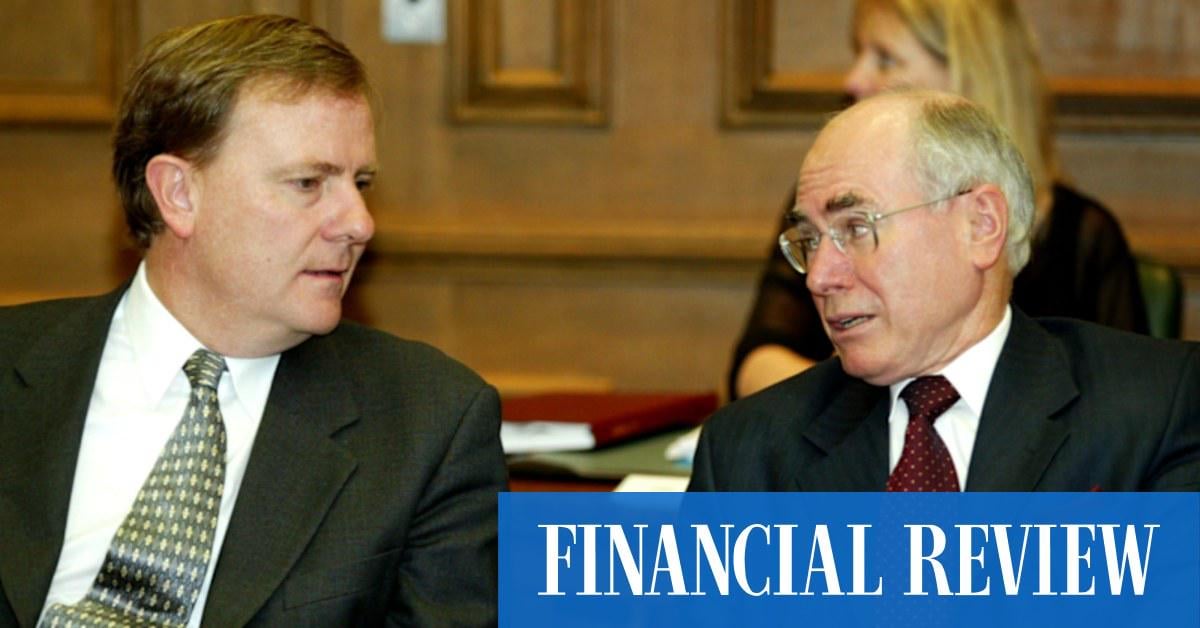
A quarter of a century after implementing Australia’s last major tax overhaul, the GST, John Howard and Peter Costello argue that Labor must convince voters that tax reform is good for the country by offering lower income taxes, compensating losers and tightening runaway government spending.
Their comments to mark the goods and services tax’s 25th anniversary on July 1 come in the same week Labor Treasurer Jim Chalmers pledged to lead an overhaul of the tax system to boost stagnating productivity and plug an unsustainable budget.
Chalmers outlined ambitions for lower income taxes, but suggested the overall tax level was likely to rise to fund spending pressures from the $50 billion National Disability Insurance Scheme, defence and interest on almost $1 trillion of debt.
The treasurer all but ruled out increasing the 10 per cent GST that Howard as Liberal prime minister and Costello as treasurer prosecuted and introduced in the face of staunch Labor opposition.
Howard first backed a broad consumption tax as treasurer in the Fraser government in the 1970s, but famously said months before the 1996 election he would “never ever” introduce a GST.
He later changed his mind and won a mandate at the 1998 election to implement the GST in return for cutting income tax and eliminating other taxes.
“People bought the argument we needed tax reform,” Howard told AFR Weekend.
“Did they like a GST? No. But we were able to persuade the public that it was good for the country.
“You also have to win the fairness argument by making sure you cover the potentially vulnerable people as there are always some potential losers in a big reform.
“Peter Costello did a very good job in talking to the welfare groups and business community about having a package of remedial measures to look after the potential casualties of tax reform.”
Former prime minister John Howard in his Sydney office. Wolter Peeters
Tax experts have called on successive Australian governments to consider increasing or broadening the 10 per cent GST on consumption.
The GST does less economic harm than income tax and corporate tax which reduce incentives to work and invest, according to economists.
Costello said he was astonished the 10 per cent rate had not been increased in 25 years, but argued that was a “great success” because reform should be about cutting taxes, not increasing taxes – in a direct challenge to Chalmers.
“Real tax reform enhances work incentives and boosts productivity,” Costello said.
“Tax reform should involve reducing the tax burden and raising our taxes in a more efficient way. It should aim to simplify the tax system.”
Costello contrasted the carefully designed GST to Labor’s proposed new tax on earnings from superannuation balances above $3 million.
“Tax reform is not this new superannuation tax,” Costello said.
“That’s a monstrous complexity, which is just important for a bit of envy politics.”
Former federal treasurer Peter Costello in his Melbourne office on Wednesday. Eamon Gallagher
Costello, the country’s longest serving treasurer from 1996 to 2007, said Australia did not have a tax revenue shortfall, but rather had a government spending problem.
Treasury forecasts federal spending as a share of the economy to hit 27 per cent in 2025-26, the highest level outside of the pandemic stimulus since 1986.
“Australia doesn’t have a taxing problem, it has a spending problem,” Costello said.
“If we could control our spending, our tax system would work very, very nicely.
“So all the people who are saying now, oh, we need to increase these tax rates or introduce these new taxes, they just want to do it to increase tax.”
Federal tax revenue today as a share of the economy is currently about 23.5 per cent of GDP, around the average level of the Howard government.
The GST was part of a major tax package known as A New Tax System (ANTS).
The introduction of the 10 per cent GST on most goods and services was accompanied by income tax cuts, welfare payment increases and abolishing the inconsistent federal wholesale sales tax applied at rates of 12 per cent, 22 per cent and 32 per cent.
All the GST revenue – today worth more than $90 billion – went to the states in return for abolishing a range of inefficient state taxes including financial institutions duty, debits tax, bed taxes, and stamp duties on shares, leases, mortgages and cheques.
Fresh food, health and education were exempted from the GST, following a Senate deal with the Democrats to water it down.
Howard said if the Albanese government was serious about tax reform, it should initiate a proper conversation with the Coalition opposition.
“There is certainly an argument for further reform to our tax system, that is self-evident,” Howard said.
“There is a lot of continuing unhappiness with our tax system and there is mileage for both sides of politics in seriously engaging in tax reform and any major political party has to do that.
Howard backed the idea of reducing income taxes to limit bracket creep.
“I think the idea of having indexation of the tax scales as part of a tax package is very good,” Howard said.
The Financial Review revealed the day after the May 3 election that during the campaign Liberal campaign headquarters pressed then opposition leader Peter Dutton to announce a policy to index the income tax thresholds by 2.5 per cent a year.
Dutton went cold on the idea at the 11th hour and withdrew it from his draft campaign speech, instead later flagging indexation as an “aspiration” without fully committing.
Howard said for the Liberal Party, tax reform was an opportunity to promote its credentials against teal independent candidates who would never control the Treasury benches.
“It’s one of the contrasts that can be made in teal seats because nobody can take seriously an individual arguing for tax reform by a single member.”
Howard declined to comment on potential future changes to the GST.
“The government seems institutionally or spiritually incapable of that and they are very hidebound in their views on indirect taxation [GST].”
Robert Breunig, director of the Tax and Transfer Policy Institute at the Australian National University, said it was disappointing that Chalmers had reiterated his past opposition to changes to the GST and appeared to all but rule out increasing the GST ahead of a productivity roundtable in August.
“It’s not tax reform if you rule things off the table like the GST before you even begin,” Breunig said. “Didn’t we already learn that lesson?”
Source: Leland-Gaunt-
3 Comments
Who’s on the phone? Howard and Costello? Why have we not hung up the phone yet?
Costello is right that we have a spending problem, the problem is that spending can’t be touched and people like him mobilise at any thought of super/negative gearing/franking credits/CGT.
The aim from them is clear, cut taxes, give concessions to the wealthy, cut spending and in turn cut services. They want a complete user pays system with handouts for their mates.
Uhh……. these two were instrumental in achieving nothing other than delivering us “the lost decade”