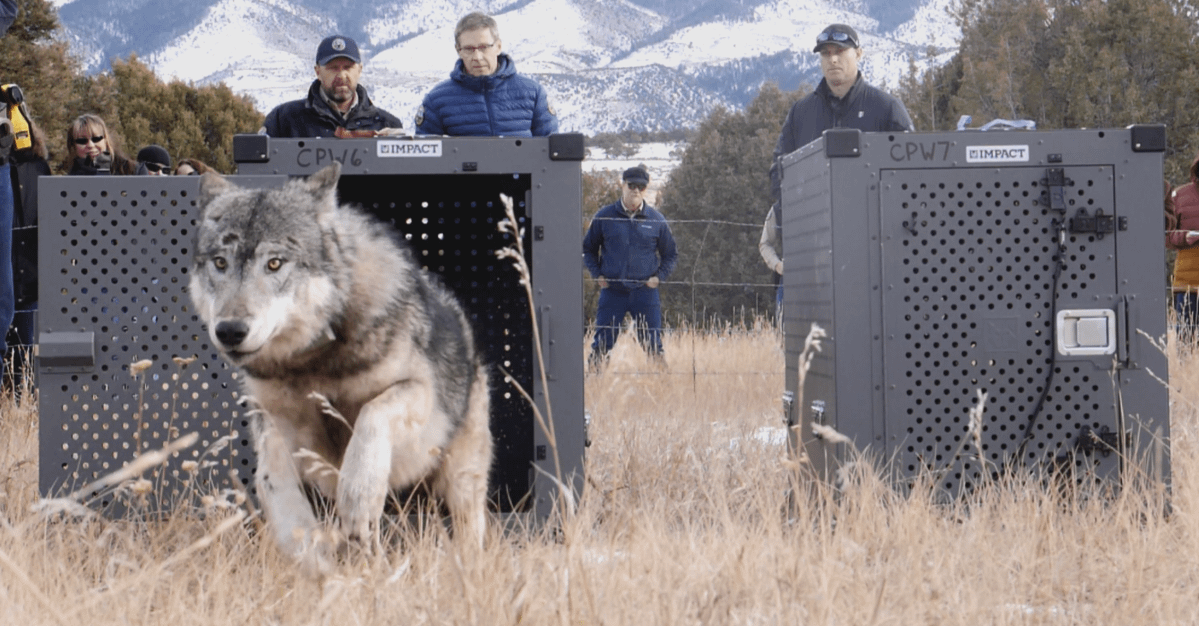
On a sunny morning two years ago, a group of state officials stood in the mountains of northwestern Colorado in front of a handful of large metal crates. With a small crowd watching them, the officials began to unlatch the crate doors one by one. Out of each came a gray wolf — arguably the nation’s most controversial endangered species.
This was a massive moment for conservation.
While gray wolves once ranged throughout much of the Lower 48, a government-backed extermination campaign wiped most of them out in the 19th and 20th centuries. By the 1940s, Colorado had lost all of its resident wolves.
But, in the fall of 2020, Colorado voters did something unprecedented: They passed a ballot measure to reintroduce gray wolves to the state. This wasn’t just about having wolves on the landscape to admire, but about restoring the ecosystems that we’ve broken and the biodiversity we’ve lost. As apex predators, wolves help keep an entire ecosystem in balance, in part by limiting populations of deer and elk that can damage vegetation, spread disease, and [cause car accidents](https://www.pnas.org/doi/pdf/10.1073/pnas.2023251118?%5C).
In the winter of 2023, state officials released 10 gray wolves flown in from Oregon onto public land in northwestern Colorado. And in January of this year, they introduced another 15 that were brought in from Canada. Colorado Parks and Wildlife (CPW) — the state wildlife agency leading the reintroduction program — [plans to](https://cpw.widencollective.com/assets/share/asset/wixcpz0wez) release 30 to 50 wolves over three to five years to establish a permanent breeding population that can eventually survive without intervention.
The takeaway is not that releasing wolves in Colorado was, or is now, a bad idea. Rather, the challenges facing this first-of-its-kind reintroduction just show how extraordinarily difficult it is to restore top predators to a landscape dominated by humans. That’s true in the Western US and everywhere — especially when the animal in question has been vilified for generations.

1 Comment
On a sunny morning two years ago, a group of state officials stood in the mountains of northwestern Colorado in front of a handful of large metal crates. With a small crowd watching them, the officials began to unlatch the crate doors one by one. Out of each came a gray wolf — arguably the nation’s most controversial endangered species.
This was a massive moment for conservation.
While gray wolves once ranged throughout much of the Lower 48, a government-backed extermination campaign wiped most of them out in the 19th and 20th centuries. By the 1940s, Colorado had lost all of its resident wolves.
But, in the fall of 2020, Colorado voters did something unprecedented: They passed a ballot measure to reintroduce gray wolves to the state. This wasn’t just about having wolves on the landscape to admire, but about restoring the ecosystems that we’ve broken and the biodiversity we’ve lost. As apex predators, wolves help keep an entire ecosystem in balance, in part by limiting populations of deer and elk that can damage vegetation, spread disease, and [cause car accidents](https://www.pnas.org/doi/pdf/10.1073/pnas.2023251118?%5C).
In the winter of 2023, state officials released 10 gray wolves flown in from Oregon onto public land in northwestern Colorado. And in January of this year, they introduced another 15 that were brought in from Canada. Colorado Parks and Wildlife (CPW) — the state wildlife agency leading the reintroduction program — [plans to](https://cpw.widencollective.com/assets/share/asset/wixcpz0wez) release 30 to 50 wolves over three to five years to establish a permanent breeding population that can eventually survive without intervention.
“Today, history was made in Colorado,” Colorado Governor Jared Polis [said](https://coloradooutdoorsmag.com/2023/12/19/wolf-update-cpw-successfully-releases-gray-wolves/amp/) following the release. “For the first time since the 1940s, the howl of wolves will officially return to western Colorado.”
Fast forward to today, and that program seems, at least on the surface, like a mess.
Ten of the transplanted wolves are already dead, as is one of their offspring. And now, the state is [struggling to find new wolves](https://coloradosun.com/2025/11/18/washington-wolf-reintroduction-colorado/) to ship to Colorado for the next phase of reintroduction. Meanwhile, the program [has cost millions of dollars more than expected](https://www.cbsnews.com/amp/colorado/news/colorados-gray-wolf-reintroduction-plan-costs-agency/).
The takeaway is not that releasing wolves in Colorado was, or is now, a bad idea. Rather, the challenges facing this first-of-its-kind reintroduction just show how extraordinarily difficult it is to restore top predators to a landscape dominated by humans. That’s true in the Western US and everywhere — especially when the animal in question has been vilified for generations.
Read more: [https://www.vox.com/climate/470075/colorado-wolf-release-program-stumbles](https://www.vox.com/climate/470075/colorado-wolf-release-program-stumbles)