
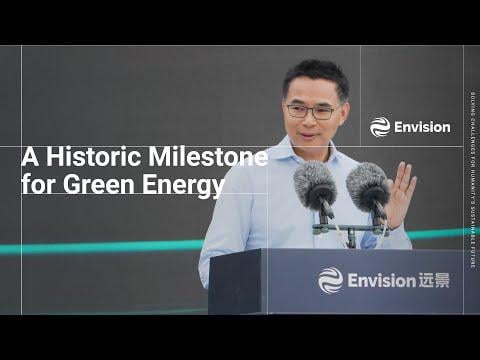
Envision Energy Launches the World’s Largest Green Hydrogen-Ammonia Project to Generate the New “Green Oil”
Source: Economy-Fee5830
Envision Energy Launches the World’s Largest Green Hydrogen-Ammonia Project to Generate the New “Green Oil”
Source: Economy-Fee5830
1 Comment
**Envision Energy Commissions the World’s Largest Green Hydrogen-Ammonia Project to Generate the New “Green Oil”**
*September 2025*
In Inner Mongolia’s Gobi Desert, a transformation is underway that its creators compare to the historic Daqing Oilfield—the discovery that powered China’s industrialisation in the 20th century. But this time, the fuel isn’t fossil. At the Chifeng Net Zero Hydrogen Industrial Park, Envision Energy has commissioned what is now the world’s largest operational green hydrogen and ammonia facility, producing 320,000 tonnes of renewable ammonia annually from wind, solar, and water.
> “Welcome to witness a historic moment in the evolution of human energy,” declared Lei Zhang, Envision’s founder and CEO, at the facility’s launch. “The Envision Chifeng Net Zero Hydrogen-Ammonia Plant—the world’s largest green hydrogen and ammonia project, and also the most cost-competitive project—is about to launch an era of ‘New Oil.'”
—
**The Economics of Green Storage**
Zhang’s “New Oil” framing isn’t mere marketing. It addresses a fundamental challenge in the energy transition: while renewable electricity has achieved cost parity with fossil fuels, electricity and chemical fuels serve fundamentally different purposes. Batteries excel at short-term storage and grid balancing. But for long-duration storage, seasonal reserves, and transportable energy, liquid fuels remain unmatched.
The numbers Zhang presented at the launch are striking. A single ammonia storage tank at the Chifeng facility, costing 150 million RMB (approximately £16 million) to construct, can store energy equivalent to 100 million kilowatt-hours. Achieving the same storage capacity with batteries would cost around 60 billion RMB—400 times more expensive.
> “Oil remains the lowest-cost solution for long-term energy storage. If we fill this tank with green ammonia, it holds the energy equivalent of 100 million kilowatt-hours.”
This cost advantage explains why ammonia—a molecule that can be synthesised from renewable hydrogen and atmospheric nitrogen, stored as a liquid at modest pressure, and used as fuel, fertiliser feedstock, or hydrogen carrier—has emerged as a leading candidate for decarbonising hard-to-electrify sectors.
—
**From Demonstration to Industrial Scale**
What distinguishes Chifeng from the constellation of green hydrogen announcements that have proliferated globally is its operational status and scale. Construction began in April 2023; first ammonia was produced in March 2024; the facility achieved its current 320,000 tonnes annual capacity by July 2025. First exports are planned for Q4 2025, with Japanese trading house Marubeni already signed as an offtake partner.
The facility operates entirely off-grid, powered by dedicated wind turbines and solar arrays connected through grid-forming battery storage and AI-optimised control systems. This configuration eliminates the accounting complexities and greenwashing concerns that plague projects relying on grid electricity with renewable energy certificates.
In May 2025, Bureau Veritas awarded the Chifeng plant its Renewable Ammonia Certification—the first such certification issued globally. The facility has also received ISCC PLUS certification for green liquid ammonia, the first project worldwide to achieve this designation, along with RFNBO (Renewable Fuels of Non-Biological Origin) compliance verification for EU market access.
—
**The European Contrast**
The scale differential with European efforts is sobering. Yara, the Norwegian fertiliser giant, operates what it calls “Europe’s largest” green hydrogen plant at Herøya, Norway—a 24 MW electrolyser inaugurated with considerable fanfare by Prime Minister Jonas Gahr Støre in June 2024. Design capacity: 20,500 tonnes of renewable ammonia annually. As of Yara’s March 2025 Integrated Report, the plant was “still in commissioning.”
Chifeng produces roughly 16 times more green ammonia than Herøya’s design capacity. More significantly, Chifeng is actually operating and certified, while Yara reports only “first tonnes delivered” to showcase customers, with no production volumes disclosed.
The cost differential compounds the scale gap. Chinese electrolyser costs run approximately $600 per kilowatt versus $2,500 in Europe—a fourfold advantage. Combined with lower renewable energy costs in Inner Mongolia and domestic supply chains for all major components, Envision projects reaching cost parity with fossil-derived grey ammonia by 2028.
—
**Demand Across Continents**
Zhang outlined the breadth of customer interest:
> “We’re seeing strong demand from customers across Japan, Singapore, the UAE, and France spanning shipping, aviation, steelmaking, green electricity, and green ammonia combustion technologies.”
The shipping sector represents the most immediate market. The International Maritime Organization’s decarbonisation targets have prompted major shipping lines to order ammonia-capable vessels, with the fuel offering zero carbon emissions at point of use and existing infrastructure for global transport. Japanese utilities are exploring ammonia co-firing in coal power plants as a transitional decarbonisation pathway. And the fertiliser industry—responsible for feeding roughly half the world’s population—faces mounting pressure to decarbonise its supply chain.
Envision’s ambitions extend well beyond the current facility. Phase expansions at Chifeng target 1.5 million tonnes annually by 2028 and ultimately 5 million tonnes. A hydrogen pipeline network is under development across Inner Mongolia, with a main line connecting Ordos City and Chifeng spanning at least 800 kilometres.
—
**The Geopolitical Dimension**
Zhang’s closing remarks at the Chifeng launch carried unmistakable geopolitical weight:
> “From the Gobi, to the Middle East, to the Sahara, to Australia’s outback, we will turn the world’s deserts into the oilfields of the green era. And we will lead the world into a new era of prosperity powered by China’s clean energy.”
The statement reflects a broader pattern. China controls approximately 70% of global planned electrolyser manufacturing capacity. Its renewable equipment manufacturers—including Envision itself, which produces wind turbines and battery systems—have achieved cost structures that Western competitors struggle to match. A November 2025 analysis by Hydrogen Insight concluded that green hydrogen imported from China would already be cheaper in Europe than locally-produced renewable hydrogen.
Whether this represents opportunity or threat depends on perspective. For decarbonisation efforts globally, cost-competitive green ammonia from any source accelerates the transition. For European and American industrial policy, it represents another sector where early climate technology leadership has migrated to China.
—
**From Daqing to Chifeng**
Zhang’s Daqing comparison merits scrutiny. The Heilongjiang oilfield, discovered in 1959, provided over half China’s petroleum for decades and enabled the country’s industrial ascent. Whether Chifeng achieves comparable historical significance depends on factors beyond Envision’s control—global carbon pricing, competing technologies, and geopolitical responses to Chinese clean energy dominance.
But the operational reality is already notable. At a moment when much of the global hydrogen economy remains trapped in feasibility studies, pilot projects, and announcements of announcements, Envision has built the world’s largest green ammonia plant, achieved international certification, secured export contracts, and begun scaling toward millions of tonnes of annual capacity.
> “This is more than a technological milestone,” Zhang said. “Scalable, green alternatives are now real and operational. We can’t get to net zero without green hydrogen, and we can’t afford to wait.”
In the Gobi Desert, at least, the waiting appears to be over.
—
**Chifeng Net Zero Hydrogen Industrial Park: Key Facts**
* **Location:** Chifeng City, Inner Mongolia, China
* **Current capacity:** 320,000 tonnes/year green ammonia
* **Planned expansion:** 1.5 million tonnes/year by 2028; 5 million tonnes/year ultimate capacity
* **Power source:** 100% off-grid renewable (wind + solar + battery storage)
* **Certifications:** Bureau Veritas Renewable Ammonia (world’s first), ISCC PLUS (world’s first for green ammonia), RFNBO-compliant
* **Offtake partner:** Marubeni Corporation (Japan)
* **First exports:** Planned Q4 2025
* **Cost parity target:** Grey ammonia price parity by 2028