
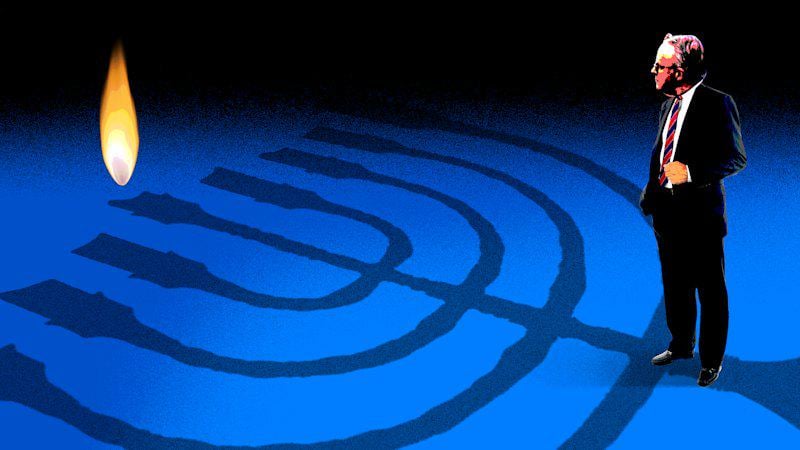
Anthony Albanese prides himself on being a long-range political thinker. He likes to game out the end point, to work backwards from where his opponents might land, and to quietly deny them an escape route. Few passages in recent political writing capture that instinct more cleanly than Niki Savva’s account in Earthquake: the election that shook Australia.
It is all part of Albanese’s strategy, she wrote, thinking ahead to “where are we going to end up, where are they going to go”.
“So how do we turn their roads into cul-de-sacs? That is what I say to people literally,” he told her later.
It is a line that once read as evidence of a disciplined, hard-headed political operator. Three weeks on from the Bondi terror attack, it reads instead like a warning. Because if there is a cul-de-sac in Australian politics right now, even his allies fear it is the one the prime minister has driven himself into – and he is still refusing to reverse.
After last May’s election, Albanese loomed as untouchable. His authority within Labor was unchallenged, the Coalition looked diminished, and his personal standing was buoyed by the sense that he had mastered the rhythms of office. Today, some within Labor say he’s visibly shrunk. His handling of the past three weeks – marked by silence, stubbornness and an unyielding refusal to call a royal commission – has left allies confused, critics enraged and a growing number of Australians uneasy.
This is not a manufactured controversy. Nor is it a noisy or narrow media cycle. Experienced political commentators from press gallery doyen Michelle Grattan to Robert Manne, emeritus professor of politics at La Trobe University, find Albanese’s response odd and confusing.
It is a moment that has begun to cut through to Labor MPs, ministers and staff, many of whom privately concede the prime minister is risking misjudging both the scale of the crisis and the public mood.
A handful would like to call for stronger action, including a royal commission. Most, however, are saying nothing at all.
Two NSW MPs, backbenchers Ed Husic and Mike Freelander, have dared to break ranks. The rest have their heads down. They know the prime minister has a long memory for those he perceives as disloyal. They know how power works inside the government. And they know that, for all the internal unease, Albanese has so far shown no inclination to bend.
“Everyone knows he and [Penny] Wong, would just never forgive you and be vindictive if you did,” says one Labor MP, insistent that they would not speak on the record. “Plus he is so stubborn it would not change anything.”
Some believe he is in shock, unable to do what they think plainly needs to be done.
“I think he’s probably distraught [at the animosity towards him] and not thinking straight,” said one former adviser, who would speak only on the condition of anonymity. “And he is genuinely so stubborn I think he is trying to just ride it out.”
From the moment that two Islamic State-inspired gunmen opened fire on Jewish men, women, children and families at Bondi, killing 15 people including a 10-year-old girl, Albanese’s instincts have been questioned. Not only by opponents, but by people who want him to succeed.
He did not attend a single funeral for the dead, even after having been warned that not attending could become a defining moment of his prime ministership. But convinced his presence might be disruptive, he did not even ask the parents of the youngest victim, Matilda, whether they wanted him there, because they had questioned his failure to act on antisemitism. He did visit families of victims privately in those first bleak days, but his critics say he chose absence in public over discomfort.
Some think it is a calculation that’s backfired. They point to former prime minister Scott Morrison travelling to fire-ravaged towns knowing he would be abused and ignored. Albanese avoided even that risk.
Perhaps, they now ponder, if he had shown up, the anger that greeted him at the Bondi memorial a week later would have been less raw. Perhaps not. But absence, in moments like this, rarely reads as respect. It reads as retreat.
At the centre of it sits Albanese’s refusal to call a royal commission into antisemitism and the circumstances surrounding the Bondi attack. What might once have been a tactical decision has now hardened into a symbol – will it become a festering sore for the government?
Albanese’s decision-making circle has been so tight-knit that few within Labor can say with any certainty why he is really opposed to holding a bigger, broader national inquiry. Some speculate that it is long-term thinking. Would it uncover uncomfortable instances of antisemitism within Labor? But, more importantly, would the findings come down in an election year?
“I’m not sure whether the whole royal commission thing hits with voters or not,” says one Labor insider, “more than [as] doubts on Albo being ‘weak’ and ‘wishy-washy’. [They] are probably coming back to front-of-mind for people.
“I assume they’ll have to backflip at some stage … they won’t get any clear air otherwise. But also he doesn’t have any agenda on anything else that’s big enough to enable him to plough through it.”
Inside Labor caucus, some MPs are now privately asking a question that should trouble any prime minister: how did we end the year after a terrorist attack fighting with the families of dead children over a royal commission?
The calls are not even fringe. Former intelligence chiefs, legal heavyweights, business leaders and community figures have all lined up.
One former staffer this week said they could imagine the prime minister poring over the list of business names vengefully.
Among the signatories is Nicholas Moore, the former Macquarie boss who authored the Albanese government’s South-East Asia business strategy and who is frequently name-checked by Albanese as a trusted adviser on economic engagement with the region. Moore’s inclusion is difficult to dismiss as the work of habitual critics or ideological opponents; he is, by any measure, part of Labor’s extended policy family.
The breadth of the support has also cut across institutional lines the government normally counts as friendly territory. Current Reserve Bank board members Alison Watkins and Elana Rubin have added their names, as has Ian Watt, the former secretary of the Department of the Prime Minister and Cabinet under Julia Gillard, later appointed to the National Disability Insurance Agency board by Bill Shorten in 2024.
Chris Bowen, Albanese’s energy minister, was sent out on Thursday morning to address the significance of some of those names.
“We recognise that many of the calls from outside politics for a royal commission come from a good place and are well-intentioned, but we have a different view,” he told ABC radio, adding that the government is implementing the Segal report (by envoy to combat antisemitism Jillian Segal), criminalising hate speech, defending the existing racial discrimination laws and outlawing doxing, which was focused on the Jewish community.
Bowen says a royal commission would “only be limbering up by April” and getting ready to think about starting its work.
“We’ll have received our first report from Dennis Richardson … So I think we’ve got the balance right here.”
But Jewish leaders have been explicit that the proposed alternatives do not go far enough. The Australian Catholic Bishops Conference agrees. In a rare political intervention on Wednesday, Timothy Costelloe, the Archbishop of Perth and president of the conference, said it was vital to confront antisemitism in Australia in “the dark corners of our society” – including its politics, business, academia, media and religious and cultural institutions.
“For that reason, alongside the Richardson review, some form of wider, national inquiry with sufficient authority and resourcing which can probe into the deeper issues which lie at the heart of antisemitism is needed,” he said.
Still, no signs the prime minister intends to shift.
Earlier this week, the government’s argument appeared to wobble. Albanese and Home Affairs Minister Tony Burke suggested a royal commission would “platform” antisemitism – an argument that landed poorly, not least because Jewish groups are among those demanding the inquiry.
He then hinted that concerns about a royal commission might even be coming from ASIO, as if it were the role of intelligence agencies to decide when democratic accountability mechanisms should be triggered.
At another press conference, he lectured the media about being careful not to make terrorists “look powerful” through imagery. The cumulative impression was of a prime minister who wanted to move on and manage rather than confront.
But even The Canberra Times, a masthead hardly known for reflexive hostility to Labor governments, delivered a blistering editorial, accusing Albanese and Burke of “world-class gaslighting” when they said a royal commission on antisemitism would “platform” antisemites and pro-Palestinian protesters by putting them on the stand to defend and justify their actions over the past two and a half years.
“Many Australians would love to see the professional rabble-rousers who have done so much to stir up ancient hatreds and undermine social cohesion summoned to undergo forensic questioning by special counsel under threat of tough penalties for perjury and contempt. Nowhere to run. Nowhere to hide,” its editorial read.
The editorial pointed to the long list of royal commissions – from child sexual abuse to robo-debt – that dragged institutional failure into the light, precisely because politics alone could not be trusted to do the job.
Yet politics does not move on outrage alone. Kos Samaras, director of research and political consultancy firm Redbridge, offers a colder assessment of the electoral consequences.
“A tragedy, yes. A vote converter, maybe, but not in the direction some conservatives are hoping for,” he says.
“The campaign against Albanese won’t shift the Labor vote in any meaningful way, and it won’t flip Australians who preference Labor ahead of the Liberals.”
In an era of “psychological sorting”, Samaras says, voters rarely cross tribal lines. Instead, damage manifests as disengagement, cynicism and softening enthusiasm – all corrosive in the long term, but not immediately visible in polling.
Peter Wertheim, co-head of the Executive Council of Australian Jewry and a figure in almost daily contact with the prime minister’s office, has made it clear the pressure will not dissipate.
He says the Richardson review’s terms of reference are “too narrowly focused” and that they fail to address the wider societal and political context.
“The matter there needs to be an honest examination of government policies and the conduct and policies of key institutions and figures in major sectors of our society. Their contribution to the unprecedented levels of antisemitism in this country over the last two years must be addressed,” he says.
“What might emerge could indeed be divisive and ugly, but the divisiveness and ugliness is already there. Confronting these demons will be cathartic. It’s our only hope of establishing a new national consensus and setting clear standards.”
Evan Thornley, a former Victorian Labor MP and co-founder of NASDAQ-listed LookSmart, social venture GoodStart and activist network GetUp! says the conversations that have stayed with him since the Bondi attack have not been with party insiders or the “chattering classes”, but with strangers in suburban shopping strips and regional towns.
Thornley says people have approached him unprompted, often because they saw him wearing a kippah. What struck him, he says, was “how wonderfully decent Australians are” and how many described the Bondi attack as “an attack on the idea of Australia”.
“They see this fundamentally as a safety issue,” Thornley says. “That’s what terrorism is – an attack on safety.”
On issues of safety, he says, voters are not looking for moderation or reassurance that the government will “do more”. “They want the government to do absolutely everything possible to keep us safe,” he says, and many he has spoken to do not feel that standard is being met.
For Thornley, that creates a trust, or “brand”, problem for the government. While “elites” argue over the merits of a royal commission, he says the broader public is asking a simpler question: is the government visibly getting in front of the threat? “If it doesn’t look like they are,” he warns, “it’s going to land very hard out here on the ground.”
As the new year begins, Albanese faces a stark choice. He can continue to hold the line, betting that time, party loyalty and electoral inertia will dull the edge of the criticism. Or he can accept that his refusal to concede any ground has boxed him in – politically and morally.
The prime minister once boasted about turning other people’s roads into cul-de-sacs. Right now, the road ahead of him looks blocked. And cul-de-sacs, as any driver knows, eventually force you to stop – or turn around.
Rob Harris SMH
Source: Usual_Rip_8726
9 Comments
While immigration, inflation and house prices again spiral out of control it seems the government is asleep at the wheel. We need a proactive leader.
So the Fairfax papers are running a campaign against the government. They are not giving reasonable evidence. Gun laws are a state issue, mental health state issue, risk assessments of events and security state issues, policing state issue. The only federal issue is the intelligence misses. A royal Comission would have to hold many closed door hearings due to the nature of intelligence both criminal and civil. It would take minimum one year.
He is the ultimate Teflon politician. Heck he even weathered “The Voice”. Nothing sticks to him. He knows that people have the memory of a goldfish. So he wants to move on from this as soon as possible. That way most will have forgotten before the election.
This strategy has done very well for Labor in the past and I don’t think it will impact them that much come election time.
Can we please stop pretending that Albanese is some tactful and masterful political operator. He’s not playing 4D chess, he’s playing checkers.
Pure media copium. They can’t find actual faults, so they just say… *rolls dice* “HE IS NARROW MINDED… burn him!”
Six months ago they were talking shit about him too, now they’re saying he was untouchable then?
I utterly detest the media in this country for making this as political and partisan as possible. Fuck sake. I’d rather an RC into them and leave the NSW Government to do their own commission of inquiry into Bondi.
Yeah, cause papers like this found a tragedy they can exploit their
Right wing media in this this country politicizing a tragedy to attack Labor. There’s no low, they won’t go to.