
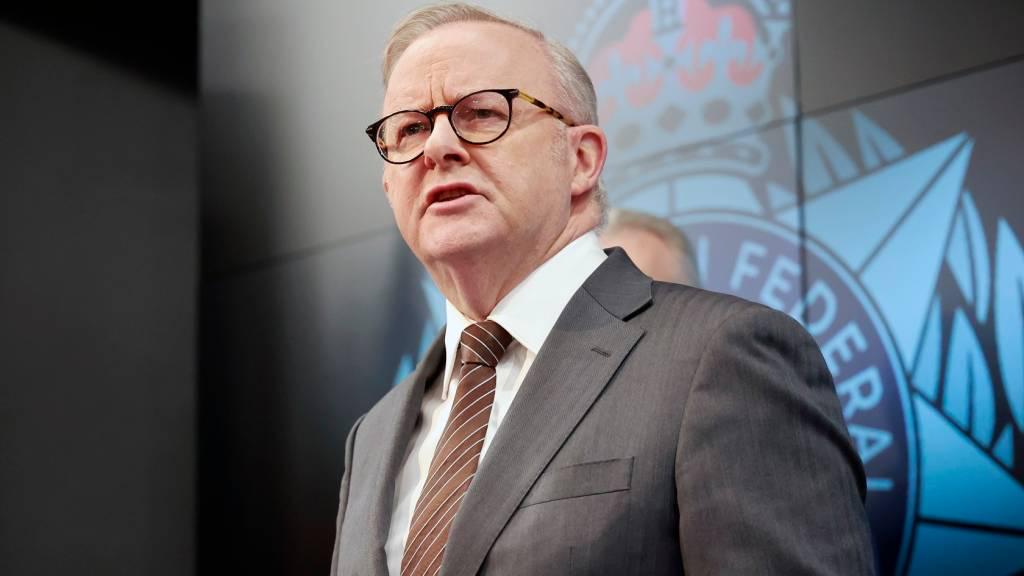
Presumably Anthony Albanese’s been waiting to hear what Wippa thinks, before he finally — inevitably — folds and calls the “Bondi” royal commission on which every man, his dog and their local café owner has expressed an opinion.
Although the campaign for a commission exists entirely within the mainstream media bubble, nobody of political consequence is saying don’t do it, so the prime minister will stick to his usual line: the one of least resistance.
Even the peak body of the legal profession, the Law Council of Australia, has finally read the tea leaves and added its weight to the call for a federal inquiry into “antisemitism in Australia and the events leading up to [the Bondi] attack”.
It’s fair enough that our most horrific terrorism incident should spark the pursuit of every imaginable line of enquiry into what just happened and the lessons begging to be learnt.
As to whether a royal commission is the appropriate vehicle for this questioning, apparently nobody particularly cares. While I have as much respect as the next person for Grant Hackett’s and Sam Newman’s legal opinions, I’m not sure we should be doing law by opinion poll.
Am I just being contrary, or is there a problem here? Well, yes there is, and there’s a clue in the depths of the Law Council’s turgid announcement:
The timing, conduct and terms of reference of any royal commission should be structured so as not to interfere with ongoing criminal proceedings.
While it’s barely ever mentioned at all, it is a fact that Bondi was, above anything else, a crime scene. Fifteen people were shot dead, dozens of others wounded, by two men wielding guns.
One of the alleged shooters is alive, in custody and facing multiple charges of murder and attempted murder.
So far as the law is concerned, crime always comes first. That is to say, the procedures and protections of the criminal justice process take precedence over every other part of the legal system. Until that process is completed, pretty much nothing else can happen.
For example, when an alleged wrong has potentially both criminal and civil law consequences — the wrongdoer can be prosecuted by the state and sued by the victims — what happens without exception is that the civil suits are “stayed” (suspended) until the criminal process is done, including all possible appeals.
This is an unremarkable incident of the justice system, rooted in the presumption of innocence and the system’s assurance that everyone gets a fair trial.
In the present case, the surviving alleged shooter has not appeared before a court yet, so he hasn’t had a chance to enter a plea. I don’t know what he’ll plead, nor does anyone else. It doesn’t matter how strong the prosecution case is or how much evidence is plastered all over the internet; he has the right to plead not guilty if he chooses and go to trial. The elements of the crime of murder and its defences involve more than just the physical mechanics of gun-bullet-death.
If a royal commission is established, and the criminal case remains live (which it could do for years), then quite simply it will be impossible for the commission’s terms of reference to go anywhere near two matters: the shootings themselves, and the motivations of the alleged shooter. That is: what happened, and why.
It would be equally impossible for the commission to traverse these questions in relation to the deceased shooter, despite his death precluding any criminal prosecution of him. The inter-relationship between the alleged shooters cannot be unpicked in a way that wouldn’t prejudice the living accused’s trial.
If the royal commission were to take any evidence that touched on these matters, it would be committing sub judice contempt of court. As I say, it simply can’t happen, and won’t.
This is why the Law Council has worded its suggested terms of reference in an oblique way, targeting antisemitism and “the events leading up”. No mention of the alleged shooters or the shootings.
But what could such a royal commission actually do? It could host an abstract exploration of the general subject of antisemitism and the much-trumpeted death of “social cohesion” since October 7, 2023, which is really what the Law Council is hinting at. It couldn’t do anything more specific.
That would be an extremely expensive exercise in futility. Without even needing to argue about the problem of prejudgment — for example, by defining “antisemitism” as a causative element rather than engaging an open-minded inquiry into what actually might be learned from Bondi — surely it’s obvious that it will be utterly pointless to have a royal commission that can’t consider the specific event that is its sole reason for being established?
That the media haven’t once mentioned this fatal problem is a testament to their laziness and stupidity. That no politician has mentioned it is equally damning. That it’s been ignored, roundly and completely, in the “debate” over a royal commission says everything about the world of performative ignorance we now inhabit.
Source: Expensive-Horse5538
2 Comments
The contempt of court/interference problem will only be possible if there is a *Bondi* Royal Commission. If it is an *antisemitism* Royal Commission investigating the events and actions of people and groups since 7 October 2023, that won’t be a problem. There are plenty of other matters to investigate, such as extremist religious organisations celebrating the 7 Oct. 2023 Hamas attacks, radical university activism, antisemitism within political parties and the arts sector, and of course activist groups promoting and facilitating hate on the streets.
> This is why the Law Council has worded its suggested terms of reference in an oblique way, targeting antisemitism and “the events leading up”. No mention of the alleged shooters or the shootings.
Yep, that’s exactly what Australians want.
The state of ignorance, stupidity and delusion driving too much media and public hysteria on this RC topic in Australia is pretty astounding and again well laid out here