
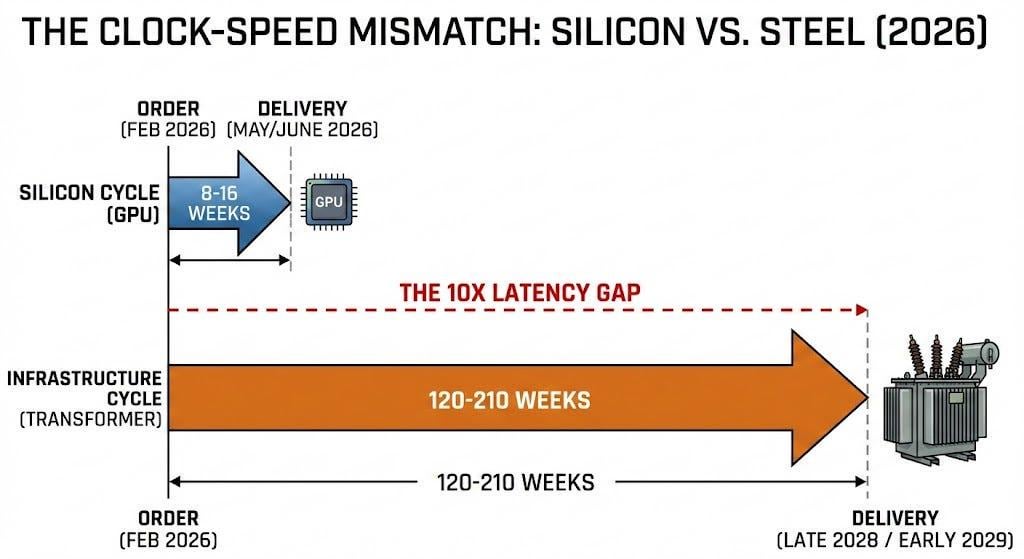
The Systems Mismatch As a systems engineer looking at grid interconnects, it’s clear we are facing a massive clock-speed mismatch. While the market optimizes for 24-month software cycles and weeks-long GPU deployments, the physical grid is operating on a mid-20th-century industrial clock. We are currently deploying billions into "Silicon" (data centers and clusters) that the "Steel" (the distribution layer) cannot yet support. This 10x latency gap between bits and atoms is the silent governor of the next decade of expansion.
The Physical Constraints The bottleneck isn't just a manufacturing backlog; it is rooted in non-negotiable physical and metallurgical constraints. Lead times for high-voltage 500kV units have scaled from ~50 weeks in 2021 to 120+ weeks today. This "Wall" is driven by two primary factors: the global scarcity of GOES (Grain-Oriented Electrical Steel) and the specialized curing cycles required for transformer oil. You can "Agile" your way through a software bug, but you cannot "Agile" your way through the physics of heavy infrastructure.
The Diagnostic & Link For Infrastructure Analysts and Asset Owners, this lead-time mismatch is the primary driver of Stranded Asset Risk through 2028. If the grid motherboard can't accept the load, the investment remains a paperweight. I’ve documented a full technical audit of these energetic and logistic constraints—including the raw lead-time data—for those modeling ROI or grid capacity.
Full Audit: https://substack.com/home/post/p-187345829
Source: Latter_Clock_9458
2 Comments
Why does China have enough transformers for all their solar power infrastructure and USA does not have enough for server farms?
According to google’s AI, this is the answer:
> China dominates roughly 60% of the global transformer production capacity, allowing them to produce transformers with 48-week lead times, compared to 143-week lead times in the U.S..
“the grid is a motherboard” pure slop