
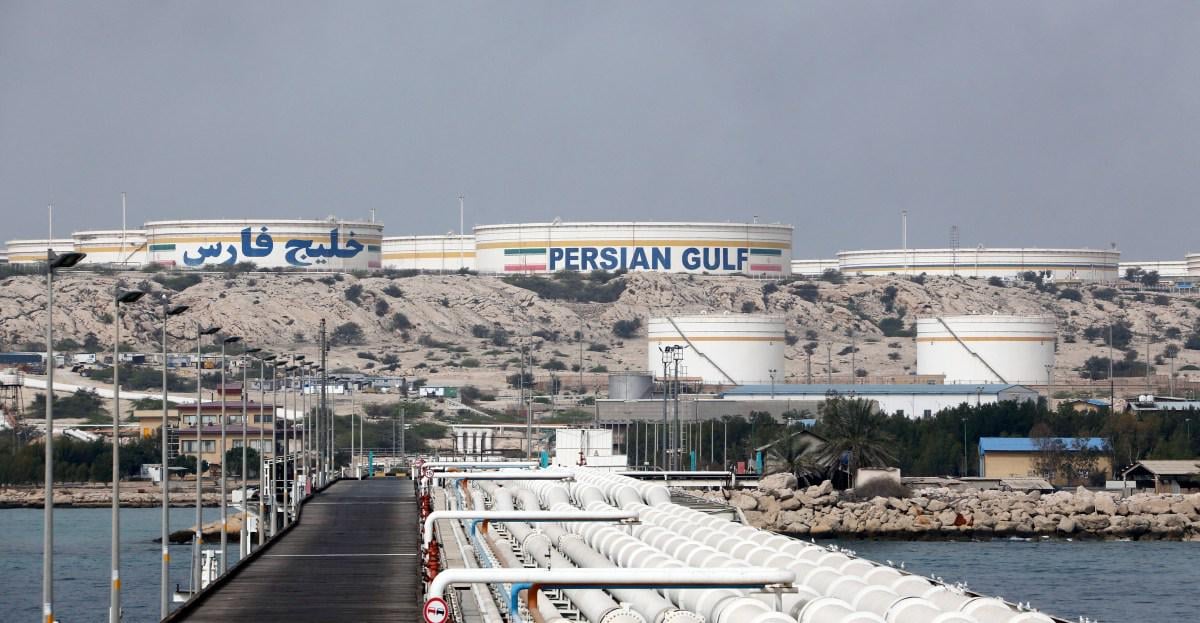
The false promise of energy independence: The Iran war shows yet again that US oil is still vulnerable to foreign shocks.
Source: vox
The false promise of energy independence: The Iran war shows yet again that US oil is still vulnerable to foreign shocks.
Source: vox
2 Comments
The United States has been chasing the rhetorical goal of [energy independence](https://www.cambridge.org/core/journals/journal-of-policy-history/article/abs/fourdecade-quest-for-an-energy-independence-policy-chasing-a-trope-through-time/FEC01071719AB990B446E9237F843CBA) — the ability to produce enough domestic energy to be essentially free of dependence on imports — since the energy crisis of the 1970s exposed the country’s reliance on Mideast oil. President Donald Trump has put his own spin on the idea, pushing beyond independence to “[energy dominance](https://www.eenews.net/articles/inside-energy-dominance-and-other-doe-buzzwords/).”
If you look just at oil extraction, the US seems to have succeeded. Thanks to the fracking revolution, it is now the [largest oil producer in the world](https://www.eia.gov/tools/faqs/faq.php?id=709&t=6), and it exports more petroleum and other liquid fuels than it imports. The US is, in fact, a dominant player in the global energy market.
But as the [US and Israel’s attacks on Iran](https://www.vox.com/politics/481087/us-iran-trump-war-israel-politics-explainer) this week have revealed, being dominant in energy isn’t the same thing as being independent. What you’re paying at the pump now is directly connected to what’s happening 6,000 miles away. Because of attacks on shipping and oil infrastructure, [gasoline prices are rising](https://www.reuters.com/business/energy/us-gasoline-crosses-3-per-gallon-mark-test-trumps-iran-war-2026-03-02/) across the country, reaching an [average of $3.25](http://v/). The last time prices jumped this high this fast was in March 2022, when Russia launched its full invasion of Ukraine. Even Trump was forced to awkwardly acknowledge the reality.
“So if we have a little high oil prices for a little while, but as soon as this ends, those prices are going to drop, I believe lower than even before,” [Trump told reporters](https://www.whsv.com/2026/03/03/pres-trump-admits-energy-prices-will-rise-iran-conflict-continues/) on Tuesday. Trump has also tasked his Cabinet to look for [any way they can to keep gasoline prices down](https://www.politico.com/news/2026/03/05/iran-energy-prices-trump-wiles-00813710).
One sign of the rising danger is that Trump also [said on his social media platform](https://truthsocial.com/@realDonaldTrump/posts/116166926920657651) that the US would offer political risk insurance for shipping through the Strait of Hormuz and possibly naval escorts, particularly for oil tankers, after transits drastically slowed. [Twenty percent of the world’s petroleum](https://www.eia.gov/todayinenergy/detail.php?id=65504) consumption and 20 percent of natural gas flows through the Strait of Hormuz. Iran itself is the world’s fifth-largest oil producer, and its [oil facilities are under attack](https://www.nbcnews.com/world/iran/live-blog/live-updates-iran-supreme-leader-gulf-attacks-israel-tehran-trump-rcna261634). It’s now launching its own [strikes on oil tankers](https://www.reuters.com/world/middle-east/more-tankers-come-under-attack-us-iran-conflict-spreads-region-2026-03-05/). We’ve seen shocks to the global oil and gas sector before, but this is the big one.
“We’re living through the geopolitical nightmare for markets,” said [Sam Ori](https://epic.uchicago.edu/people/sam-ori/), executive director of the Energy Policy Institute at the University of Chicago. “This is the crisis that has kept people up at night.”
And with the route throttled, Americans are likely to see [even higher gasoline prices](https://www.vox.com/politics/481190/iran-war-gas-prices-oil-economy) in the weeks to come. For most Americans, gasoline is their single-highest energy expense, averaging [$2,930 per household](https://energywallet.epri.com/en/executive-summary.html) in 2024. Adjusting for inflation, the US has been blessed with [fairly steady gasoline prices](https://afdc.energy.gov/data/10641) over the decades, so a big, sudden price spike will hit households hard.
All of which raises the question: If the US is producing more oil than ever, how are we still vulnerable to supply shocks occurring half a world away?
So they are lying to us? Who would have guessed that??