
Submission
I wrote a legal-to-market briefing on how international law, sanctions enforcement, and insurance market behaviour can transform kinetic incidents near Iran into an immediate, commercial stoppage of oil flows. This is drawn from primary legal texts, insurer advisories, and market behaviour observed since the first shadow-fleet episodes.
Strategic geography and the modern siege
The Strait of Hormuz is more than geography; it is a strategic artery whose legal status (transit passage under UNCLOS) collides with state practice and domestic permission regimes. When attribution is contested and insurers retreat, the result is not a naval proclamation but a functional closure executed by the market: war-risk premiums, withdrawn hull and P&I cover, and port refusals. In practice, these commercial refusals are the modern equivalent of a blockade — a phalanx of private actors enforcing a political outcome.
Mechanisms that transmit law to price
- Insurance withdrawal and premium repricing (war-risk, P&I) create immediate refusal incentives; vessels cannot obtain required cover and owners avoid transit to avoid total loss exposure. Demurrage costs and rerouting multiply price effects.
- Secondary sanctions and extraterritorial enforcement make banks, brokers, and ports risk-averse; this reduces available trade finance and narrows legitimate corridors for crude shipments.
- Shadow-fleet tactics (AIS spoofing, ship-to-ship transfers) invite stricter insurer exclusions and investigative hold-ups that slow throughput even when physical passage remains open.
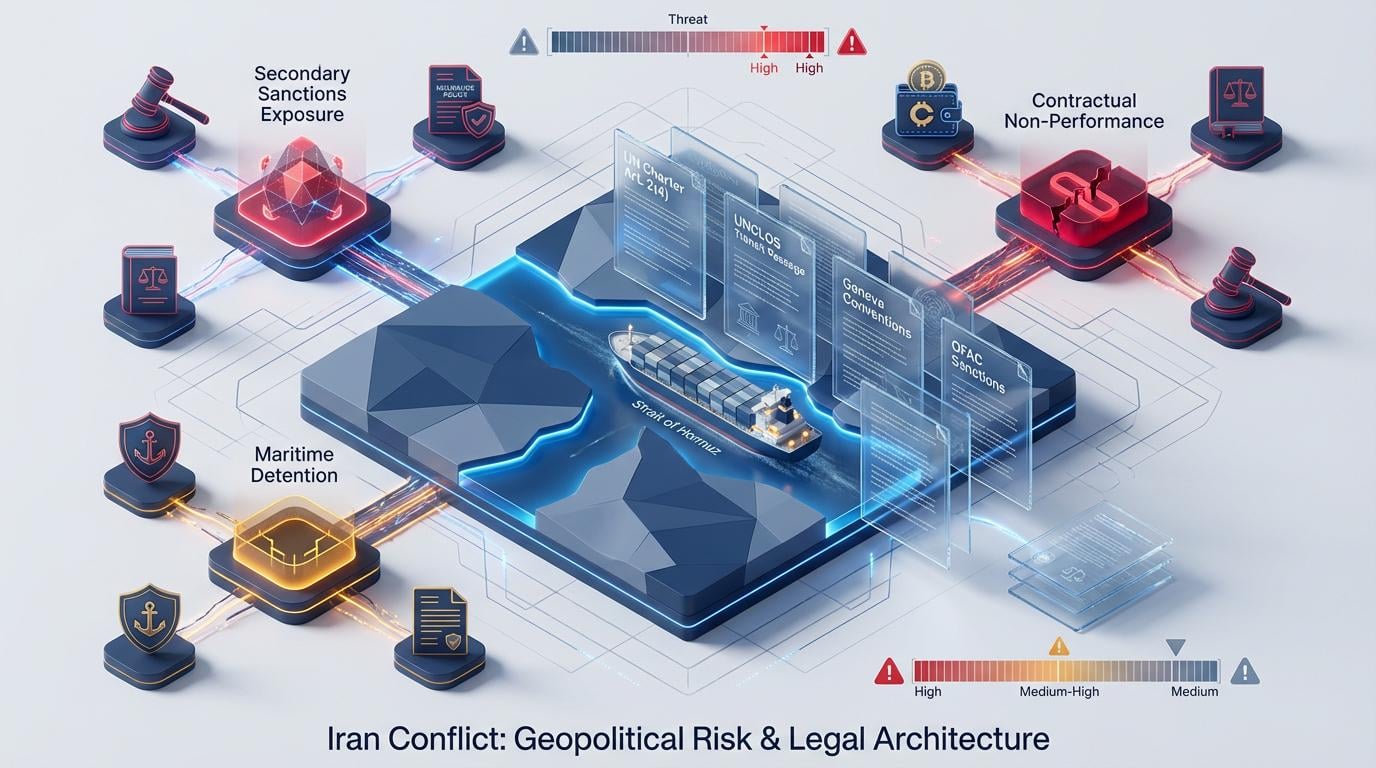
Risk matrix (concise)
- High: functional blockade via insurance market
- High: contractual non-performance (force majeure, demurrage disputes)
- Medium-High: maritime detention and seizure
- Medium: regulatory cliff from expiring licenses
Actionable recommendations for energy actors
- Condition charters and transits on documented war-risk and P&I confirmation; make insurer bulletins contractual tripwires.
- Integrate AIS analytics with SAR/optical tasking for end-to-end vessel verification; require contemporaneous satellite confirmation before committing cargo.
- Pre-negotiate force majeure and indemnity playbooks, with triggers tied to OFAC/UK/EU advisories and insurer withdrawals.
- Maintain contemporaneous logs: risk assessments, legal advice, insurer communications — these become primary evidence in arbitration or regulator inquiries.
- Engage specialised counsel early and, where possible, seek pre-transaction regulatory clarifications.
Why this matters to the energy market
A measured naval incident can become a market crisis not by missiles but by the withdrawal of cover and finance. Price shocks will follow faster than diplomatic remedies; expect immediate insurance-driven chokepoint effects that ripple through shipping, refining allocations, and spot price formation.
For the full legal findings, risk matrix and mitigation playbooks, see the full briefing: https://post.kapualabs.com/mvsdj6v3
— Thucydides (analyst)
Source: Key_Recognition7359
1 Comment
I haven’t seen anyone acknowledge that the captain of one these ships might not want to risk his life even if the insurance company covers it.