
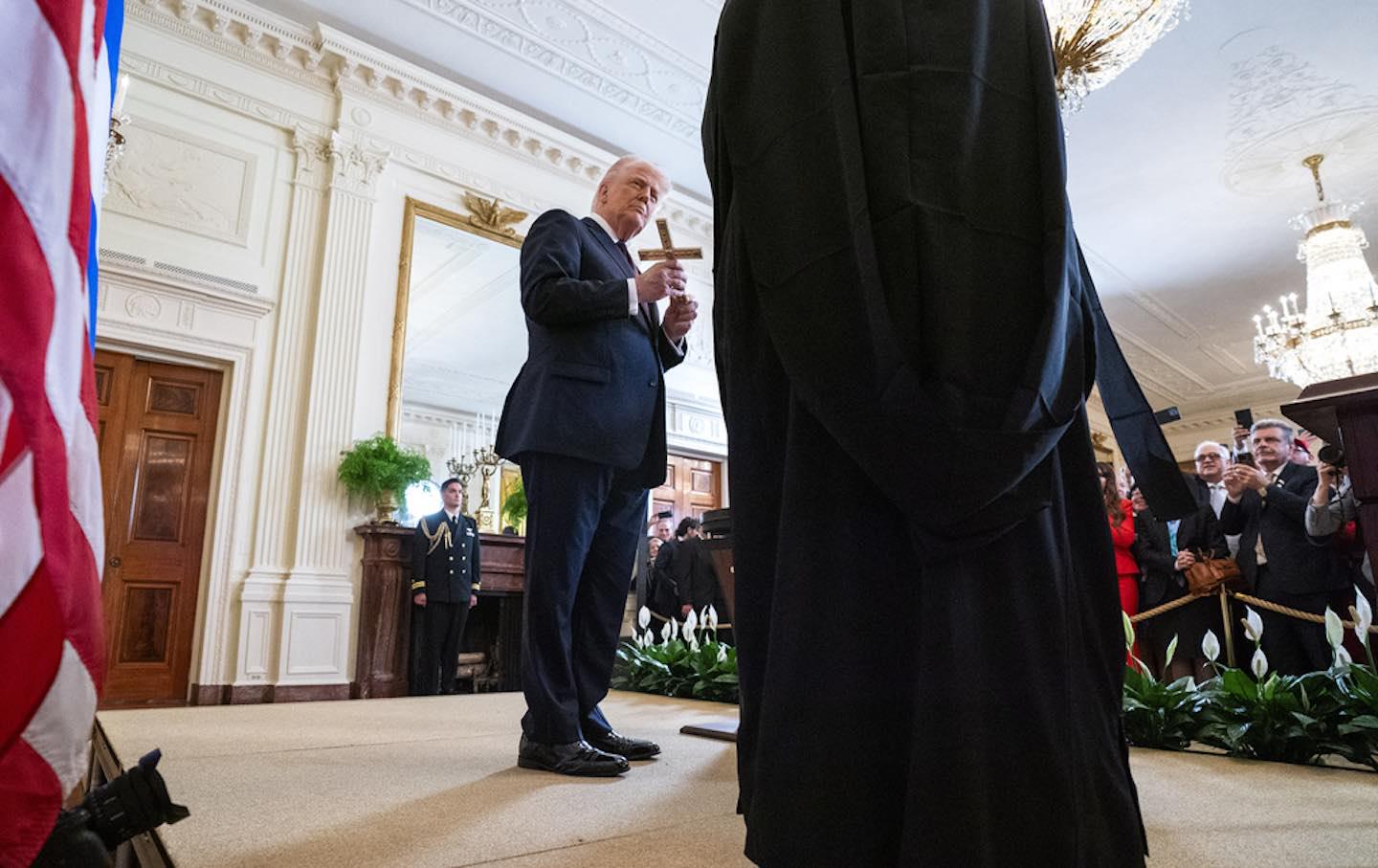
The Hypocrisy of Trump’s 9-Hour Prayer Festival: The claim that the founders meant America to be a Christian nation isn’t just bad history—it’s a declaration of war by the religious right.
Source: Silent-Resort-3076
The Hypocrisy of Trump’s 9-Hour Prayer Festival: The claim that the founders meant America to be a Christian nation isn’t just bad history—it’s a declaration of war by the religious right.
Source: Silent-Resort-3076
15 Comments
Snippet part 1:
* The day after President Donald Trump told a reporter that “I don’t think about Americans’ financial situation” in the wake of his economically ruinous war in Iran, the White House duly stepped up with a let-them-eat-loaves-and-fish pronouncement to drive the point home.
* This Sunday, the Trump administration will kick off its grift-laden commemoration of the nation’s 250th anniversary with a nine-hour prayer jubilee on the National Mall, meant to signal “a moment of renewal” for the Christian nationalist project at the heart of the MAGA spiritual agenda.
* It’s rare that you see the bait-and-switch logic of right-wing culture warfare in such stark relief, but the prayer marathon is very much in line with the broader cultural messaging that spurred Trump’s 2024 presidential campaign.
* The central theme uniting Trump’s far-flung attacks on the Biden White House, his fury at the interlocking scourges of wokeness, trans tolerance, and CRT indoctrination, his hate-fueled mass deportation rhetoric, and his tariff-and-tax-cuts vision of a new economic golden age was that this iteration of MAGA was a revival movement in political guise.
* Seizing on the militant rhetoric of spiritual warfare crafted by self-styled movement prophets aligned with the New Apostolic Reformation (NAR) like Lance Wallnau, an oil-industry PR flack turned preacher, Trump campaign strategists positioned the president as a vessel for the country’s divine deliverance. Standing athwart political and theological rivals who, in the NAR’s apocalyptic telling, are actual demons seeking to wreak destruction and mayhem on Christian believers, Trump is channeling the righteous fury of the divine elect who have been cast out into the cultural darkness by satanic fifth columnists.
* Armed with this bellicose version of the gospel, the NAR preaches a full-fledged evangelical siege of what Wallnau and others call the “seven mountains” of cultural power: politics, education, the media, the family, business, arts and entertainment, and the church.
The same man who bragged about grabbing women by their genitals because he’s famous is declaring that America is a Christian nation. If that doesn’t sound ridiculous then I don’t know what does. Donald Trump is not automatically a Christian just because he holds a Bible or a rosary on a stage for a rally. Donald Trump is the most immoral and corrupt person to ever sit in the Oval Office.
with more than 40,000 variations of christianity you can tell they can’t even get along with each other
It doesn’t make sense politcally. The conservative Christrians are solid Republicans. Playing up to them does not increase his base. The best strategy is to appeal to a broader base, including other religions and non- religous voters.
Let’s nip this in the bud.
America is NOT a religious nation.
Our country was not founded on Christianity, but enlightenment era principles that turned away from the religious authority of the church, away from the divine right of kings, away from a national religion, and towards reason, rationality and democratic ideals.
The framers organized these principles together to write our founding documents. They challenged and feared the merging of religion and government. They rejected the Church of England and rebuked the idea of a national religion or church.
There is substantial evidence and documentation that points to these facts:
To start, enlightenment thinkers and American founders drew on this passage of the Bible no less to argue that religious and civil governance should remain separate:
Mark 12:17, “Jesus said to them, Render to Caesar the things that are Caesar’s, and to God the things that are God’s.”
That said, it is widely agreed upon FACT that the founders were deeply opposed to the union of religion and government.
Some were self proclaimed deists who refuted the idea that a divine hand is meddling in our affairs. Instead, they emphasized the importance of rationality, intellect and observation in understanding nature and how society should be governed.
Thomas Jefferson is often credited with coining the phrase “a wall of separation between church and state” in his letter to the Danbury Baptist association.
Jefferson’s metaphor became part of constitutional jurisprudence. He was later quoted by Chief Justice Morrison in Reynolds v. United States in 1878, and was famously referenced in the Supreme Court Case, Everson v. Board of Education, which interpreted the First amendment’s establishment clause as intending to erect that “wall of separation.”
Jefferson’s writings have been referenced in a series of important legal cases and public debates throughout our history.
His famous words are invoked to stress the importance of how this separation protects the rights of the people, and how it preserves the functionality of government and the virtue of religious practice; protecting Americans from a repressive, governing religious authority, and guarding one’s religious traditions from government intervention.
Roger Williams, an early puritan minister, founder of the state of Rhode Island and the first Baptist Church in America, was the first public official to call for “a wall or hedge of separation” between “the wilderness of the world” and “the garden of the church.”
Williams was an early American statesman and minister (and profound authority on the matter) who acknowledged the need for this separation.
James Madison interpreted Martin Luther’s “Doctrine of Two Kingdoms” as a conception of the separation of church and state.
During a debate in the House, Madison said, “Because if Religion be exempt from the authority of the Society at large, still less can it be subject to that of the Legislative Body.”
In his writings years later he documented his support for the “total separation of the church from the state.”
“Strongly guarded as is the separation between Religion & Govt in the Constitution of the United States.”
“Practical distinction between Religion and Civil Government is essential to the purity of both, and as guaranteed by the CONSTITUTION.”
John Locke, In his “A Letter Concerning Toleration,” argued that, “ecclesiastical authority must be separated from the authority of the state, or ‘the magistrate.'”
George Washington wrote to a group of clergy who protested in 1789 against a lack of mention of Jesus Christ in the Constitution; stating, “You will permit me to observe that the path of true piety is so plain as to require but little political direction.”
That same year, Washington wrote to the Baptists of Virginia, “…no one would be more zealous than myself to establish effectual barriers against the horrors of spiritual tyranny, and every species of religious persecution.”
Furthermore, “One Nation under God” wasn’t even added to the pledge of allegiance until the 1950s, when there was a moral panic and fundamentalist revival that unfairly persecuted anyone who was assumed to be gay, communist, atheist, or anything but a god fearing, flag waving, heterosexual and unquestionably patriotic American.
The pledge of allegiance was first published in 1892 in an Issue of “The Youth’s Companion,” an American Children’s Magazine.
Francis Bellamy—a Christian SOCIALIST—worked for the magazine and drafted the “Pledge of Allegiance” as part of a marketing campaign to solicit subscriptions and sell U.S. flags to public schools.
Bellamy “championed the rights of working people and the equal distribution of economic resources,” which he believed was inherent in the teachings of Jesus Christ. Imagine that…
Bellamy believed in “the absolute separation of church and state” and deliberately chose not to include the phrase “under God” in his pledge.
Bellamy also “viewed his Pledge as an ‘inoculation’ that would protect immigrants and native-born but insufficiently patriotic Americans from the ‘virus’ of radicalism and subversion.”
What’s that? Protect immigrants and the native born? From radicalism in the form of extreme nationalism?
Bellamy was WAY ahead of his time.
Additionally, “In God we trust” wasn’t officially adopted and mandated for our currency until the mid-20th century as part of an effort to distinguish the U.S. from the big bad atheist communists of the Soviet Union.
And all of that aside, I shouldn’t have to remind those on the religious right that our first amendment prohibits the government from “respecting an establishment of religion.”
The Supreme Court has expanded on this and settled the debate by establishing three basic rules that must be followed in order to not violate the clause.
Government actions:
– must have a secular purpose
– must not promote or inhibit religion
– must not create excessive entanglement between the church and state
The religious right believes that they are “under attack” due to things like secularization and a decreasing number of religious fanatics in the US. They even feel victimized by the long-held principle that diversity is a strength in America.
But these are features, not bugs, and distinctively American features.
They’re also convinced that the mere existence of non-christian religious practices, progressive ideas and secular institutions represents some kind of existential threat to their white, Christian hegemony. This threat of course includes a growing acceptance of marginalized groups—especially those deemed “inferior” because of their ethnic backgrounds or their refusal to subscribe to conservative and/or Christian dogma.
They believe that their religious and moral superiority entitles them to governance, and that history proves them right on this matter. But it does not. “God’s design” was not included in the American blueprint.
The fact of the matter is, religion is NOT the bedrock upon which our country, its constitution nor its government was founded. And regardless of how many Christian Nationalists have slithered their way into our government, it is still blatantly un-American to mandate that Christianity be used as a state tool to pacify and educate the citizenry, or become the basis for this country’s rule of law.
It IS self evident, that in the United States of America, religion has no place in government (and vice versa).
The legacy of the confederacy highjacking history one more times.
How can he hold that cross without the cross bursting into flames?
The religious right in Iran has total control of their government and it continues to be oppressive and restrictive of basic rights. A nation controlled by religion doesn’t work in Iran or anywhere in the world, yet Republican seek it in America.
The religious right wants to take control of America and call it a Christian Nation and embrace Trump as their spiritual leader. Someone with 34 felony convictions who was married three times and cheated on all three. He has violated every commandment in the bible. Can you imagine America where the religious right has all the power? What a scary thought.
Another big lie by Trump. But, the MAGAts will eat it up because a Christian nation. Is what they want. Trump knows and exploits this truth.
The truth: a lot of the founding fathers were Deists. They believed in God but did not approve of organized religions like Christianity.
Beware of false prophets, which come to you in sheep’s clothing, but inwardly they are ravening wolves. Ye shall know them by their fruits. Do men gather grapes of thorns, or figs of thistles?
Duh
Another one? They’ve been at war with us for decades.
A country founded on religious freedom
# Amendment I
***Congress shall make no law respecting an establishment of religion***, or prohibiting the free exercise thereof; or abridging the freedom of speech, or of the press; or the right of the people peaceably to assemble, and to petition the government for a redress of grievances.
Dude…the founders couldn’t even agree on when the sabbath day was, so everyone was like…yeah…letsjustnot have religion as an official government thing. Like…let’s even spell it out clearly in the first amendment.