
The hard-won pay deal for Victorian teachers has highlighted shortfalls in how public schools are funded and staffed, so why is the state government forgoing $2.4 billion in much-needed money for the poorest schools? By Julie Hare.
—–
It was the election of Dan Andrews as premier in 2014 that turned the cars on Victorian roads into mobile advertisements for his pitch: The Education State.
As opposition leader, Andrews had made education policy central to Labor’s positioning as the party of opportunity, equality and prosperity. He invoked the reforms of former prime ministers Gough Whitlam, Bob Hawke – and his education minister John Dawkins – and Julia Gillard.
Two months before he was elected premier, Andrews told a gathering of Labor luminaries, alongside the rank and file: “From preschool to postgrad, a Labor government will be there for you every step of the way. We won’t just fix schools, we’ll help them do more,” he said.
Of his single-term predecessors, he said, “The Liberals abandoned our schools, they rolled up master plans and wound up construction work, and across Victoria, classrooms are crowded, facilities are failing, kids aren’t comfortable, and kids aren’t safe.”
Twelve years on, and well into the third term of a Labor government, it’s not just the kids who aren’t comfortable or safe. As of last week, their teachers were among the lowest paid in the country – with salaries ranging from $79,589 to $129,554. Victorian teachers report appallingly low levels of satisfaction, with two in three saying they will leave the profession within the next five years.
“This has been in the making for 10 years,” says Kos Samaras, former Victorian Labor Party adviser and founder of polling and strategy firm RedBridge Group.
“This is the story of the transition between the Andrews and the Allan administrations, and then having to play catch-up.
“If in 2014 the newly minted Andrews Labor government actually tried to ensure that teachers’ pay was in line with the rest of the country, then would we be having this discussion right now? No.”
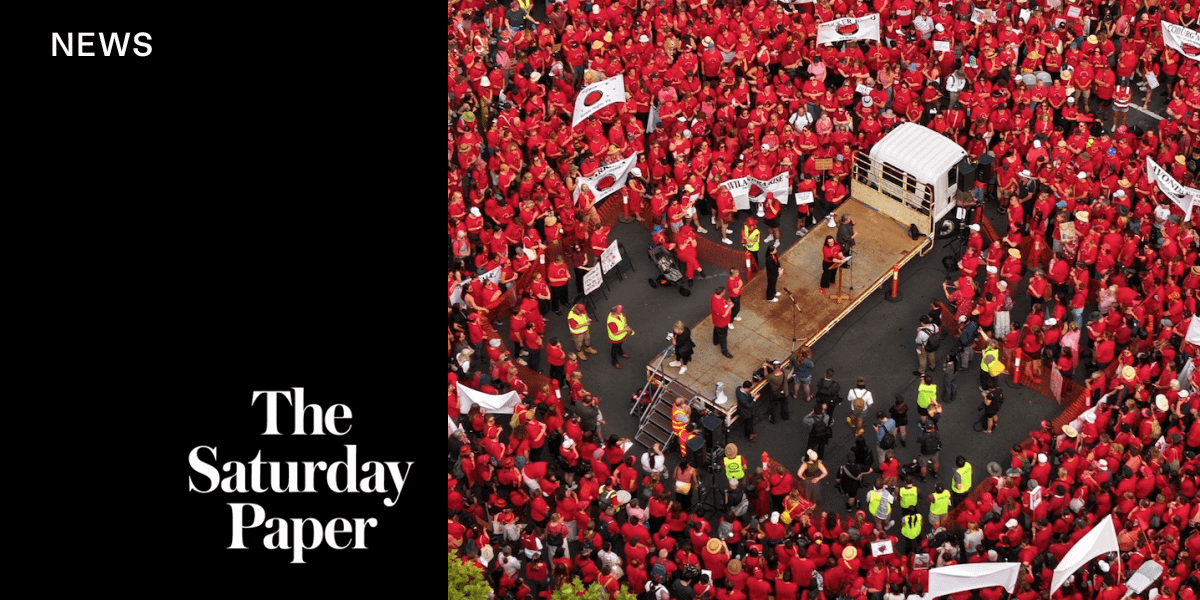
On March 24, Victorian public school teachers, teachers’ assistants and principals went on strike for the first time in 13 years. An estimated 35,000 were angry enough to take to the streets of Melbourne in protest.
An AEU survey … found among more than 10,000 public school teachers … 86 per cent spent their own money on classroom supplies, with an average annual outlay of $988 per teacher.
The strike was ostensibly about pay. One placard was succinct: “Give Vic teachers more $$”.
After a full year of protracted negotiations, the state government had offered just 17 per cent over four years – half of what the union had been pushing for.
This month brought the threat of rolling half-day strikes, which were suspended after reports that the education minister, Ben Carroll, had upped the state’s offer.
An in-principle agreement was finally reached on Friday for pay rises of between 28.3 and 32.4 per cent over four years for school teachers, assistant principals and principals – increases that would bring them in line with their NSW counterparts.
The deal is also expected to include measures to ease workloads, which have contributed greatly to the despondent mood in the industry. Victorian public school teachers average 12.4 hours of unpaid overtime per week, while principals average 17.5 hours.
“A pay rise is just the beginning of recognising what teachers do,” says Professor Lucas Walsh, professor of education policy and practice at Monash University.
“Theirs is also invisible labour,” he says, describing the complex classrooms and residualisation, where poorer children and kids with special needs are concentrated in public schools. Moreover, he says, “personal out-of-pocket contributions are routinely exploited by governments of all political stripes”.
“All that has become normalised,” Walsh says.
There is plenty of data to support Walsh’s point. An Australian Education Union (AEU) survey of more than 10,000 public school teachers across the country conducted at the end of last year showed that 86 per cent spent their own money on classroom supplies, with an average annual outlay of $988 per teacher.
Nationally, this amounts to $177 million annually – money saved by state and territory governments.
“We’re not talking about nice-to-haves or personal touches,” said AEU federal president Correna Haythorpe at the time of the survey’s release. “Teachers are paying for basic items like stationery, books, classroom equipment, and materials to support individual students.”
And an 2025 report for the AEU conducted by four Monash University academics, led by Fiona Longmuir, delivered a damning assessment of conditions in Victoria’s public schools.
“Longstanding shortfalls in how public schools are funded, staffed, and supported have led to uncompetitive wages, excessive workloads causing burnout, and a lack of professional recognition, with these factors identified as some of the reasons why many public school staff don’t intend to stay in the system long-term,” the report reads.
Unsurprisingly, only 30 per cent of 8000 teachers surveyed for the report said they intended to remain in that workforce until retirement. Seventy per cent cited poor student behaviour and violence as reasons for intending to leave the profession, while more than 30 per cent pointed to parent or carer behaviour, including threats and rudeness, as factors driving them out of their chosen profession.
The Victorian auditor-general wrote a terse report about workplace-related violence in schools last year. It noted that while the Education Department goes to some lengths to coach staff on how to address inappropriate and threatening behaviours from students and parents, there are significant gaps in how it handles these problems.
“The department does not record or report incident numbers completely. This means that it does not have a clear overall picture of work-related violence resulting from student behaviour,” the report said, adding that it does not “comprehensively review its policies or systematically collect lessons learned from how it responds to incidents”Perhaps the most egregious failing of the Victorian government with regard to its publicly educated students and their staff is that it has not fully signed on to a landmark federal government funding agreement that will drive billions of extra dollars into the system.
Known as the Better and Fairer Schools Agreement, it is the Albanese government’s plan finally to fund all public school students across the country to the Schooling Resource Standard, lifting the Commonwealth’s contribution from 20 per cent to 25 per cent. The SRS is the estimate of the minimum required to provide a high-quality education for every student in Australia, based on recommendations from the landmark Review of Funding for Schooling commissioned by the Gillard government and led by David Gonski. Since that review, in 2011, funding has fallen short of the SRS benchmark for all public schools in the country, bar a few in the ACT. Even under the new agreement, those funds won’t be delivered in full until 2034, contingent on the states reaching set targets.
In 2026, the amount to be dispersed from the Commonwealth is $14,467 for primary and $18,180 for secondary students, with additional funding flowing to those schools with high concentrations of poor and disadvantaged students.
While all other states and territories have agreed to the arrangements until the 2034 expiry date, Victoria signed up for only two years, leaving it under the previous funding framework and so forgoing an estimated $2.4 billion in much-needed money for the poorest schools.
Professor Glenn Savage, an expert in state and federal funding for schools at the University of Melbourne, says Victoria’s withholding is undermining the public school system. “That is just terrible. For Australia to be so far off as a nation in fully funding its public schools is a problem in itself. But then to have Victoria, the second-largest education system in the country, to not have a date at which it commits to fully signing the agreement is dreadful,” Savage says.
With all the broader issues affecting the teacher workforce, Savage says Victoria is “a tinderbox of concern”.
“When we talk about the full funding of schools, it’s not just what is the minimum needed to run them, but also to attend to equity challenges and so forth. Victoria’s just persistently been a long way off,” he says.
“It’s a wicked cycle where the underfunding of schools clearly contributes to conditions within those schools that make the everyday work environment of teachers very difficult. Sure, it’s pay and conditions, but it’s more than that.”
Education Minister Ben Carroll’s office did not respond to questions.
Source: stirringthemerde