
Translated Article
In the summer of 2014, when Crimea had been occupied and war was flaring up in Donbas, two men set out in a sailboat made from a kayak from the Sea of Azov coast in the stanitsa of Dolzhanskaya, Krasnodar Krai, Russia. On this homemade vessel, 43-year-old Russian Oleh Butusin and his 17-year-old eldest son Roman set off toward the Ukrainian shore.
"We sewed a sail, set up a mast, leeboards, a rudder — everything as it should be," Oleh recounts. "We wanted to reach the Berdiansk spit. We were curious whether it was possible to get into Ukraine that way. After a few hours, the wind started pushing us toward Novoazovsk, where the 'monkeys' (DNR militants — UP) already were, and we had to turn back to Kuban."
At the moment of that attempt at a maritime reconnaissance, Oleh and his wife Tetiana had decided to move with their children to Ukraine. In Putin's Russia there was no quiet corner for them.
Oleh was born in Buryatia and lived in the Far East. In 2004–2005 he led the Cossack community of Vladivostok and was already then agitating for active resistance to the Kremlin regime.
"I understood that the people had to be prepared for a future partisan struggle in Primorye," he says. "We went to shooting ranges, learned how to orient ourselves on the ground. We were setting up our own cells."
In 2008 a case was opened against Butusin for "inciting interethnic hatred." While on the federal wanted list, in 2013 he became a hero of Russian media as a farmer-partisan who wounded traffic police officers in a shootout and then hid from pursuit in the forests.
In 2014 Oleh crossed the border from the Kursk region; the family was already waiting for him in Ukraine. Eventually the family of committed Russian nationalists settled in Galicia, in the homeland of the Bandera movement.
In 2015 Oleh Butusin joined Right Sector. On March 9, 2022, his two sons — 20-year-old Leonid and 24-year-old Roman, with whom the father had tried to sail to Berdiansk — were killed in battle in the village of Lukashivka in the Chernihiv region.
UP tells the story of the Butusin brothers, Roman and Leonid. Ethnic Russians, citizens of Ukraine, soldiers of the 58th Brigade of the Ukrainian Armed Forces, who were born in Vladivostok, ten thousand kilometers from Kyiv. And who received the title "Hero of Ukraine" posthumously for one of the key battles of March 2022 in the Chernihiv region.
Trash on Lenin's Head
"Do you believe in God?" Oleh Butusin asks as soon as the UP reporter crosses the threshold of his home. "The Lord will sort everything out."
It seems God has always been the only one for the Butusin family. At least one of the key problems of modernity — television as a deity — Oleh solved with his own hands during the collapse of the USSR. When Butusin was eighteen, he got rid of the TV set. So later, his children had no chance to worship Kremlin propaganda either.
"Roman and Lyonia grew up understanding that we live in a Russia occupied by the Bolsheviks, that the country is ruled by godless people. And when it all began (in 2014 — UP), we all decided that we had to be on this side (in Ukraine — UP)," the father recalls.
When the Butusins were leaving Russia, there were ten children in their family. Another two were born after they moved to Ukraine.
At the time of the move to Ukraine, Roma Butusin was 17 and Lyonia was 13. Having moved to the neighboring country, the young daredevils found what they had longed for — freedom. Although back home, under the conditions of Putinism, the boys had already stood out from most of their peers by their love of freedom and their nonconformism.
"They grew up in combat boots," their father says.
One night, in secret from their parents, the brothers took a ladder and went to put a bag of trash on Lenin's head. This happened in the town of Kolchugino in the Vladimir region of Russia. The pedestal stood in a small square surrounded by residential buildings.
Roman was 13 then, Leonid was 9. Their political action ended successfully.
"My ancestors have Cossack roots," Oleh explains his sons' dislike of the "reds." "My father was an anti-Soviet. My grandmother sang Kuban songs. Our relatives were repressed as counterrevolutionaries. So our family never had a common language with the communists."
In Truth
Don't refuse service, but don't ask for service either — Oleh Butusin reminded his sons of this proverb when Roman, and later Leonid, decided to join the military.
Even before reaching adulthood, the older of the brothers packed his things to join Azov. But his parents convinced him: the war isn't going anywhere, you need to study first. "What's the point of running off to the front at that age, when you have no experience or knowledge?" mother Tetiana asked.
Roman quickly mastered the Ukrainian language and enrolled at the Sahaidachnyi Ground Forces Academy to become a reconnaissance artilleryman. Due to an ulcer he developed during his studies, he didn't finish the institution in Lviv. But he later became a student at the National Aviation University in Kyiv.
His younger brother Leonid studied at a military-sports lyceum in Nadvirna. He enrolled at the law faculty of Odesa Mechnikov University.
Leonid and Roman found themselves in their element in 2020, when they signed contracts with the 58th Brigade of the Armed Forces of Ukraine.
The brothers were always together — in service, in their view of the world, and in fights for their convictions. When the family lived in the Moscow region, the Butusins proved their dignity with their fists in the heartland of their family's eternal enemy.
"That was the last of the Russian schools they attended — in Porechye," Oleh shares. "Just so you understand, that settlement has a military town for the SVR (Russia's foreign intelligence service — UP). Naturally, the population there is of a certain kind. And Roma got into it with some kid who was two years older. The little ones came to help — Lyonia and Liuda (one of the daughters — UP)."
Tetiana Butusina's father is from Kryvyi Rih, but after his army service in Soviet times he settled in Russia.
They also had to defend the family's honor in Ukraine. Once, after a fight in the Prykarpattia region, Roman Butusin ended up in the hospital.
"My husband and I were working in the forest at the time, guarding and taking care of the territory," mother Tetiana recalls. "The boys helped too. And then there was a conflict with locals. Roma found out about it and went to settle scores himself, he wasn't afraid. Five people beat him up."
"Romchyk and Lyonia were kind, caring," the mother continues. "Once Roma brought home a cat he'd found in the mountains. When he saw a stray dog in Kalush that had been scalded with boiling water, he took it to Ivano-Frankivsk to save it. And he rushed to donate blood when he found out a local girl had leukemia."
"Lyonchyk also knew how to defend justice with his fists," Tetiana Butusina says. "He wanted everything to be by the rules, in truth — that's why he went into law. He really hated wrongdoing. He never bowed to anyone."
"Lyonia was the life of the company," father Oleh says. "He was, you know, like a cat. Always smiling. He and his brother never cried. They weren't afraid of anything. Anything at all."
A Spark of Life
They met in the hospital. Roman Butusin was recovering from a fight, and Olena and her sister, who had left Crimea for the west of the country after the peninsula was occupied, brought food to his ward.
"Our families are friends," Olena recounts. "And Roma's parents asked us to feed him over the weekend. That's how we started talking. Simple, sincere — Roma was an adventurer in the good sense, for me. I don't know how to convey it to you, but in his eyes I saw a very powerful spark of life."
"He and his brother were savvy in army matters," the girl continues. "When they started serving in 2020, I, for example, still knew nothing about tourniquets, first-aid kits, and everything else, and they told me about all of it. Roma would send me photos of Donetsk Airport that he took with a thermal imager."
Roman was born on the shore of the Sea of Japan and planned to travel with Olena along the Black Sea coast and Bessarabia, but he didn't get the chance.
One winter, shortly before the full-scale invasion, the couple had a chance to be alone together. During a two-week leave, Roman Butusin and Olena traveled around Ukraine.
They were in Sumy, Kyiv, and Lviv. For a few days they secluded themselves in the Carpathians, in a house that was a 40-minute walk from the nearest village.
"In that little house, just the two of us and no one around," the girl recalls. "We took water from the river, heated the stove. It was really, really cool.
Once we were walking down through the snow into the village and met a tiny kitten. At first I thought it was some kind of squirrel: long ears, fluffy tail, a vividly orange color. But it was a kitten.
I said: 'Romka, let's take him with us.' We took a bus back for several hours, and he calmly slept the whole way in Roma's arms."
The Last Battle in Lukashivka
The miracle that saved Ukraine from falling in 2022 has many faces and names of those who didn't get scared. Among them are the Russians Leonid and Roman Butusin, with the call signs "Leo" and "Rem."
On March 9, 2022, in the small village of Lukashivka near Chernihiv, a battle took place that was of great significance for the defense of the regional center. Trying to close the ring around the city, the enemy advanced toward Lukashivka in a column of dozens of pieces of equipment: APCs, IFVs, tanks, trucks.
On March 6, 47 soldiers of the 58th Brigade were thrown in to help the local territorial defense. Two tanks (one of which didn't fire), an old Fagot anti-tank missile system, and an RPG — that was all the defenders had.
"I don't know how Roma managed to get a connection, but he tried to talk to me at least a little," the girl Olena recalls. "As always, he reassured me: 'Olenko, don't worry. Better call my parents, support Mom.' He said the enemy was bypassing them, and they were sitting in some backwater."
The last photo from the Chernihiv region. Roman Butusin is in the front row in the center. To the right, in a balaclava, is his younger brother Leonid.
"It was an unequal battle on March 9, 2022, but Romchyk and Lyonka didn't falter. They fought to the last," the father says.
Despite the order to withdraw, the brothers stayed. By radio they helped adjust the fire of Ukrainian artillery.
"They had an RPG with three rounds," Oleh Butusin says. "They say they 'put down' an IFV and a tank. They even managed to warn the local farmer who was helping the Armed Forces: 'Get out, we won't hold Lukashivka anymore.'"
The brothers didn't get back on the radio, and for a long time they were considered missing in action. In those days, in early March, their father was carrying out a mission a few kilometers away from them.
When it became known that there was no contact with his sons, Butusin tried several times to break through to Lukashivka. But he was only able to get into the village on April 1, after the de-occupation of the Chernihiv region. There he found the bodies of Roman and Leonid out in the open.
"Lyonia was riddled with bullets," Oleh recalls. "When I lifted him, they fell out and rang. Roma had a wound in the abdomen, evidently from a grenade explosion. Possibly he blew himself up so as not to surrender."
Don't Waver
"Lyenusko, let's adopt someone when the chance comes."
These were the words Roman Butusin said to his beloved over the phone when he saw the news that two orphans were left in Mariupol after the death of a local couple.
Roma's idea of adoption had to be realized by his parents, as the eldest son's testament — Oleh and Tetiana took in two more children.
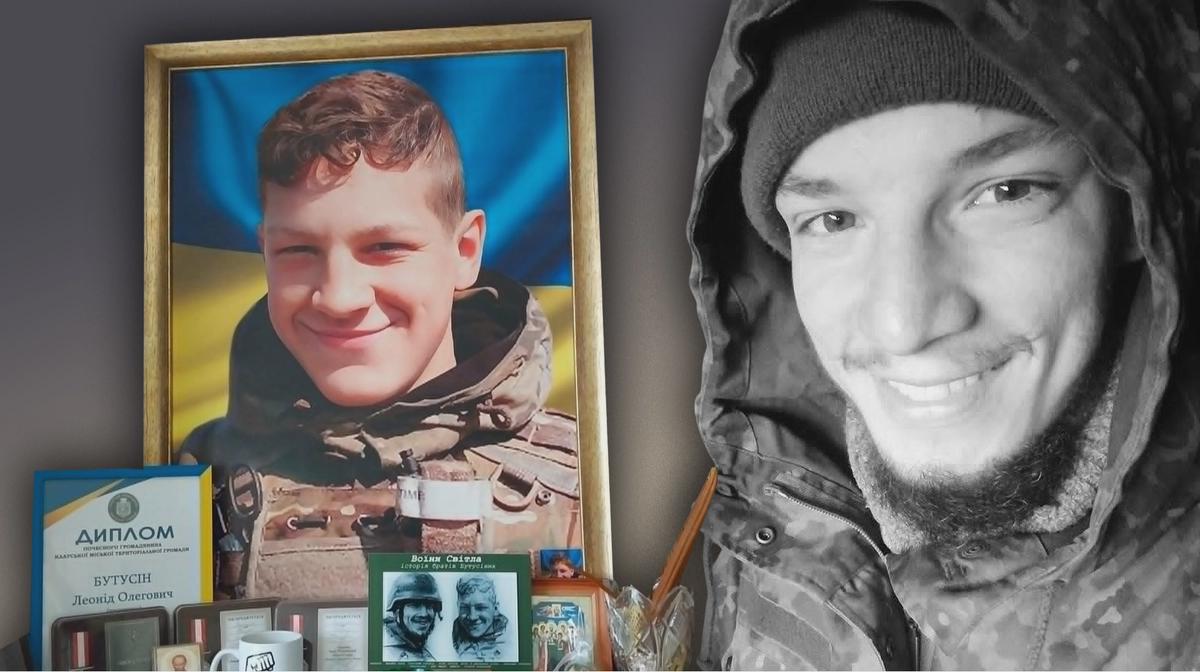
Now there are twelve of them. Alive. And two more are present in their hearts — Roman and Leonid, whose portraits hang in the house of the Russian nationalists Butusin in a Carpathian forest.
The cat Simba, whom Roman brought from the mountains, also lives here and has privileged rights. "Anything goes for him," the father says. "The other cats get tossed out (of the house — UP) — feathers fly."
Simba enjoys human love to the full. He squints in the rays of the sun, sitting on a kitchen stool. He purrs. He loafs on the children's beds. Or on the windowsill — right beneath the photos of the fallen Roman and Leonid.
The cat got the nickname Simba from the call sign that belongs to officer Maksym Panchenko — the brothers Butusin served with him, and he was the commander in the battle for Lukashivka.
Mother Tetiana from time to time takes the photo album in her hands as a testimony to her sons' growing up and to their deed.
"The boys are now like a guiding star for us," she says. "Usually, children should follow the example of their parents, but for us it turned out the other way around. Lyonia and Roma showed us, the adults, how we should go on living.
I was in Lukashivka, at the place of their death. The position there is such that they could have withdrawn, but they didn't retreat. And now we, as their parents, have to keep going straight, not waver.
Sometimes you want to close or turn away your eyes so as not to see what's happening around. But if the boys didn't spare their own lives for the sake of truth and justice, then we too must stand our ground, not stay silent.
Often we hear unpleasant words about the fact that we are Russians, because all Russians are bad. But our sons are real heroes, Heroes of Ukraine."
Yevhen Rudenko — Ukrainska Pravda.
Source: Panthera_leo22
1 Comment
VOIN