
Inside Labor, the Albanese’s government fifth budget was initially met with rapturous applause. Here was a bold Labor budget, making Labor reforms, showing a government willing to use its mandate to meet the moment. That quickly evaporated as the budget met with the biggest media attack seen since the anti-carbon tax campaign more than a decade ago.
A new staging post in the legacy media’s decline occurred on Tuesday, when News Corp’s The Daily Telegraph splashed an AI-generated meme of Prime Minister Anthony Albanese doing the splits on its front page.
The fake picture, which showed Albanese surrounded by hostile Pilates practitioners, one of whom was correcting his pose with a stick, was posted by a Bribie Island Pilates studio whose account had no prior political content.
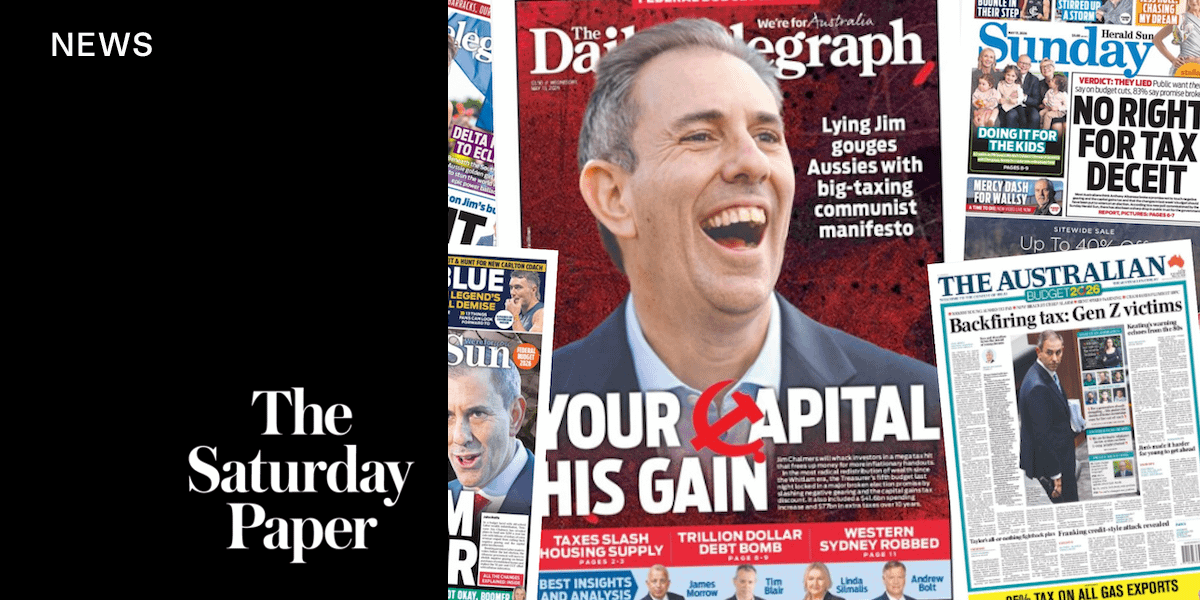
This front page exceeded the low the same newspaper set in its budget edition the previous week, picturing a laughing Treasurer Jim Chalmers with the headline, “Your Capital His Gain”. A red hammer and sickle replaced the “C” in “Capital”.
Chalmers was accused of delivering a “big-taxing communist manifesto” in “the most radical redistribution of wealth since the Whitlam era” – a hysterical take on the budget.
“I understand why the greedy are whingeing but it’s depressing how stupid everyone else is,” a well-placed source said.
“I mean, how many average young people are making their fortune running their own business and building their share portfolio? It’s unconscionable that the media are giving airtime to these entirely non-representative stories.”
The Betoota Advocate punctured the Telegraph’s hyperbole with a story headlined, “Boomers with 5 Properties and $4.9m in Super Reduced to Gruel and Stale Bread in Jim’s Communist Dystopia”. The stricken Boomer was pictured eating what looked like vichyssoise with a bottle of Penfolds Grange adjacent.
Chalmers himself passed it off as a joke in a video budget briefing he did with Housing Minister Clare O’Neil for Labor Party members and friends last week, which more than 2000 people registered to attend.
The briefing was part of a government strategy to reach around the media and talk to Australians directly, given that parts of the media are so febrile and hyperpartisan social media posts are so untethered from the truth.
News Corp’s national masthead, The Australian, claimed on Monday that its latest Newspoll showed the budget was the “worst in decades”, and that “Jim gives Keating a run for his money”.
Just 22 per cent of those surveyed said the budget was “quite good” or “extremely good”. However, this was the same level for the government’s previous budget in 2025, and Labor was re-elected in a landslide just two months later.
Nor did the post-budget Newspoll published this week show any fall in Labor’s primary vote of 31 per cent, which has been steady since March. Coalition support fell to 20 per cent (-1), and One Nation’s rose to 27 per cent (+3).
Old Labor hands were dismissive of the News Corp onslaught.
“It was so hard to actually attack, so they’re making stuff up,” said one. “Shock!”
“They might be reinforcing their base but they’re not even trying to be a trusted source,” said another. “Are they only up to circus tricks now? They’re competing with their in-house stable to see who can be the most stupid. It’s embarrassing.”
Asked about the media framing of the budget, Eric Beecher, the author of The Men Who Killed the News, said “framing” suggested “something considered or thoughtful”, whereas “to me it’s yet another example of banality creating more banality”.
“This is a bunch of desperados waving and flailing their arms to attract attention as their business model sinks,” Beecher says.
The Resolve poll, published in the Nine newspapers on Monday, showed Labor’s primary vote on 29 per cent (-3), the Coalition steady on 23 per cent, and One Nation on 24 per cent (+2).
Resolve showed that 36 per cent of those surveyed said Albanese’s “broken” election promise not to alter property taxes had “damaged my view of Labor”. However, 31 per cent said it had “not changed my view of Labor”, and another 14 per cent said it had “improved my view of Labor”.
The reporting of the Resolve figures also treated Albanese’s policy change in isolation.
It could have been contextualised in the history of other “broken” promises, including by Liberal prime ministers such as John Howard, who as opposition leader promised to “never, ever” establish a goods and services tax, yet went on to champion one in office.
The fact Albanese prominently “broke” his 2022 election promise not to change the Morrison government’s stage three tax cuts, yet went on to a massive win at the 2025 election, has been lost in the melee, too.
The lesson is that voters will forgive changes in position if they can be brought to accept them as worthwhile.
“There’s an assumption that budgets move polls,” says Essential Media pollster Peter Lewis. “And that doesn’t really happen because people aren’t engaged. The government’s challenge is how to get the debate to where they want it to be, where voters see the value behind the changes.”
Labor’s approach has been to “own the change and explain it”, monitoring reach and sentiment on social media but not getting thrown off kilter by the noise.
“So far, despite the best efforts of News Corp and right-wing influencers, it hasn’t really taken off either way because penetration is still low,” a well-placed government source tells The Saturday Paper.
That doesn’t mean Labor MPs weren’t unsettled by this week’s media fracas.
“Small business has no idea what CGT is and we haven’t been quick enough to tell them,” one MP said, worried that, from a backbench perspective, the plan to deal with the backlash was not clear.
NSW Premier Chris Minns’s midweek budget criticism, based on a fundamental misunderstanding of how the PAYG tax thresholds work, did not help.
However, former prime minister Paul Keating’s endorsement of the budget changes, close on the heels of Minns’s attack, did. Keating’s credibility on tax reform is high and his intervention came at a critical moment.
University of Sydney honorary professor Simon Jackman said the budget was “a reasonably big deal in terms of unpicking some of the structural drivers of inequality” in the tax system and that the “grandfathering is generous”.
Jackman noted that the budget commentary has taken the media focus away from falling consumer confidence, the oil price shock still working its way through supply chains, and the ongoing fuel crisis.
“The structural work is important and overdue but Labor’s political success will be tied to its management of these acute short- to medium-term pressures,” he said.
In this, Albanese and Chalmers are “going to sink or swim together now”, according to a senior Labor source.
“Jim’s probably moving into the best position we’ve ever seen in him,” the source said. “He’s going for broke. He’s got the credibility. He’s got the knowledge. He’s not worried about Tim [Wilson] or Angus [Taylor].
“He’s a scrapper. He’ll draw strength from it. He’s used to working hard to get things done. That’s the problem with people like Angus Taylor – they’re not used to working hard for things.”
How a situation is framed depends on the viewer’s perspective. From the strife-torn northern hemisphere, the Albanese government looks good.
The view from Westminster is that the Albanese government is successful – particularly when compared with the British Labour government of Prime Minister Keir Starmer.
Starmer’s tenure is being counted down in months, not years, as potential successors manoeuvre to challenge him. His support among voters and his own MPs has slumped, partly because of his reluctance to lead in a way that meets and deals with the chronic problems Britain and its citizens face.
“If the would-be successors want to learn about effective left-of-centre leadership they should study Anthony Albanese in Australia and Mark Carney in Canada,” British political biographer Anthony Seldon wrote in the London Financial Times last weekend. “Both show what intelligent progressive leadership looks like in the 2020s.”
This framing suggests that the budget, far from being the act of political insanity the local media has described, is the product of prudent and deliberate political pacing by a government now facing up to the harder tasks. Inside Labor, the Albanese’s government fifth budget was initially
met with rapturous applause. Here was a bold Labor budget, making Labor
reforms, showing a government willing to use its mandate to meet the
moment. That quickly evaporated as the budget met with the biggest media
attack seen since the anti-carbon tax campaign more than a decade ago.
A new staging post in the legacy media’s decline occurred on Tuesday, when News Corp’s The Daily Telegraph splashed an AI-generated meme of Prime Minister Anthony Albanese doing the splits on its front page.
The fake picture, which showed Albanese surrounded by hostile Pilates
practitioners, one of whom was correcting his pose with a stick, was
posted by a Bribie Island Pilates studio whose account had no prior
political content.
This front page exceeded the low the same newspaper set in its budget
edition the previous week, picturing a laughing Treasurer Jim Chalmers
with the headline, “Your Capital His Gain”. A red hammer and sickle
replaced the “C” in “Capital”.
Chalmers was accused of delivering a “big-taxing communist manifesto”
in “the most radical redistribution of wealth since the Whitlam era” – a
hysterical take on the budget.
“I understand why the greedy are whingeing but it’s depressing how stupid everyone else is,” a well-placed source said.
“I mean, how many average young people are making their fortune
running their own business and building their share portfolio? It’s
unconscionable that the media are giving airtime to these entirely
non-representative stories.”
The Betoota Advocate punctured the Telegraph’s
hyperbole with a story headlined, “Boomers with 5 Properties and $4.9m
in Super Reduced to Gruel and Stale Bread in Jim’s Communist Dystopia”.
The stricken Boomer was pictured eating what looked like vichyssoise
with a bottle of Penfolds Grange adjacent.
Chalmers himself passed it off as a joke in a video budget briefing
he did with Housing Minister Clare O’Neil for Labor Party members and
friends last week, which more than 2000 people registered to attend.
The briefing was part of a government strategy to reach around the
media and talk to Australians directly, given that parts of the media
are so febrile and hyperpartisan social media posts are so untethered
from the truth.
News Corp’s national masthead, The Australian, claimed on
Monday that its latest Newspoll showed the budget was the “worst in
decades”, and that “Jim gives Keating a run for his money”.
Just 22 per cent of those surveyed said the budget was “quite good”
or “extremely good”. However, this was the same level for the
government’s previous budget in 2025, and Labor was re-elected in a
landslide just two months later.
Nor did the post-budget Newspoll published this week show any fall in
Labor’s primary vote of 31 per cent, which has been steady since March.
Coalition support fell to 20 per cent (-1), and One Nation’s rose to
27 per cent (+3).
Old Labor hands were dismissive of the News Corp onslaught.
“It was so hard to actually attack, so they’re making stuff up,” said one. “Shock!”
“They might be reinforcing their base but they’re not even trying to
be a trusted source,” said another. “Are they only up to circus tricks
now? They’re competing with their in-house stable to see who can be the
most stupid. It’s embarrassing.”
Asked about the media framing of the budget, Eric Beecher, the author of The Men Who Killed the News,
said “framing” suggested “something considered or thoughtful”, whereas
“to me it’s yet another example of banality creating more banality”.
“This is a bunch of desperados waving and flailing their arms to attract attention as their business model sinks,” Beecher says.
The Resolve poll, published in the Nine newspapers on Monday, showed
Labor’s primary vote on 29 per cent (-3), the Coalition steady on 23 per
cent, and One Nation on 24 per cent (+2).
Resolve showed that 36 per cent of those surveyed said Albanese’s
“broken” election promise not to alter property taxes had “damaged my
view of Labor”. However, 31 per cent said it had “not changed my view of
Labor”, and another 14 per cent said it had “improved my view of
Labor”.
The reporting of the Resolve figures also treated Albanese’s policy change in isolation.
It could have been contextualised in the history of other “broken”
promises, including by Liberal prime ministers such as John Howard, who
as opposition leader promised to “never, ever” establish a goods and
services tax, yet went on to champion one in office.
The fact Albanese prominently “broke” his 2022 election promise not
to change the Morrison government’s stage three tax cuts, yet went on to
a massive win at the 2025 election, has been lost in the melee, too.
The lesson is that voters will forgive changes in position if they can be brought to accept them as worthwhile.
“There’s an assumption that budgets move polls,” says Essential Media
pollster Peter Lewis. “And that doesn’t really happen because people
aren’t engaged. The government’s challenge is how to get the debate to
where they want it to be, where voters see the value behind the
changes.”
Labor’s approach has been to “own the change and explain it”,
monitoring reach and sentiment on social media but not getting thrown
off kilter by the noise.
“So far, despite the best efforts of News Corp and right-wing
influencers, it hasn’t really taken off either way because penetration
is still low,” a well-placed government source tells The Saturday Paper.
That doesn’t mean Labor MPs weren’t unsettled by this week’s media fracas.
“Small business has no idea what CGT is and we haven’t been quick
enough to tell them,” one MP said, worried that, from a backbench
perspective, the plan to deal with the backlash was not clear.
NSW Premier Chris Minns’s midweek budget criticism, based on a
fundamental misunderstanding of how the PAYG tax thresholds work, did
not help.
However, former prime minister Paul Keating’s endorsement of the
budget changes, close on the heels of Minns’s attack, did. Keating’s
credibility on tax reform is high and his intervention came at a
critical moment.
University of Sydney honorary professor Simon Jackman said the budget
was “a reasonably big deal in terms of unpicking some of the structural
drivers of inequality” in the tax system and that the “grandfathering
is generous”.
Jackman noted that the budget commentary has taken the media focus
away from falling consumer confidence, the oil price shock still working
its way through supply chains, and the ongoing fuel crisis.
“The structural work is important and overdue but Labor’s political
success will be tied to its management of these acute short- to
medium-term pressures,” he said.
In this, Albanese and Chalmers are “going to sink or swim together now”, according to a senior Labor source.
“Jim’s probably moving into the best position we’ve ever seen in
him,” the source said. “He’s going for broke. He’s got the credibility.
He’s got the knowledge. He’s not worried about Tim [Wilson] or Angus
[Taylor].
“He’s a scrapper. He’ll draw strength from it. He’s used to working
hard to get things done. That’s the problem with people like Angus
Taylor – they’re not used to working hard for things.”
How a situation is framed depends on the viewer’s perspective. From
the strife-torn northern hemisphere, the Albanese government looks good.
The view from Westminster is that the Albanese government is
successful – particularly when compared with the British Labour
government of Prime Minister Keir Starmer.
Starmer’s tenure is being counted down in months, not years, as
potential successors manoeuvre to challenge him. His support among
voters and his own MPs has slumped, partly because of his reluctance to
lead in a way that meets and deals with the chronic problems Britain and
its citizens face.
“If the would-be successors want to learn about effective
left-of-centre leadership they should study Anthony Albanese in
Australia and Mark Carney in Canada,” British political biographer
Anthony Seldon wrote in the London Financial Times last weekend. “Both show what intelligent progressive leadership looks like in the 2020s.”
This framing suggests that the budget, far from being the act of
political insanity the local media has described, is the product of
prudent and deliberate political pacing by a government now facing up to
the harder tasks.
Source: goosepipegames