
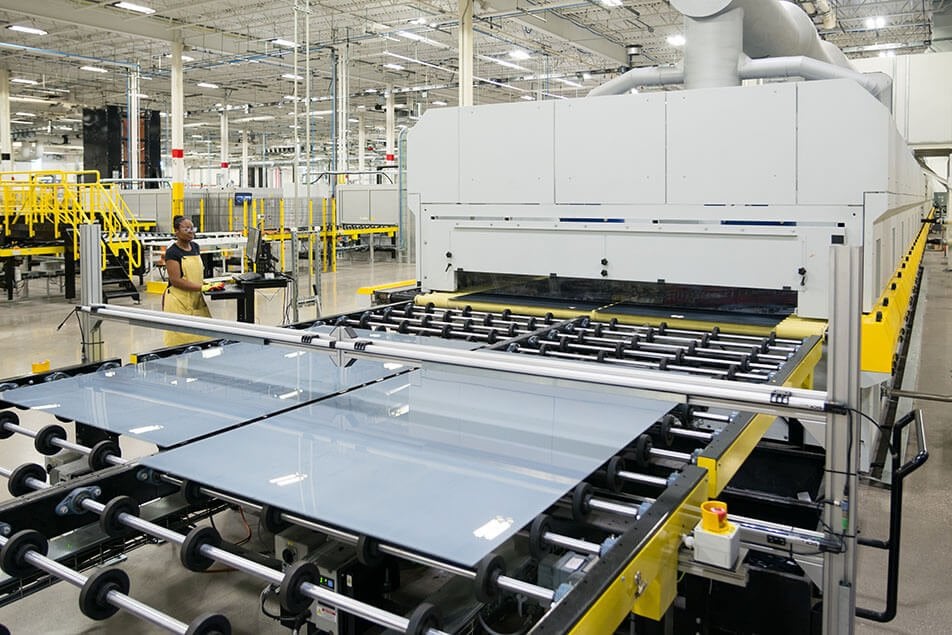
US Solar Manufacturing Surges. The US added a record-breaking 9.3 GW of new solar module manufacturing capacity in the third quarter, including five factories in Alabama, Florida, Ohio and Texas. The total is now nearly 40 GW. Also, solar cells were produced in the US for the first time since 2019.
Source: mafco
1 Comment
A breif explainer of the title: it says cells were produced in the US for the first time, while total production was over 30GW. The cell is the wafer of silicon that converts light to power, it is about as thick as two hairs. Cell manufacturing is high tech material science similar to making microchips. Module assembly is putting it in a frame and connecting wires to it. But that simplicity belies the importance of module assembly as a business. [Module assembly is more expensive than the high tech process of turning silicon into cells](https://www.nrel.gov/solar/market-research-analysis/solar-manufacturing-cost.html) 40 GW of capacity involves about 70 square miles of glass, and a corresponding amount of metal frames and supports. That’s not a bad business to be in, and it saves a lot of shipping emissions to make it in the region. If China was an ally and a responsible actor on the world stage, it might be reasonable to let them have the cell business, while promoting domestic modules.
Also, they headline and the article is wrong. Wrong as fuck. [First Solar manufactures at least 9 GW of cells in the US.](https://www.pv-tech.org/first-solar-added-6-8-gw-nameplate-capacity-in-2023/) (It is a little difficult to reaseach as some sources include overseas production, and many talk about capacity that is about to come online. They produce cadmium telluride thin film solar, it doesn’t involve silicon at all. They make the cells and the modules, and most of their production is in the US. They’ve been doing it for years, they never stopped making cells domestically. They’re in a different category from other solar manufacturers, and they are somewhat inherently limited by the supply of tellurium, but their global nameplate capacity is 16GW, they are not a small player.