
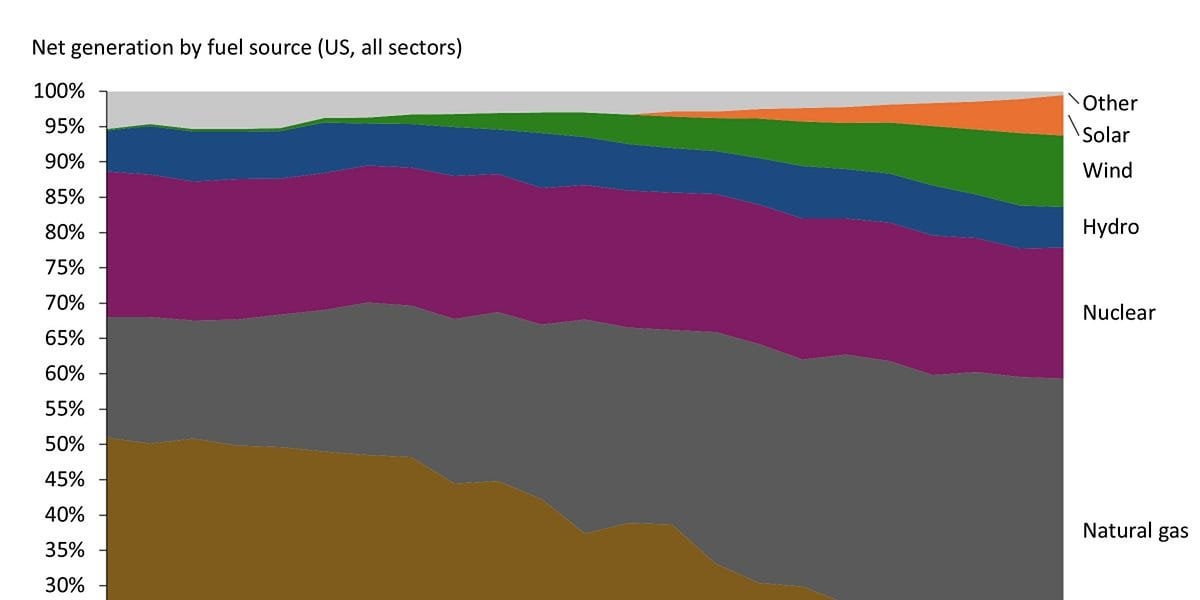
This is an intriguing argument that the concept of "baseload power," which is always brought up as an obstacle to renewables, is largely a function of the way thermal plants operate and doesn't really apply any more:
Instead of the layered metaphor of baseload, we need to think about a tapestry of generators that weaves in and out throughout days and seasons. This will not be deterministic – solar and wind cannot be ramped up at will – but a probabilistic tapestry.
The system will appear messy, with more volatility in pricing and more complexity in long-term resource planning, but the end result is lower cost, more abundant energy for everyone. Clinging to the myth of baseload will not help us get there.
It's persuasive to me but I don't have enough knowledge to see if there are problems or arguments that he has omitted. (When you don't know alot about a topic, it's easy for an argument to seem very persuasive.)
Source: GraniteGeekNH
7 Comments
It’s not a myth, the concept is just changing. The utility I work at views the base load as their coal and nuke units. These are sold daily in the market.
Then renewables fill in the gap of this base baseload to meet demand. Any demand that is missed is met by gas units ramping up.
Ideally the end goal would be nuke plants and batteries serving as the base load, then having the renewable and gas system meet the rest of the demand.
This is true for most American utilities
I studied business, and looking at the grid with renewables reminds me a lot of making a stock portfolio. I wonder if the value of renewables projects can be decided not only by their generating capacity, but by how much they reduce “beta” or risk in the grid. So for example, if a location has wind at a time when the other renewables of the same size are off, it would be valued higher. The value could be in the marginal batteries that don’t need to be built because of that risk reduction.
Oh it’s very simple. Baseload power isn’t real and it is never needed. You do need firm, dispatch-able power but running a plant 100% of the time is NEVER required. And guess what? Almost no (possibly 0)plants in the U.S. run 100%. It’s just not a thing.
But if you’re an accountant, you like high utilization. It’s a financial preference not an energy one.
Baseload power is a term attributed to a constant load component required by the aggregate of the power demand curves. This is useful because certain kinds of generation have long startup and stop times + narrower modulation abilities, as with the usually identified kinds of power plants.
Grid stability hinges on the ability to match load and generation, so chaotic generation like with wind power and an periodic but not constant generation like with PV make it a requirement to have a generally massive energy storage capacity AND some kind of controllable peak generation capacity as we do now with gas (thinking they will all be closed is stupid, you will always need a backup).
I would say that having baseload plants isnt really mandatory. Baseload isnt a myth, theres a specific reason it exists as a concept, but it isn’t really the only way to get to a certain power generation.
Of course theres other things to consider in grid stability but this is the main point i think.
It’s literally in the word **baseload** not **base generation**. Baseload is the minium amount of power we need at any given time. Histoically, this has been met by plants running 24/7 (or close to that). But there’s nothing inherent to the energy system that it must be provided by the same plant at all times.
Baseload is largely just a contractual term.
If you agree to buy all the power from a plant ahead of time they cut you a deal.
Well, how much do you want to buy? Well you go back and basically look at what your minimum typical need is and buy that amount or so. You just found your “baseload” that you want to pre-buy to make it cheaper.
That’s all it is. It’s a way to figure out how to buy power cheaper. That’s all.
Isn’t it also party due to the rate structure that rewards consumers for using power at night? If the rate for power was lower in the middle of the day, because of solar, maybe there would be loads that would suddenly disappear from night and appear in day.