* Hydrogen’s versatility means that it can power many applications; however, clean hydrogen should be strategically deployed in areas where it seems likely to have greatest potential for cost and sustainability benefits compared with alternatives such as direct electrification with clean power sources.
* Supply, demand and supporting infrastructure must all develop simultaneously to overcome systemic barriers; yet hydrogen’s physical properties — its low energy density, flammability and propensity to leak and embrittle metals — impose challenges in terms of cost, safety and acceptance at all stages.
* For decades, forecasts of a clean hydrogen economy have relied on rapid scale-up driving down costs. However, production costs are dominated by engineering and energy inputs and supplemented by transport, storage and usage costs; none of which seems likely to exhibit the rapid reductions seen with solar photovoltaics and batteries.
* To contribute to decarbonization objectives, clean hydrogen must have low emissions across its entire supply chain. System-level assessments identify issues with upstream and consequential greenhouse gas emissions from clean hydrogen production, alongside broader environmental impacts. Several preconditions must be met to deliver sustainable and clean hydrogen across its full life cycle.
* In the short term, renewable electricity could achieve greater emissions abatement if used directly to displace fossil fuels in power generation, heating or transport, instead of being used for green hydrogen production. In the longer term, hydrogen could instead facilitate renewables uptake by integrating excess generation into power systems.
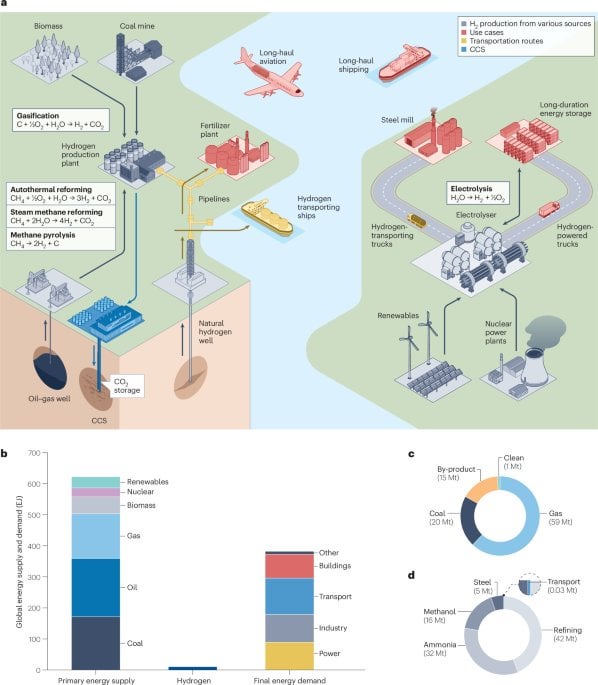
* Low-carbon hydrogen will be essential to decarbonize its existing applications such as petrochemicals and fertilizers (~2% of global CO2 emissions), or in applications in which decarbonization alternatives are prohibitively expensive, such as steelmaking, heavy transport and long-duration energy storage. Hydrogen strategies should prioritize and support these areas to achieve the greatest impact.

1 Comment
Key points from the study:
* Hydrogen’s versatility means that it can power many applications; however, clean hydrogen should be strategically deployed in areas where it seems likely to have greatest potential for cost and sustainability benefits compared with alternatives such as direct electrification with clean power sources.
* Supply, demand and supporting infrastructure must all develop simultaneously to overcome systemic barriers; yet hydrogen’s physical properties — its low energy density, flammability and propensity to leak and embrittle metals — impose challenges in terms of cost, safety and acceptance at all stages.
* For decades, forecasts of a clean hydrogen economy have relied on rapid scale-up driving down costs. However, production costs are dominated by engineering and energy inputs and supplemented by transport, storage and usage costs; none of which seems likely to exhibit the rapid reductions seen with solar photovoltaics and batteries.
* To contribute to decarbonization objectives, clean hydrogen must have low emissions across its entire supply chain. System-level assessments identify issues with upstream and consequential greenhouse gas emissions from clean hydrogen production, alongside broader environmental impacts. Several preconditions must be met to deliver sustainable and clean hydrogen across its full life cycle.
* In the short term, renewable electricity could achieve greater emissions abatement if used directly to displace fossil fuels in power generation, heating or transport, instead of being used for green hydrogen production. In the longer term, hydrogen could instead facilitate renewables uptake by integrating excess generation into power systems.
* Low-carbon hydrogen will be essential to decarbonize its existing applications such as petrochemicals and fertilizers (~2% of global CO2 emissions), or in applications in which decarbonization alternatives are prohibitively expensive, such as steelmaking, heavy transport and long-duration energy storage. Hydrogen strategies should prioritize and support these areas to achieve the greatest impact.