
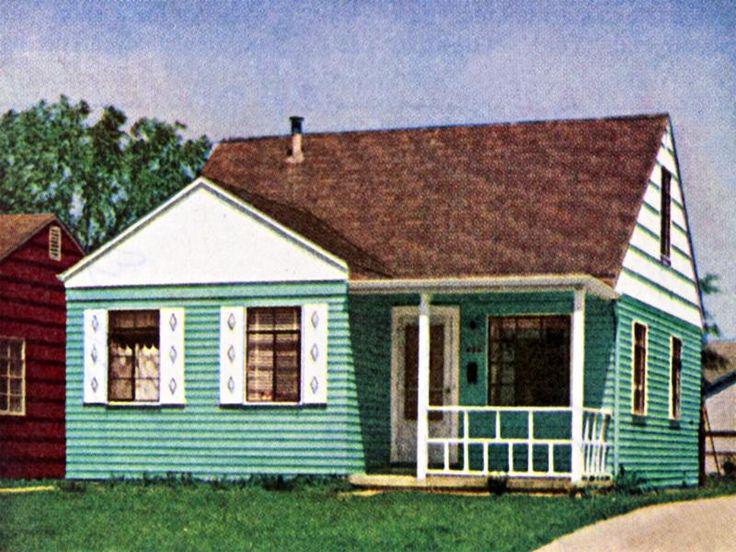
I constantly see people glamorize the 1950s as some kind of golden age for people, and that everybody lived much better back then. I think a lot of this has to do with media from the era largely being entirely focused on upper class suburban living.
They lived with a lot less. Median household incomes, adjusted for cost of living, were only around 25-30k in 1955 compared to 82k today. Median home sizes were 970 square meet in 1958. Today its 2,400 square feet, with less people per home. People mostly weren't living in large suburban homes, back then people still mostly lived in poorer urban areas and dilapidated rural towns. The suburbs they DID build were filled with homes that would be considered comically tiny and shoddily built by todays standards. There's also a survival bias here. The better built, larger ones are the only ones which are still around. The older ones are largely only still found in poorer areas.
Food used to be 16-20% of incomes and is, as of 2024, 10%. Clothing was around 8% and is today around 1-2%. The images you see of women dressed very fancy? That was not the norm. This was the norm. Not because that was the 'style' but because it was all people could afford. Items we take for granted were many times more expensive back then, to the point where a huge portion of homes didn't even have them. Air conditioners, washing machines, dishwashers, fridges, TVs, radios, toaster ovens, microwaves, clothing irons etc.
College? Only 3-4% of americans in 1960 had a bachelors compared to nearly 40% today. Tuition was far less expensive, but again, people lived in poverty. The vast majority of people couldn't take 4 years off and spend $6,200 (adjusted for inflation, median tuition costs over 4 years) to go to school, you had to start working immediately. There were no major government programs to help you out.
The big elephant in the room of course is housing costs. I've already gone over housing sizes, so I'll skip that. But housing is the one thing that has gone up, even proportional to income. Housing was 23% of peoples income in the 1950s and is today 28%. The increase is not nearly as much as people think with the recent spike in prices, partially because median incomes have risen so much and also because most people already are locked into their mortgages from years before.
However, 23% of 30k is a much, much bigger deal than 28% of 82k is. That means you have around 23k left over. 28% of 82k means you have 59k left over.
Source: kolejack2293
13 Comments
This is true, also it is not. Now much less people in USA can afford to buy a home of any size, anywhere. Also do you know what is median income – not incomes. It is the income of the person in the middle between richest and poorest person. Obviously poverty has bottom line. Wealth does not have cap. So on average – which is a different thing, personal incomes, specially compared to purchasing power did not rise so much.
In the 50’s only one of my grandparents homes had indoor plumbing. Dairy farmer family used an outhouse.
The other had 1200 sqft one bath and 3 bedrooms with 6 kids. Veterinarian
I guarantee neither went out to eat more than once a year, if that.
Neither family took vacations other than camping and short road trips. They didn’t leave the country except for WWII.
Most clothes were homemade or hand me downs. My mom‘s most treasured possession is the “fancy” dress she inherited from her mother. It was the “Sunday best” dress for my grandma as well as my mom and her two sisters when they were kids. It is Walmart quality at best.
That is solid middle class in the 50’s
This is some bullshit
Economists are constantly commenting on how the size of new construction has gotten larger though that’s often a very minor addition to the cost of a house. Especially these days when cities charge developers tens of thousands sometimes over a hundred for the privilege of building a house. Some say that cities got a lot of money in that decade to pay for infrastructure but that data isn’t easily available.
Quality and regulation creep has happened but things like plumbing aren’t the problem and are stupid cheap today for a sfh, residential piping isn’t iron/lead/copper these days. All the appliances you listed are stupid cheap as well. Most people could probably buy one of each for less than 3 months rent/mortgage. Even forced air is insanely cheap when done with the new construction.
I appreciate the history lesson and the reminder that the grass is almost never greener.
[$30,000 in 1950 would be $406,000 today](https://www.calculateme.com/inflation/30000.00-dollars/from-1950/to-now) due to inflation.
I don’t see your cost of living numbers.
One could get a college degree without incurring any debt.
One didn’t need a college degree in the ’50s to get a good job.
I owned a house in Denver that was about 800 sq ft. (might have been smaller.) $76000 Made of brick. The whole neighborhood was brick. It wasn’t an upscale neighborhood. (1990) but the house was built around 1940. It was nice enough. Not “the house” but in the same neighborhood. $450,000
I grew up in the ’50s. There wasn’t that much poverty around. At least not until the migrant workers came from Mexico to pick the crops. Although we had 5 kids in a 900 sq ft house. The basement helped a lot.
Edit, in 1960 you could get a 3 course meal at McDonalds for 45cents. That includes a honest to god milkshake which you can’t get anywhere any more.
I don’t go to McD’s, but a whopper, fries, and coke was $17.
Went to the local burrito place. Great burrito $27. Only the burrito. Nothing else.
I kinda think you need to redo your analysis.
Sorry logic and numbers aren’t acceptable in this sub-Reddit, lol
Yes we had to walk through the snow, uphill both ways, to school and we couldn’t even afford any legs!
We had to hop on our stumps, using our arms, with our book bags in our teeth, and boy oh boy our Fannie’s froze!
Those were the days!
Solid breakdown
People also forget the 50s came with a boat load of other (non-financial) issues
Racism and sexism were very rampant every day life. You generally had a few outfits you wore and fixed yourself. There weren’t these closets of different clothes for each and every day. Hines had a single TV if that. Vacations weren’t flights to the Bahamas it was maybe a road trip to the state over at a national park.
The portrayal of families on TV (for example Al.Bujdy is used a lot for representing the 80s) is just flat out wrong. It’s equivalent to the girl in big bang having her own condo by herself next to the rocket scientist people sharing a place. Just made for tv
Isn’t this all just technological improvements?
Most could afford to get married.
Most could afford to have a family and raise kids.
Most had a home.
That sounds pretty good compared to not being able to have children, and that if you do, knowing 50% of them are being raised in poverty.
I don’t know the statistics but my grandmother was telling a story and off-handedly mentioned that in the summers they picked tomatoes. A farmer with a pick-up came by and they spent the day in the fields. – This was probably in the 40’s but that would be associated with some extreme form of poverty today. Back then, I think it was free daycare.
Adjusted for inflation, $30,000 in 1952 is equal to $357,289 in 2025. Annual inflation over this period was 3.45%.