
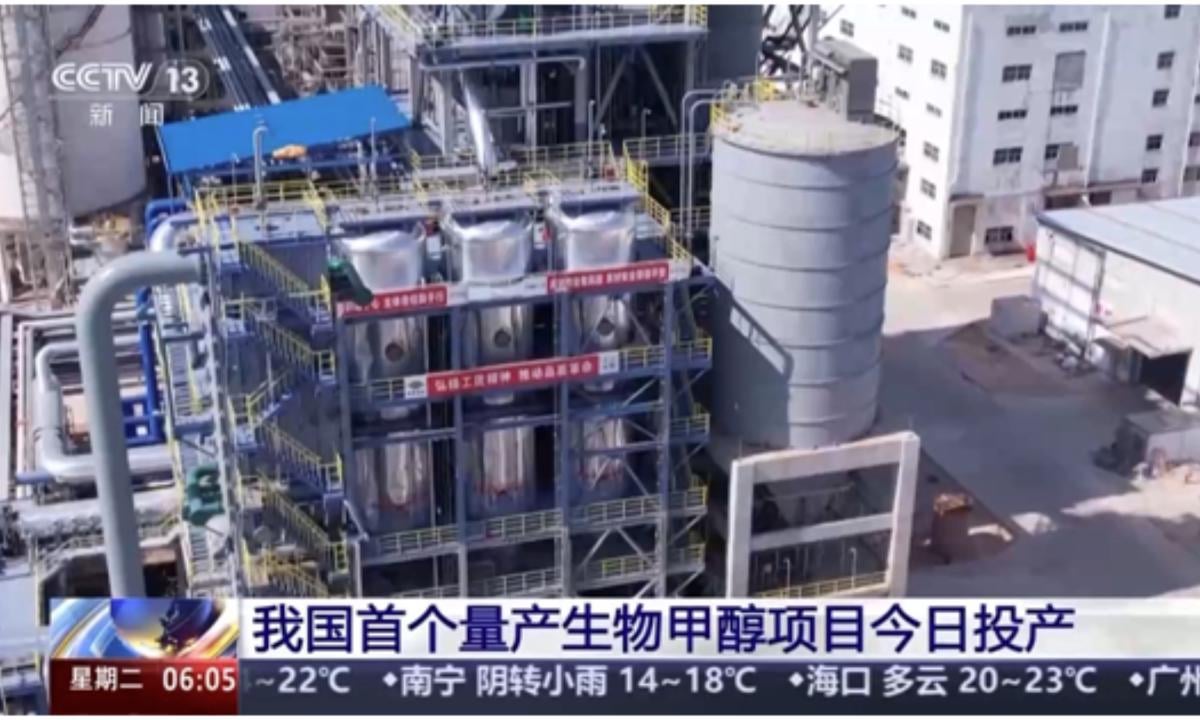
China’s first large-scale bio-methanol project enters full operation, to produce 50,000 tons of green methanol annually
Source: Economy-Fee5830
China’s first large-scale bio-methanol project enters full operation, to produce 50,000 tons of green methanol annually
Source: Economy-Fee5830
1 Comment
# China’s first large-scale bio-methanol project enters full operation, to produce 50,000 tons of green methanol annually
China has launched its first large-scale bio-methanol facility in Zhanjiang, Guangdong Province, marking a strategic shift from hydrogen energy to advanced liquid fuels. The plant produces green methanol with 99.9% purity from biomass waste like tree bark and straw through high-temperature gasification above 1,000°C.
The facility processes waste materials in a gasification island, extracting carbon monoxide and hydrogen for methanol production while filtering over 99% of dust, with residues repurposed for cement manufacturing. This bio-methanol offers an 85% carbon dioxide reduction compared to fossil fuels across its full lifecycle, positioning it as the most competitive sustainable shipping fuel.
Supporting infrastructure includes 30,000 cubic meters of methanol storage at Zhanjiang Port’s deep-water terminal, enabling one-hour closed-loop production-storage-transportation cycles and same-day delivery throughout the Greater Bay Area. The location provides optimal access for exports to major international ports like Singapore.
**Oil equivalency context:** 50,000 tons of methanol is approximately equivalent to **23,000 barrels of oil** (or roughly 630 barrels per day over a year). Methanol contains about 15.6 MJ/kg compared to crude oil’s approximately 42 MJ/kg, meaning methanol has roughly 46% of the energy density of crude oil. While the volumetric energy content is lower, methanol’s cleaner combustion and carbon reduction benefits make it increasingly attractive for maritime applications where emissions regulations are tightening.