
The case for scrubbing the seas to save the climate: We can extract CO2 from the ocean. Can it turn into a business?
Source: vox
The case for scrubbing the seas to save the climate: We can extract CO2 from the ocean. Can it turn into a business?
Source: vox
1 Comment
We’ve painted ourselves into a corner on climate change — our planet is going to [exceed 1.5 degrees Celsius of warming](https://www.vox.com/climate/472626/climate-change-1-5c-2025-goal-warming). And while greenhouse gas emissions aren’t rising as fast as they used to, we’re still [emitting carbon dioxide at record-high levels](https://climatetrace.org/news/climate-trace-data-show-global-greenhouse-gas-emissions-hit-a-new-record-high-in-2025), so further warming is inevitable.
Stopping Earth from heating up further demands effectively zeroing out everything we emit from burning fossil fuels. But at this rate, there’s no way around the fact that we have to go further: We must not just reduce carbon emissions, but pull carbon dioxide back out of the air. The latest comprehensive report from the [United Nations’ body of climate scientists](https://www.ipcc.ch/report/sixth-assessment-report-cycle/) made it clear that every scenario that sees us escaping dangerous warming requires carbon capture.
It’s possible to wrench the thermostat back in the other direction and avoid the worst outcomes. It just requires the small matter of scaling up nascent technologies to a global scale and building an entirely new industry from scratch to pull upward of [9 billion metric tons of carbon dioxide](https://www.ox.ac.uk/news/2024-06-05-new-report-states-7-9-billion-tonnes-co2-must-be-sustainably-removed-year-hit) from the air each year. No problem.
But there may be a solution to this that checks all the right boxes and very few of the bad ones: extracting carbon directly from the sea.
It gets around some of the squeamishness around geoengineering approaches like [dimming the sky](https://www.vox.com/videos/2023/5/4/23711213/solar-geoengineering-climate-controversy-emissions) to cool the Earth since there’s nothing being added to the environment; just removing the waste that shouldn’t have been spewed so recklessly in the first place. In 2023, hundreds of [scientists signed onto a letter](https://www.oceancdrscience.org/) calling for more research, development, and field-testing of ocean-based CO2 removal.
It can also address another problem created by our gargantuan carbon emissions: [ocean acidification](https://www.noaa.gov/education/resource-collections/ocean-coasts/ocean-acidification). When carbon dioxide dissolves in water, it forms carbonic acid, which is slowly starting to shift the pH of the world’s oceans. That affects marine chemistry in ways we’re only beginning to understand, and can threaten sea life by dissolving the shells of tiny organisms that form the foundation of the ocean’s food pyramid. Pulling carbon out of the ocean can slow this down.
So two fish on one hook. Simple, right?
Of course not. “There are quite a lot of challenges, to be honest,” said [Adam Yang](https://www.dal.ca/faculty/engineering/civil-resource/faculty-staff/our-faculty/adam-yang.html), who studies ocean CO2 removal at Dalhousie University in Canada. “This whole field of marine carbon dioxide removal is quite new.”
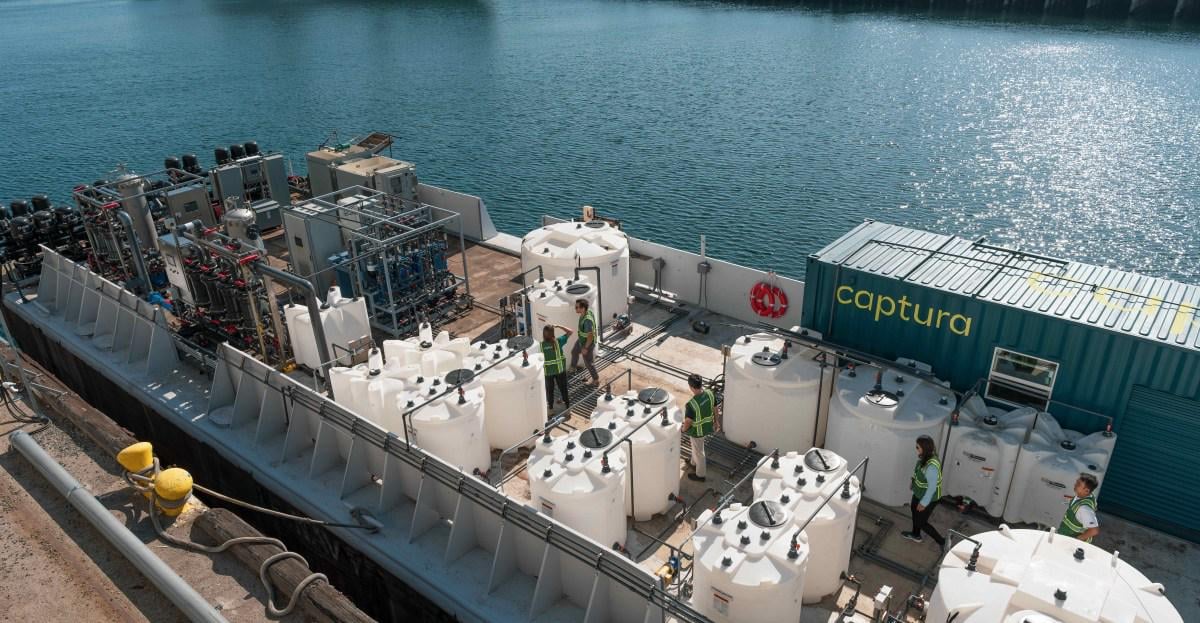
Yet there are already companies working on the problem with new technologies who say there is a business here that is planet-saving *and* profitable. Later this year, one ocean CO2 capture company — [Equatic](https://www.equatic.tech/) — is planning to commission the [largest marine CO2 removal plant](https://www.channelnewsasia.com/sustainability/world-largest-ocean-based-carbon-dioxide-removal-plant-built-singapore-4152536) in the world in Singapore. It will pull about 10 metric tons of carbon dioxide from the ocean every day. That’s a miniscule amount compared to the billions of tons of extraction needed, but it would provide a demonstration that the technology does indeed work.