
(Putin’s decision to launch the Russia–Ukraine war—one that is not rationally necessary—stems not only from the specific Russia–Ukraine conflict, ideological factors, and the need to divert domestic tensions, but also from his advancing age, prolonged exposure to a high-risk environment, and his position of immense power accompanied by fears of assassination, aging, and death, all of which have contributed to psychological distortion. Under the strain of psychological issues he can no longer fully control, as well as an intense fear of mortality, he chose to initiate war as a means of relieving pressure—while at the same time leading many others toward death.)
On the last day of 2022, Russian President Vladimir Putin delivered his 2023 New Year address at the headquarters of Russia’s Southern Military District. In his speech, Putin emphasized the importance of defending Russia’s national sovereignty and protecting the moral integrity and dignity of the Russian people. He also clearly stated that military operations in Ukraine would continue and called on Russian soldiers and citizens to fight for the nation.
This indicates that Putin has not halted the war despite the enormous setbacks and severe losses suffered by Russian forces in the Russia-Ukraine conflict. Instead, he seeks to prolong the war until Russia achieves “victory.”
In the war, which has now lasted nearly a year, the Russian military has suffered over 100,000 casualties, including deaths and injuries, and has lost most of the Ukrainian territory it initially occupied. Russian forces have been steadily retreating on the battlefield. Moreover, the war has exposed serious flaws in the Russian military, including outdated equipment, obsolete tactics, poor combat effectiveness, and widespread corruption—making it unlikely that Russia can defeat the Ukrainian army, which is well-armed by NATO.
But why does Putin persist in continuing the war? What motivates him to invade and occupy Ukraine? And what might be the future fate awaiting Putin personally?
Most observers have interpreted Putin’s invasion of Ukraine as an act of imperial dominance and expansionism driven by Russia’s pragmatic interests—a method to counter the United States, NATO, and the European Union. This is indeed part of the rationale.
However, Putin’s motivations go beyond that. In this New Year address, as well as in other venues (such as the annual Valdai Discussion Club forums, which he has attended in recent years), Putin has repeatedly expressed admiration for the Russian people, deep devotion to Orthodox Christianity, and a steadfast commitment to traditional values derived from both. He often emphasizes the importance of upholding moral codes rooted in these traditions.
At the same time, Putin fiercely criticizes the values and behavior of Western progressive forces and the broader establishment. This includes condemnation of progressive criticism and deconstruction of nationhood, religion, and the family; and the promotion of pluralistic societies, feminism, LGBT rights, and environmentalism—all of which are openly disparaged and attacked by the Putin regime.
From the perspective of Putin and his supporters (including Russian ultra-nationalists, racists, and Orthodox Christian conservatives), Western establishment forces—particularly progressives—have abandoned traditional values rooted in nation, religion, and family, and have dismantled the corresponding social structures. This has, in their view, led to national collapse and moral decay, akin to the Biblical story of Sodom. Putin believes that Western societies are controlled by forces with such “degenerate” values and malicious intent—often labeled by conspiracy theorists as the “deep state.” While Putin does not fully embrace the deep state conspiracy theory, he does view the Western establishment as corrupt and adversarial.
Putin and his supporters argue that in the face of widespread Western moral decline, Russia must not only resist the erosion of its own culture but must actively defeat those holding power and shaping discourse in the West. They believe Russia should liberate Europe and even the world from this “degeneracy,” restoring traditional social structures in all nations and returning the global order to a system of imperial spheres of influence.
These ideological motivations have received limited international attention. Although some figures—such as Nobel laureate Paul Krugman—have touched on them in publications like The New York Times, overall attention and research remain insufficient.
The ideological worldview held by Putin and his supporters is, to some extent, similar to Samuel Huntington’s “clash of civilizations” theory. However, unlike Huntington—who argued that there are no inherent superiorities or inferiorities between civilizations—Putin and his camp frame the conflict as a moral struggle between good and evil: Russia’s adherence to “moral” and “righteous” traditional values against the “degenerate” values of Western progressivism and the establishment (or “deep state”). (Of course, Putin himself may not devoutly believe in these values—he is more of a pragmatic opportunist. However, many of his key allies and supporters are devout nationalistic and religious conservatives. These factions and individuals use each other strategically—Putin maintains power through them, and they pursue their ideological and material goals through him.)
The domestic and foreign policies of Putin and his circle over the past decade are deeply rooted in these value systems. It is precisely because of these ideological leanings that Putin abandoned earlier efforts to integrate into the Western world, instead asserting Russian sovereignty, promoting national and Orthodox traditions, and embarking on a path of long-term confrontation with the West.
The invasion of Ukraine represents a key step in Putin’s project to “defend Russia” and “rescue the degenerate West.” In the view of Putin and his supporters, Ukraine’s independence and pro-Western alignment not only threaten Russia’s practical interests and geopolitical security, but also pose a moral and ideological danger. Ukraine’s government, in their eyes, acts as an agent of the Western establishment (the “deep state”), a forward base for subverting Putin’s rule, and a conduit for Western values that could corrode Russian national identity. Thus, Putin launched this large-scale war, which, from a pragmatic standpoint, was unnecessary. It has plunged Ukraine into catastrophic suffering and cast a dark shadow over Europe and the world.
Why Does Putin Persist in a Losing War? An Analysis of His Behavior and Psychological Motivation
Now that the Russia-Ukraine war has lasted nearly a year, with the Russian military suffering heavy losses and retreating step by step, why does Putin still insist on continuing a war that is seemingly unwinnable? This can be speculated upon through an analysis of Putin’s conduct and psychological motivations.
Since entering the center of Russian politics, Putin has always portrayed himself as tough, resolute, and courageous. This “tough guy” persona has been a key element in securing widespread support, rising to the presidency, and maintaining long-term power.
For example, the reason Putin stood out among Yeltsin’s many confidants and became his successor was that, during his tenure as prime minister, he launched the Second Chechen War and suppressed the Chechen Muslim rebellion and bid for independence with an iron fist—including many brutal actions violating human rights, such as using internationally banned weapons of mass destruction, attacking civilian areas, and executing prisoners of war. By avenging the shame of Russia’s defeat in the First Chechen War, Putin earned praise from Russia’s military and political elite and gained the support of the masses. His infamous statement during the Chechen war—“We will drown the terrorists in the toilet”—though later regretted by Putin himself, became widely quoted and admired by authoritarian sympathizers and those who worship strength, including many in China.
Over the following two decades in power, Putin has continuously cultivated his “tough guy” image. Whether through foreign policy posturing (especially against the U.S. and NATO), ruthless crackdowns on domestic oligarchs, or personal displays of masculinity through hunting, swimming, and fitness, Putin has consistently projected aggression and intimidation.
For a “tough guy” like Putin, maintaining this image means never appearing weak or defeated in any conflict. He must exhibit aggression and achieve victory. Only by staying uncompromising and appearing successful (even if the success is fabricated) can he command obedience from powerful figures across government, business, and the military, and maintain the admiration of the public. Any sign of retreat or admission of failure would cause him to lose authority and risk being overthrown by his once-loyal subordinates and supporters.
Therefore, even as the Russian military continues to suffer defeats in Ukraine, Putin refuses genuine peace talks. He insists on fighting to the end, because only by doing so can he retain the support of the Russian elites and public, who revere him for his authoritarian resolve. If he were to admit failure and withdraw, he would be perceived as weak and abandoned.
But given the current situation—where a Russian military victory is no longer possible—is Putin really going to continue a doomed war until final defeat? Again, this can be understood by examining his psychological outlook.
As mentioned earlier, for someone like Putin, retreat is not an option. Strength must be shown not only in times of advantage but especially in times of adversity. Autocrats who rely on violence and deceit to gain and hold power are especially terrified that compromise and concession will lead to the collapse of their authority. The weaker they are, the more they must bluff and escalate provocations and attacks, to prevent others from realizing their vulnerability.
Such people often pursue their goals recklessly, without regard for consequences, using any means and paying any price to intimidate adversaries and secure their objectives. In international relations, there is a well-known theory called the “Game of Chicken.” The basic idea is that two parties, like cars speeding toward each other in the same lane, refuse to yield in order to demonstrate resolve. If neither side backs down, they crash—both suffer. If one yields at the last moment, they are labeled a coward, damaging their reputation, but at least avoid disaster. (Of course, such dynamics aren’t limited to international politics; they appear in power struggles within countries and institutions as well.)
Putin is someone who thrives on playing the “Game of Chicken.” He launched the war in Ukraine based on the prediction that the West would not support Ukraine—or at least not provide large-scale support—and that he could achieve victory through a bold gamble. But he miscalculated, and the Russian military has paid a terrible price. A typical leader might retreat under such circumstances, but Putin chose to continue fighting Ukraine and the West.
Putin’s logic is that, under his control, the Russian military does not fear casualties (or rather, regardless of the scale of casualties, the military will obey his orders and fight on). He believes that Ukraine and the West, because they value human rights, democracy, and public opinion, will not be able to endure growing losses and costs, and will eventually “chicken out.” Thus, Russia can achieve victory—or at least force Ukraine and the West to make major concessions in exchange for a face-saving ceasefire.
In Chinese science fiction author Liu Cixin’s acclaimed novel The Three-Body Problem, there is a character named Thomas Wade—ruthless, devious, and aggressive, willing to do anything to achieve his goals, even mutual destruction. Putin is very much this type of person.
Putin not only continues the war, but has repeatedly threatened to use nuclear weapons. This too is part of the “Game of Chicken,” aiming to coerce Western compromise. Moreover, if the survival of his regime or his own life were threatened, Putin would likely choose to use nuclear weapons (though whether the order would be successfully carried out is another matter—he might be arrested by his subordinates before that happens).
In fact, Putin’s tough and risk-taking personality has been evident since his youth. During the collapse of Eastern Europe and the fall of the Berlin Wall, Putin, then a KGB officer stationed in East Germany, once held a gun to fend off East Germans trying to storm the KGB office. After entering politics, he continued to act tough both domestically and internationally, achieving success through skillful political maneuvering, favorable circumstances, and sheer luck.
These successes encouraged Putin, convincing him that toughness and risk-taking always lead to victory. Russia’s successful “reunification” with Crimea in 2014 and control over Donbas further inflated his ambitions. Thus came the full-scale invasion of Ukraine in 2022.
Putin’s invasion of Ukraine surprised many observers. At least before the U.S. intelligence community learned of and disclosed Putin’s intentions, most people didn’t expect a full-scale invasion. After all, Putin had already taken Crimea and controlled Donbas through pro-Russian local forces—there was no need to occupy the whole of Ukraine. But Putin invaded anyway. Beyond ideological motivations, the invasion reflected his psychological need to take risks others wouldn’t dare. The act of launching a full-scale war was a performance of his personal traits: “bravery,” “toughness,” aggressiveness, and fearlessness of sacrifice. If successful, it would further solidify Putin’s “tough guy” image and earn him more admiration and loyalty from Russian elites.
However, the Russian military’s unexpected defeats over the past year dealt a heavy blow to Putin. But instead of changing course, he doubled down—digging in, escalating further—in hopes of making a comeback and restoring his confidence and authority.
From Putin’s perspective, this strategy is logical. If he retreats or admits failure, not only would he have no way to answer to Russia’s 100 million citizens, but he himself might not even survive. Continuing the war, and hoping that Ukraine and the West buckle under the pressure, at least gives him a chance to exit with dignity.
Yet the cost of Putin’s stubbornness and continued aggression must be borne by others, including Russian soldiers and civilians. Over the past year of war, tens of thousands of Russian troops have died, and many more have been wounded or disabled. Unlike the just cause of defending the homeland against Nazi Germany in WWII, this war is unjust and unnecessary—these fallen or maimed soldiers are nothing more than cannon fodder for a political strongman’s ambition.
One of the Nobel laureate Svetlana Alexievich’s most famous books is Zinky Boys, referring to young Soviet soldiers killed in the Afghan war, whose bodies were returned in zinc coffins. In today’s Russia-Ukraine war, many Russian soldiers hit by HIMARS missiles have been blown to pieces, leaving only fragments—mothers cannot even see their sons one last time.
The Soviet invasion of Afghanistan (1979–1989), another unjust war, killed 15,000 Soviet troops and wounded tens of thousands more. In contrast, Putin’s war in Ukraine—more unjust and even less necessary—has exceeded those death and injury tolls in less than a year. All this tragedy stems from Putin’s ambition and his need to sustain his “tough guy” persona.
Putin is now conscripting more Russians—including middle-aged men—to fight, simply sending more cannon fodder to the front lines. As the war drags on, more families are torn apart. Mothers, wives, and children of the dead can only mourn in tears, forever bereft of their loved ones. This is the consequence of Putin’s actions—the very man who claims to uphold “family values.”
The war harms not only soldiers. Russian civilians who are not in the military also suffer from Putin’s war. Since Russia annexed Crimea in 2014, it has faced harsh international sanctions and growing economic decline. When Putin launched the full-scale invasion in 2022, the U.S. and Europe intensified sanctions, cutting Russia off from Western trade and finance. Russia was expelled from many international organizations and cooperative systems. For example, U.S. and EU sanctions removed Russian banks from the SWIFT payment system, crippling their international transactions and leaving ordinary citizens unable to access their savings.
Years of sanctions, especially the intensified measures of the past year, along with enormous military expenditures, have pushed Russia’s economy and people’s livelihoods into severe crisis. Many regions now resemble the Soviet or Yeltsin eras, with people queueing for cheap food to meet basic needs. Today, Russia’s national GDP is equivalent only to that of Guangdong province in China, highlighting the extent of its economic decline. Although authoritarianism and corruption are the root causes of this hardship, the war has clearly made everything worse.
Of course, Ukraine has also paid a heavy price for resisting the invasion: tens of thousands of soldiers and civilians have been killed or injured, many towns and cities destroyed, and millions of people displaced or left homeless. The West, in supporting Ukraine, has borne enormous financial costs and political strain. The Russia-Ukraine war has destabilized an already fragile international landscape, casting a long and dark shadow over Europe and the world.
In Summary: The Cost of Putin’s Aggression Is Paid by the People, While He Seeks Power and Glory
In short, Putin’s toughness and recklessness exact a cost borne by people across many nations, including Russian civilians and soldiers. In pursuit of personal power and gain, Putin is willing to let over a hundred thousand Russian and Ukrainian civilians and soldiers perish in war—and still refuses to stop. This is utterly shameless.
It must be stated clearly: Putin and the entire ruling clique under his leadership are not truly sacrificing for the nation or acting with integrity and self-discipline. On the contrary, the ruling elite in Russia, including Putin himself, are deeply corrupt, plundering resources and living in extravagant luxury. Putin personally owns luxury residences and expensive watches far beyond what his official income could afford. He possesses a luxury yacht abroad, and his two daughters have amassed unexplained wealth. Other loyal officials, military officers, police, and oligarchs around him are likewise massively corrupt. Can such a morally decayed and degenerate ruling group truly fight and sacrifice for the people?
Yet in Russia, China, and many other countries, there are countless people who deeply admire strongmen like Putin, even praising his brutal and barbaric actions. This mindset is ugly, but unfortunately widespread. The Chinese thinker Lu Xun sharply commented on this phenomenon in his essay Napoleon and Jenner:
“I know a doctor, very busy, but also often attacked by patients. One day, he sighed and said: ‘If you want praise, it’s best to kill people. Just compare Napoleon and Jenner…’
I think that’s true. What do Napoleon’s military feats have to do with us? Yet we always admire his heroism.
Some even go so far as to praise Genghis Khan, under whom our ancestors were enslaved. From today’s racial perspective, Asians are considered an inferior race, yet we still boast about Hitler.
Because all three were calamities who killed without blinking.
But if we look at our arms, we mostly have scars—that’s from the smallpox vaccine, which saved us from deadly disease.
Since this method was discovered, countless children have been saved—even if some of them later still became cannon fodder for ’heroes.’
But who remembers the name of the inventor, Jenner?
The killers destroy the world; the healers patch it up. And those with the qualifications to become cannon fodder always admire the killers.
If this mindset doesn’t change, I think the world will keep getting destroyed, and people will keep suffering.”
Lu Xun’s century-old criticism of people worshiping murderous tyrants while neglecting those who save lives still strikes a powerful chord today. If, in the imperialist struggles of the early 20th century, it was somewhat understandable for people to idolize figures like Hitler or Genghis Khan, then in the 21st century—a time defined by peace, development, and a focus on human rights—so many people in Russia and China continuing to admire an iron-fisted expansionist dictator like Putin is nothing short of disgraceful and self-degrading.
The Russian people have a long tradition of worshiping strongmen and romanticizing war and expansion (even if most are merely cannon fodder in wars initiated by such figures). Putin’s rise to leadership and his ability to remain in power for over two decades is inseparable from Russians’ reverence for autocracy. Dictators and the people are mutually reinforcing. The kind of leader a nation has reflects its people—and vice versa. Russia’s entrapment in a cycle of despotism and turmoil over the past century is closely tied to this cultural tendency to venerate violence and strongmen, while scorning peace and constitutional order.
Russia’s current quagmire of war and international sanctions is, in some sense, self-inflicted. Unless the Russian people come to widely recognize the consequences of strongman worship and violence, and pursue the establishment of democracy, rule of law, and a pluralistic society, even if Putin falls, his replacement is likely to be another tyrant in the mold of Putin or Stalin—and history’s tragedy will repeat itself.
Similarly, in China, from elites to commoners, many people admire political strongmen—even tyrants. Chinese citizens not only idolize domestic despots like Qin Shi Huang and Mao Zedong but also highly praise foreign autocrats like Stalin and Putin. In China, admiration for Putin is common among both top scholars in the humanities and social sciences (including researchers at the Chinese Academy of Social Sciences) and among grassroots workers such as migrant laborers.
If praising domestic autocrats can be attributed to the pressures of political censorship, then the admiration of foreign tyrants reveals an even deeper mindset of power-worship. For elites within the system, siding with Putin may reflect shared authoritarian inclinations. But for the ordinary people—the very ones who would be cannon fodder in such systems—idolizing Putin is simply a manifestation of ignorance and servility.
In recent years, Social Darwinism has gained strong traction in Chinese society. As noted earlier, The Three-Body Problem can be seen as a hymn to Social Darwinism. The character Thomas Wade epitomizes this ideology—ruthless, cunning, and utterly amoral. The popularity of the book in China, along with widespread admiration for the vicious Wade and the ridicule of Cheng Xin—the sincere, kind-hearted female protagonist—as a naive “Saint Mother,” reflects how deeply entrenched Social Darwinist thinking is in contemporary China.
In reality, Putin fits the mold of a Thomas Wade-type figure more than anyone. The Chinese adulation of Putin stems from the same psychological pattern. Many in China loudly cheer Putin’s defiance of the West—especially his anti-American stance. They fawn over his references to Russia’s nuclear capabilities, seemingly unconcerned that they themselves might be cannon fodder in his wars or victims in a nuclear apocalypse. As for Putin’s suppression of dissent and ethnic minorities, or his manipulation of fake news to destabilize the world—many either remain unaware, treat it as trivial, or even praise such behavior as evidence of his leadership strength, his ability to “maintain stability” and influence global affairs.
Chinese people’s admiration for tyrants like Putin reflects the pervasive influence of Social Darwinist ideology and a moral deterioration of societal values. They idolize brutal, success-at-all-costs figures like Putin and Stalin, while vilifying humane and democratic leaders such as Gorbachev. This reveals a widespread cognitive distortion and ethical decline in Chinese society.
Beyond China and Russia, many people in other countries also support Putin. Some share similar motivations—worship of authoritarian strongmen—while others align with Putin’s rhetoric defending “traditional values.” In the West, far-right and ultra-right-wing factions support Putin precisely because of his emphasis on nationalism, religion, and the family, and his condemnation of secularism, diversity, feminism, and LGBT rights. This ideological alignment has won Putin international followers. In politics, prominent figures like Donald Trump in the United States, Marine Le Pen of France’s National Rally, and Viktor Orbán in Hungary are all self-professed admirers of Putin.
Putin and these far-right movements in the West promote a worldview rooted in racism/extreme nationalism, religious conservatism, and rigid traditionalism—especially the glorification of “family values.” While some aspects of these ideas may seem reasonable or appealing on the surface, they ultimately stand in opposition to universal progressive values based on equality and inclusion. These ideologies are exclusionary and narrow-minded, and they severely undermine the rights and dignity of women, LGBT individuals, ethnic minorities, and other vulnerable groups.
Moreover, even the nationalist, religious, and family values that Putin claims to defend have in fact deteriorated under his rule in Russia.
True defense of national and ethnic interests should ensure that every citizen enjoys rights and freedoms, and that every compatriot lives in prosperity and security. Yet in the reality of internal despotism and external hostility under Putin, Russia suffers from deep corruption and widespread poverty, with its citizens stripped of rights and struggling to survive. Is this the vision of a genuine nationalist who loves his country and people?
On religion: although Putin constantly emphasizes the importance of Orthodox Christianity and elevates the status of the Orthodox Church, Russian citizens remain spiritually impoverished and morally underdeveloped. Many worship violence and money, gaining little genuine benefit from religion. Even the top leadership of the Russian Orthodox Church, including the Patriarch of Moscow, have become tools and henchmen used by Putin to uphold authoritarianism.
As for family values, they are indeed essential. But the social unrest and moral decay in Putin’s Russia—especially the rampant crime (such as high homicide rates)—reflect widespread familial discord and failed upbringing. Over his more than two decades in power, Putin has not led Russians to love and cherish their families more. Instead, rates of domestic violence and other serious crimes against family members—especially homicides and sexual assaults—are among the highest in the world. According to reports from women’s rights organizations, the domestic violence rate in Russia is as high as 40%, with many cases resulting in severe injury or disability. Of every ten women killed worldwide, one is Russian—even though Russia comprises less than 2% of the global population, Russian women are over five times more likely to be murdered than the global average. The Putin-controlled parliament (State Duma) has rejected more than 40 legislative attempts to pass anti-domestic violence laws. In 2017, domestic violence was even decriminalized—lighter forms of abuse are no longer criminal offenses.
In contrast, although Western countries often oppose extreme nationalism and tend to be skeptical of religious conservatism, and although deconstruction of family values is relatively common in some circles (though only a minority of Westerners completely oppose family values—most of the public still affirms the importance and positive role of family, and conservative parties that promote family values frequently govern), the rights of citizens and ethnic diasporas in these countries are generally well protected. Religious freedom allows believers of different faiths to participate in fellowship and church life, where members enjoy relatively equal and harmonious relationships. Western nations have a much higher rate of stable, happy families than Russia—as illustrated by the epidemic of domestic violence against Russian women. Russian youth are growing up in an environment filled with violence. By contrast, Western countries have strict anti-domestic violence laws and robust protection systems for women and children. Except for the United States, most developed countries enjoy very high levels of public safety. Many Western families also have the means and willingness to adopt abandoned children from countries like China, Russia, and across Asia, Africa, and Latin America—giving more children around the world the warmth of a family. These achievements remain far beyond the reach of Putin’s Russia, which claims to champion nationalism, religious conservatism, and family values.
On the handling of international disputes, the Western-led international order offers comparatively peaceful and just resolutions. To be sure, Western countries are not entirely fair or impartial when major interests are at stake, and sometimes resort to force in resolving international conflicts. But they are clearly better than authoritarian regimes like Russia and China that openly reject universal human rights and international norms. Today’s international system is far from perfectly fair or reasonable and may never be—but it is preferable to a lawless jungle where rules and contracts are ignored, and power and treachery alone determine outcomes. Putin’s unnecessary use of force and his nuclear blackmail have harmed not only Ukraine but also the Russian people and the entire world. The “toughness” and “courage” he displays are not directed toward any worthy goal, but instead toward selfish or even mutually destructive ends that defy logic and justice.
If Putin were to use nuclear weapons, it would plunge the world into catastrophic destruction. Even localized nuclear strikes would kill at least hundreds of thousands and irreversibly damage local ecosystems. Therefore, Putin’s repeated nuclear threats should not be seen as “bravery” to be praised, but rather as the reckless behavior of a gangster in power. His frequent use of the “Game of Chicken” risks mutual miscalculation among conflict participants and escalating retaliation, leading to disaster—tens of thousands killed or injured at minimum, or at worst, global annihilation. His zero-sum thinking ensures that one party will suffer, or both. There is no vision for peaceful cooperation. Even when war is avoided, this approach poisons interpersonal and international relationships, fostering more hatred, suspicion, and conflict. It undermines trust and harmony between people and damages global peace and cooperation. Therefore, the world should not admire Putin’s supposed “strength,” “bravery,” or “manliness,” but should collectively reject and condemn him.
In fact, while Putin likes to portray himself as a strong-minded political strongman, his inner world is filled with fear and weakness. Constantly battling both internal and external enemies with violence and deception, his psyche has become deeply distorted and traumatized. His ability to perceive reality and manage affairs is inferior to that of politicians in normal democratic countries—and in some respects, even to ordinary citizens in good mental health.
For instance, Putin’s decision to invade Ukraine was based on a severe misjudgment of the West’s position. He underestimated Western support for Ukraine and the determination of President Zelensky and the Ukrainian people. At the same time, he overestimated the strength of the Russian military and the Russian people’s enthusiasm for war. These mistaken perceptions were key reasons behind his blind decision to go to war and Russia’s subsequent military debacle.
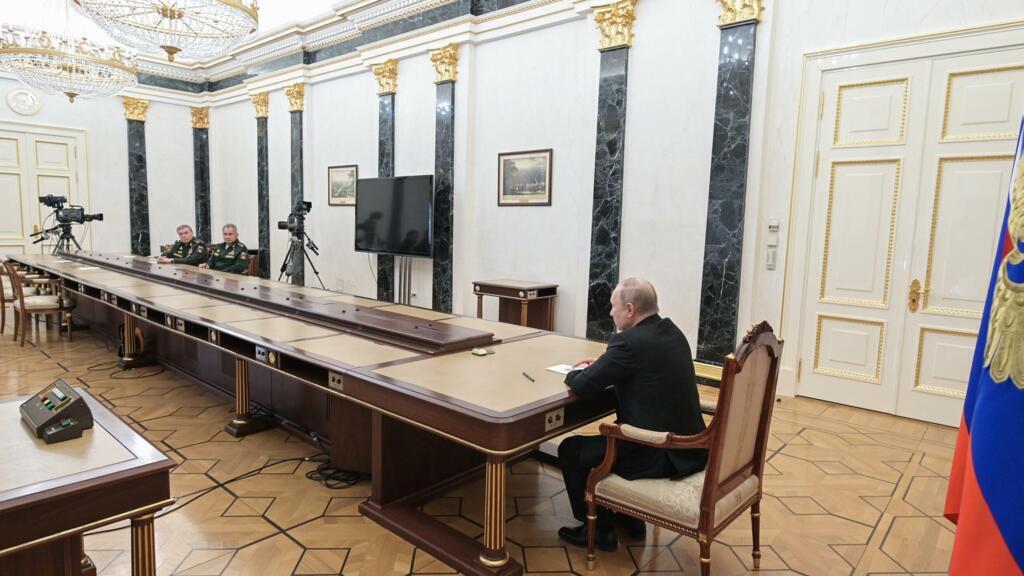
After the Russian military suffered repeated defeats, Putin’s appearances during meetings with subordinates and foreign leaders made his weakness even more visible. In internal meetings, he sat at extraordinarily long tables, keeping dozens of meters between himself and others—clearly indicating his fear of being attacked or assassinated by close aides.
When meeting with foreign leaders such as Iran’s Supreme Leader Ali Khamenei, Putin lost his once-dominant posture due to the military setbacks, and instead appeared humble and deferential. Previously, when meeting with Turkish President Erdoğan at the height of his power, Putin deliberately kept Erdoğan waiting as a show of dominance. But in July of this year, after Russia’s failures in Ukraine, Erdoğan turned the tables and made Putin wait awkwardly under the spotlight before joining him for talks. These moments reveal that Putin’s supposed “strength” is only performative in times of power, and when he is weakened, he is more cowardly than the average person. It underscores the essence of figures like Putin: bullying the weak, fearing the strong, swaggering in triumph, and cowering in defeat.
Putin, a former KGB officer, spent years immersed in the deceptive world of espionage, where he developed weak moral instincts but high cunning. After entering politics, he thrived in the already corrupt and filthy Russian political scene, relying on violence and deceit. But this method naturally earns many enemies. He has killed countless political insiders and dissidents. Many military and political elites who claim loyalty to Putin do so out of fear, not sincere admiration—and once he loses power, they may well turn against him.
Having used so many ruthless tactics against others, Putin knows better than most how terrifying such methods can be. His fear of betrayal by others—and the world at large—is greater than average. For example, he knew that former German Chancellor Angela Merkel had been bitten by a dog as a child and feared them. Yet during one meeting, he deliberately let a dog into the room to roam in front of Merkel. She composed herself to avoid reacting. This is just one example of Putin’s petty and sinister tricks. But having used such methods himself, he fears being subjected to them as well. His insistence on meeting subordinates across vast tables during the war is a clear sign of his fear of close-range betrayal.
(Unfinished due to Reddit’s post length limit; the remaining part is in the comments section.)
(The author of this article, Wang Qingmin(王庆民), is a Chinese writer based in Europe and a researcher of international politics, with multiple publications on the Russia–Ukraine issue.)
Source: Slow-Property5895
2 Comments
Due to length constraints, the main body of the post could not be published in full at once. The remaining part is provided here.
In conclusion, Putin as a president resembles a mafia boss—inflicting fear and harm upon others, while being deeply terrified that others will treat him with the same or even more sinister cruelty.
Because Putin fears others will “repay him in his own coin,” he is constantly on alert against being harmed, which inevitably distorts his mental state. Behind his “tough guy” façade lies a disordered mind and a helpless, bewildered psyche. After orchestrating assassinations, wars, and other acts of terror, he appears resolute and fearless, but is in fact plagued by anxiety. His tormented psyche cannot maintain rationality under such pressure, which inevitably leads to irrational actions. Holding unchecked power, and having the final say in all matters in Russia, only makes him more unrestrained and erratic.
This also illustrates the impossibility of achieving peace between nations or harmony within societies through brute force and violent repression, as attempted by Putin and others like him—strongmen and social Darwinists. Even they themselves, under violence and coercion, cannot remain in control or unshaken, contrary to their self-image of unwavering resolve. Even if they do not completely collapse, they exhaust their energy in mutual harm and paranoia, leaving no strength for constructive efforts or national development—let alone prosperity.
When Putin devotes his energy entirely to power struggles, harming others, and preventing being harmed, his body and mind are tormented, leaving little capacity for learning about domestic or global realities, or for calmly contemplating serious national matters. A twisted psyche leads to distorted behavior, which naturally results in policy blunders. Subordinates, for various reasons, dare not openly oppose him (indeed, the entire Russian leadership harbors similar mindsets—fierce infighting, mutual sabotage and suspicion, moral rot, and a general lack of talent or patriotic intent). Few can offer constructive policies for domestic or foreign affairs. As a result, Russia’s governance in all areas—domestic politics, diplomacy, the military, and the economy—suffers continuous setbacks and crises. The catastrophic failure of Russia’s army in the Ukraine war is merely the most prominent example.
Beyond the misjudgment that the war would be an easy win, Putin may also have had deeper psychological motives. For a dictator who has ruled Russia for over two decades, all material and even many immaterial enjoyments—domestically and internationally—are within easy reach. But this can also deepen his sense of loneliness and existential confusion, gradually alienating his mental state.
At the same time, with age, his fear of death intensifies. Dictators—even when seemingly invincible and willing to sacrifice everything to achieve their goals or eliminate opposition—cannot escape death, the ultimate certainty. And because they have enjoyed unchecked power, luxury, and excess, they often cling desperately to life, longing to possess power, wealth, beauty, and every form of resource and privilege indefinitely.
As a result, dictators tend to be more anxious and afraid of death than most people, which drives a range of erratic behaviors. Ancient Chinese emperors such as Qin Shi Huang and Emperor Wu of Han, after unifying China and achieving civilizational glory, spent their later years desperately seeking immortality. After failing in this pursuit, Emperor Wu of Han lashed out with violent purges and erratic decisions. Even the Tang dynasty’s enlightened monarch, Emperor Taizong, became irritable in old age and turned from respectful to harsh toward his ministers. Mao Zedong, the CCP leader, caused national chaos in his twilight years and brought suffering upon both party elites and the masses—due in part to the same psychological forces.
Putin is no exception. Immersed in an environment of violence, conspiracy, and betrayal, Putin has fought fiercely to remain in power, only to face the unavoidable obstacle of death. This exacerbates his anxiety and unrest. Like those rulers before him, he uses his power to vent his fear and conceal his terror. Launching a war against Ukraine offered Putin an outlet for his ideals and a means of psychological distraction. Naturally, diverting attention from domestic strife and economic decline was also a major motive. Thus, a war that was entirely unnecessary came to be launched by Putin’s iron-fisted will, under the combined influence of ideology, pragmatic interest, and personal psychological turmoil.
Of course, much of this is speculative—but not unfounded. Many Western media outlets and commentators have examined and analyzed Putin’s life, values, and psychology. Publications like The New York Times and The Economist have run numerous articles on Putin over the years, while television networks around the world have aired documentaries and conducted interviews with him. These materials together present a multifaceted and complex Putin, providing insights into his inner world. When considered alongside historical examples of other dictators and monarchs, these analyses offer reasonable support for such psychological interpretations.
Regardless of what lies in Putin’s heart, his decision to start a war and his unwavering hardline approach reveal the barbaric and evil nature of his rule. Since taking power, Putin has occasionally followed international norms and participated constructively in global affairs—but just as often, he has undermined international order and resorted to violence. At home, he has purged political opponents, cracked down on dissent, and resorted to imprisonment, harassment, threats, and humiliation against resisters and their families.
Putin’s domestic dictatorship and foreign aggression have inflicted grave harm and losses on Russia, its neighbors, Europe, and the world. And his success in repression and expansion has not satisfied him—it has only increased his appetite and made his methods more brutal. His domestic crackdowns and external invasions are now seen as the foundation of his “tough guy” persona, earning him admiration and imitation from authoritarian rulers and ordinary people worldwide.
If Putin’s gangster-like behavior is not stopped—and if he is not brought to justice before a Russian court (after democratization) or an international tribunal—then not only will Putin continue to commit crimes, but those who worship and emulate him will also gain more power. They will trample, exploit, and mock the victims of such strongmen, treating them as sacrifices and stepping stones on the road to their own success. World civilization will be ravaged by the jungle logic of social Darwinism, and vulnerable groups will suffer the most. To deal with such a figure—one who cloaks brutality and cunning behind the mask of the ever-victorious “tough guy”—we must not only bring him to justice physically, but also deconstruct his speech, actions, and psyche at a deeper level. Only by doing so can we destroy his false idol status, put an end to his crimes, and prevent future adulation and imitation.
Therefore, the people of all countries—including the Russian people—must actively work toward overthrowing Putin’s dictatorship. The most urgent task at present is to completely crush Putin’s plot to occupy Ukraine. The next step is to support the Russian people (including military and police officers willing to oppose Putin’s rule) in resisting his regime by every means possible—eventually bringing an end to his dictatorship, putting him on trial, and making him confess and face justice. Only then can Putin’s arrogance be extinguished, and only then can other brutal and devious imitators around the world be deterred—thus preserving global peace and democracy.
Successfully toppling Putin’s regime—and preventing him from making desperate last moves like using nuclear weapons or committing other crimes against humanity—requires careful planning and a comprehensive strategy. One aspect of this is psychological research: we must study Putin’s mental state and thought patterns to better predict his next steps.
This approach should not be limited to Putin. Valuable insights can be gained by analyzing the psychological and mental dynamics of dictators and military strongmen around the world. Those committed to ending tyranny and aggression, and to advancing democracy and peace, should treat the study of these figures’ psychology as an essential tool for understanding their actions and formulating effective countermeasures.
Wang Qingmin(王庆民) January 11, 2023
Below is a list of articles and links I have written on the Russia–Ukraine war, Russia, and Ukraine. All originals are in Chinese and can be read with the help of translation tools.
[“The Ukraine Crisis and Great Russian Expansionism”](http://www.zaobao.com/forum/views/story20220108-1230751)
[“A Letter from Chinese Writer Wang Qingmin to the Government and People of Ukraine”](https://www.chinesepen.org/blog/archives/193907)
[“A Letter from Chinese Writer Wang Qingmin to the Government and People of Russia”](https://www.chinesepen.org/blog/archives/193913)
[“China’s Refusal to Attend the Ukraine Peace Summit in Switzerland: A Renewed Trend Toward Isolation”](https://yibaochina.com/?p=253314)
[“Putin’s Visit to North Korea and Meeting with Kim Jong-un: Marginalized Dictators Banding Together”](https://yibaochina.com/?p=253328)
[“The Ukraine War: Can Europe Be Relied Upon?”](https://yibaochina.com/?p=254615)
[“Russia Under Putin: A Stagnant Pool of Still Water”](https://www.upmedia.mg/news_info.php?SerialNo=125107)
[“The Most Realistic Compromise Solution to End the Russia–Ukraine War”](https://www.upmedia.mg/news_info.php?Type=2&SerialNo=149035)
[“Both the Russia–Ukraine and Israel–Palestine Conflicts Should Seek Peace Through Compromise”](https://www.upmedia.mg/news_info.php?Type=2&SerialNo=196200)
[“Trump’s Pro-Russia and Anti-Ukraine Stance—Ukraine’s Tragedy Is a Misfortune for the World”](https://www.storm.mg/article/5276708)
[“Analyzing the Causes and Subsequent Developments of Putin’s Launch of the Russia–Ukraine War from the Perspective of Values and Psychology”](http://www.xys.org/xys/magazine/GB/2023/xys2305.txt)
[“Discussions on Twitter and in Groups Regarding the Wagner Mutiny/Civil War Situation in Russia and China’s Policy Toward Russia”](https://www.chinesepen.org/blog/archives/19278)
[“Nation, Economy, Power Struggles, and Geopolitics—Ukraine’s Past, Present, and Future”](https://www.chinesepen.org/blog/archives/155788)
[“War Trauma, Poverty, Widespread Violence, Collapse of Faith, Despair in Life…: The Social Causes Behind Russia’s Refusal to End the Invasion of Ukraine and Achieve Peace”](https://www.storm.mg/article/11073189)
[“The Endgame of the Russia–Ukraine War and Ukraine’s Tragedy”](https://www.storm.mg/article/11084136)
(Some of these articles were written some time ago. Due to changes in reality, I have slightly revised some of my views, but I still uphold most of the positions expressed. In addition, some titles were modified by media editors and are not my original titles.)