*As global powers eye the region’s promise, its harsh realities — from ice to infrastructure — underscore how poorly it’s understood.*
*Louie Palu and Liam Denning for Bloomberg News*
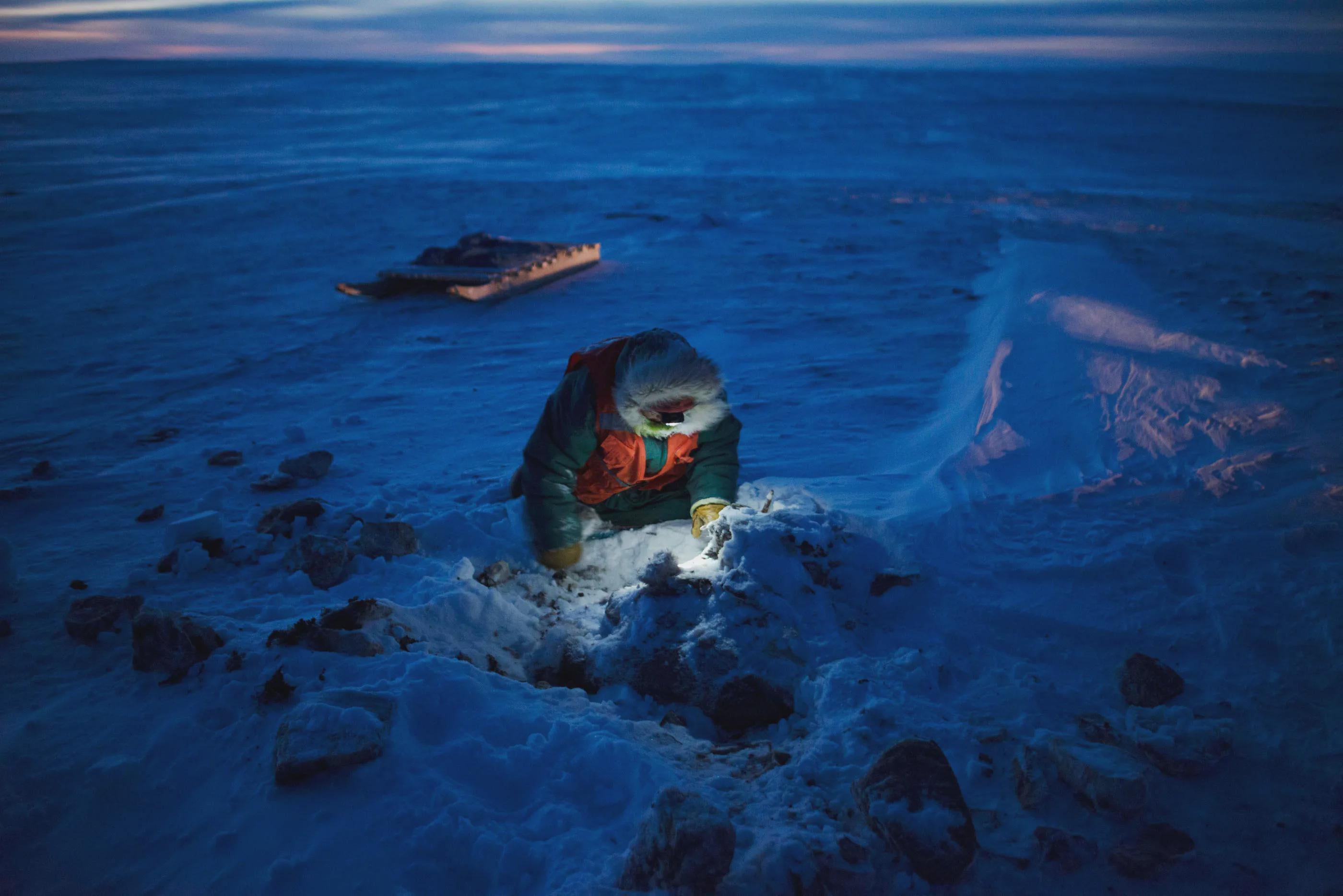
What do you see in this photograph?
A sea of ice. Day overlapping with night. Isolation, beauty, bitter cold. Exactly what you’d expect in Canada’s Arctic archipelago. But look more closely, and you can see something else: technology, developed through centuries of adaptation to one of Earth’s most extreme environments. This Canadian Ranger, photographed near Gjoa Haven, Nunavut, in November 2019, wears a parka, the life-preserving outerwear invented by the Arctic’s Indigenous peoples. In the shadows behind him sits a komatik, a sturdy but flexible sled held together with bindings rather than screws, allowing it to handle the rough, icy terrain. He’s digging up caribou meat, buried there months earlier to ferment in the cold earth.
We have traveled to the Arctic multiple times over the past three years; Louie, raised in Canada, has been going there for three decades. Wherever we’ve been — embedded with conscripts practicing for a future war in Lapland, or listening to Yu’pik elders battling a fishing crisis in off-the-grid Alaskan villages — we’ve observed the same thing again and again: a wide gap between what is imagined about the Arctic and what is actually there.
This year’s crisis over President Donald Trump’s desire to “own” Greenland was a case in point. The kernel of truth, that Greenland’s location makes it critical to US missile-interception ambitions, was drowned in a sea of misconceptions, with not just the White House but also mining prospectors portraying the Danish territory as a tabula rasa awaiting easy exploitation by the United States. The episode laid bare the pressing need for better understanding of the realities of the region — including basic appreciation for logistics and costs in a vast, rugged land, as well as the perspectives of its inhabitants.
In his book *Arctic Dreams*, Barry Lopez wrote that “people’s desires and aspirations were as much a part of the land as the wind, solitary animals, and the bright fields of snow and tundra.” The images that follow, drawn from our recent reporting trips and Louie’s extensive archive, aim to set those dreams — along with the infrastructure and effort they require — within the foundation of the Arctic’s land, sea and sky.

1 Comment
*As global powers eye the region’s promise, its harsh realities — from ice to infrastructure — underscore how poorly it’s understood.*
*Louie Palu and Liam Denning for Bloomberg News*
What do you see in this photograph?
A sea of ice. Day overlapping with night. Isolation, beauty, bitter cold. Exactly what you’d expect in Canada’s Arctic archipelago. But look more closely, and you can see something else: technology, developed through centuries of adaptation to one of Earth’s most extreme environments. This Canadian Ranger, photographed near Gjoa Haven, Nunavut, in November 2019, wears a parka, the life-preserving outerwear invented by the Arctic’s Indigenous peoples. In the shadows behind him sits a komatik, a sturdy but flexible sled held together with bindings rather than screws, allowing it to handle the rough, icy terrain. He’s digging up caribou meat, buried there months earlier to ferment in the cold earth.
We have traveled to the Arctic multiple times over the past three years; Louie, raised in Canada, has been going there for three decades. Wherever we’ve been — embedded with conscripts practicing for a future war in Lapland, or listening to Yu’pik elders battling a fishing crisis in off-the-grid Alaskan villages — we’ve observed the same thing again and again: a wide gap between what is imagined about the Arctic and what is actually there.
This year’s crisis over President Donald Trump’s desire to “own” Greenland was a case in point. The kernel of truth, that Greenland’s location makes it critical to US missile-interception ambitions, was drowned in a sea of misconceptions, with not just the White House but also mining prospectors portraying the Danish territory as a tabula rasa awaiting easy exploitation by the United States. The episode laid bare the pressing need for better understanding of the realities of the region — including basic appreciation for logistics and costs in a vast, rugged land, as well as the perspectives of its inhabitants.
In his book *Arctic Dreams*, Barry Lopez wrote that “people’s desires and aspirations were as much a part of the land as the wind, solitary animals, and the bright fields of snow and tundra.” The images that follow, drawn from our recent reporting trips and Louie’s extensive archive, aim to set those dreams — along with the infrastructure and effort they require — within the foundation of the Arctic’s land, sea and sky.
[Read the full photo essay here.](https://www.bloomberg.com/features/2026-arctic-paradox/?accessToken=eyJhbGciOiJIUzI1NiIsInR5cCI6IkpXVCJ9.eyJzb3VyY2UiOiJTdWJzY3JpYmVyR2lmdGVkQXJ0aWNsZSIsImlhdCI6MTc3NzY1ODEwMSwiZXhwIjoxNzc4MjYyOTAxLCJhcnRpY2xlSWQiOiJURUNHTzhLR0NUR0YwMCIsImJjb25uZWN0SWQiOiJEMzU0MUJFQjhBQUY0QkUwQkFBOUQzNkI3QjlCRjI4OCJ9.IohM3O6zQdha349OAciqVq6fEFKLx9fWkystoGK9lxA)